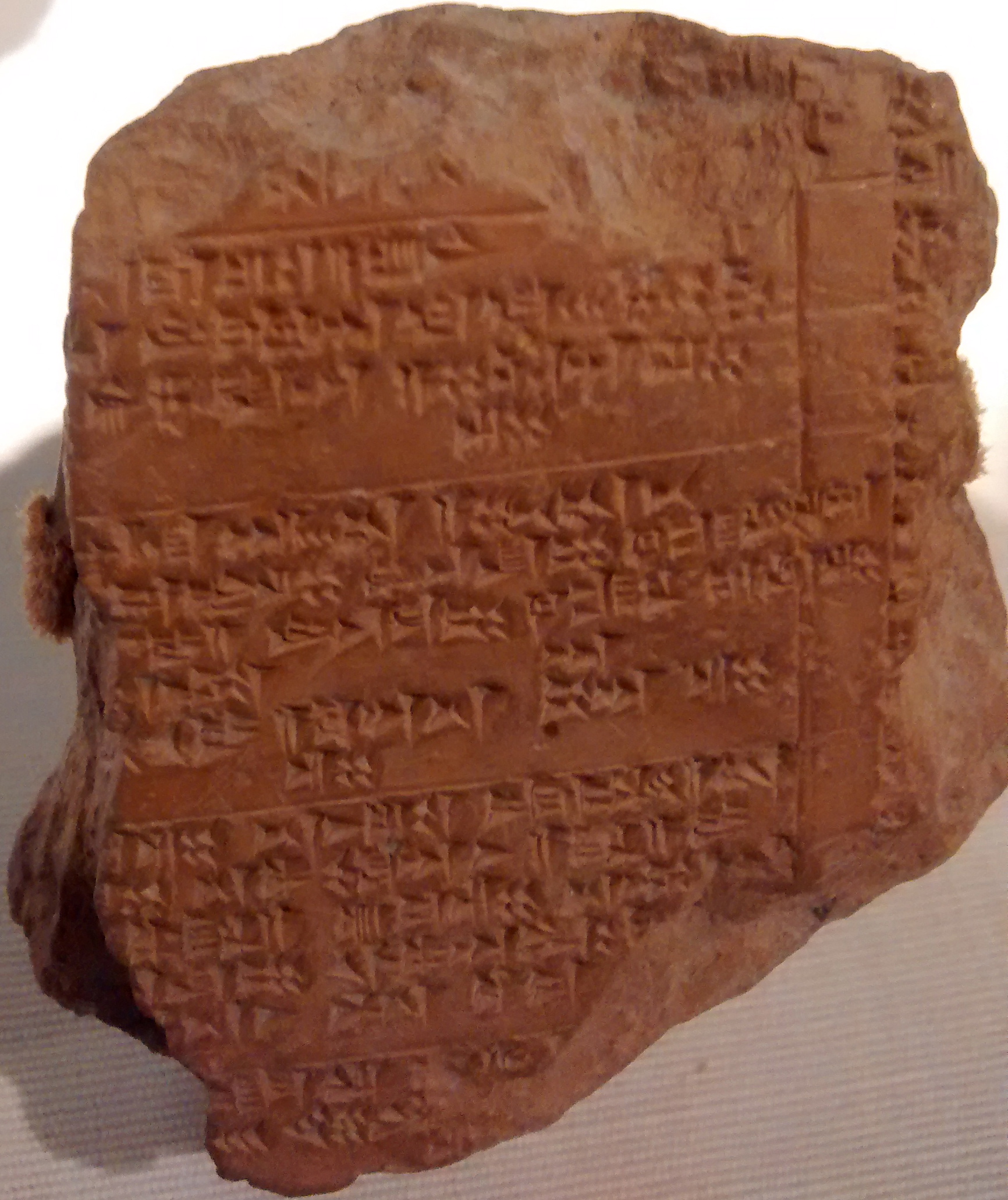
Featured image: a Hittite cuneiform tablet from Hattusa, probably 14th century BC, in the Oriental Institute collection, Chicago. It is shown for illustration and is not one of the new Kayalıpınar tablets. Photo: Mx. Granger, Wikimedia Commons, CC0.
Our first weekly roundup covers news from 3 to 10 October 2026: a royal archive in Anatolia, a lighthouse on a ring from the Alexandrian seabed, the lost monastery of Lismore, Neanderthal woodwork and two new open-access books. Each item links to its source. Where a story broke a little before the week, we say so.
India and South Asia
Five signs on an Iron Age bowl near Salem
Tamil Nadu’s state archaeology department has found an intact black-and-red ware bowl at Thelunganur, in the water-spread area of the Mettur dam near Salem, carrying five graffiti signs set out from left to right. The excavators say it is the longest sequence of such marks yet recorded in the state, and a second bowl bears the same five signs in a different order. Thelunganur and its twin site Mangadu have been dated to between 1600 and 1200 BCE. The dig also produced iron weapons, copper objects and what may be a steel sword. “We have to decipher the meaning,” said K. Rajan, adviser to the department. Whether the signs amount to writing remains an open question. Source: The Times of India, 9 October.
A running animal on a granite rock in Kannur
Kerala’s Department of Archaeology has found petroglyphs on a granite rock near the seven megalithic umbrella stones it recently restored at Peralam-Kozhummal in Kannur district. The engravings cover about 10 square metres and came to light while a house plot was being cleared. Part of the surface is badly weathered, so the motifs are not yet identified. “Looking at the engravings, it appears to be a running animal,” said K. Krishnaraj, who led the survey. He compares the style with the known rock art at nearby Ettukudukka. Source: The Hindu, 3 October.
Anatolia and Egypt
A Hittite royal archive grows to 184 tablets
Excavators from Koç University working at Kayalıpınar in Sivas province, identified with the Hittite city of Šamuḫa, recovered 131 cuneiform tablets and fragments this season. With earlier finds, the archive now holds 184 documents. They date to around 3,400 years ago, in the reign of Tudhaliya II. A first reading mentions military campaigns, epidemics, the death of an infant princess and appeals for help sent to the king by his commanders. The team describes it as the largest Hittite royal archive found this century and one of the biggest groups of Hittite texts from outside the capital, Hattusa. Source: HeritageDaily, 8 October.
The Pharos of Alexandria, engraved on a bronze ring
A joint mission of the European Institute for Underwater Archaeology (IEASM) and Egypt’s Supreme Council of Antiquities has recovered a bronze seal ring from the sunken island of Antirhodos in Alexandria’s Eastern Harbour. It shows the lighthouse on Pharos in a form close to its image on Alexandrian coins of the 2nd century AD. The Council calls it the first known depiction of the lighthouse on a seal ring. The same season has brought up pottery, amphorae, lamps and glass spanning the 4th century BC to the 4th century AD. Source: HeritageDaily, 7 October; Smithsonian, 9 October.
Europe
Lismore’s lost monastery comes to light
On the small Hebridean island of Lismore, volunteers from the local historical society, led by Clare Ellis of Argyll Archaeology, have found the early medieval monastery of Lios Mòr, founded by St Mo Luóc in the sixth century. Beside the parish church they uncovered burials dated between AD 650 and 1040, pieces of carved cross slabs, an oval stone building and more than 1,000 fragments of metalworking debris, among them crucibles and moulds. A few crucibles carry traces of silver and gold. The paper appeared in Antiquity on 1 October, a couple of days before our window, and the story spread this week. Source: Antiquity paper; Antiquity press release; Smithsonian, 9 October.
A temple of Mars beside a Roman fort in the Taunus
Archaeologists from Hessen Archaeology digging the civilian settlement beside the Kapersburg fort, about 26 km north of Frankfurt, have found a temple. Fragments of a dedicatory inscription name Mars, and the finds include remains of a statue of the god and a statuette of a winged figure with palm branch and wreath, probably Victoria. The fort was garrisoned until around AD 275. The state heritage office announced the find on 25 September; English-language coverage followed on 7 October. Source: Live Science, 7 October.
Stone Age timbers 20 metres down in Lake Arendsee
Divers from Saxony-Anhalt’s heritage office have recovered worked wood from about 20 metres beneath Lake Arendsee in northern Germany, including a post some 1.6 metres tall with apparent felling marks and split boards up to 1.3 metres long. First results put them at around 10,500 years old, in the Mesolithic. State archaeologist Harald Meller said that buildings of this period in central Germany had so far been known only as soil stains. Whether the timbers come from huts or something else is still being worked out. Source: HeritageDaily, 3 October.
Hunters’ camp and an antler axe in the Trieste Karst
An Italian and Slovenian team led by Federico Bernardini of Ca’ Foscari University of Venice has finished a fourth season in the Tina Jama cave near Mount Lanaro, close to the Slovenian border. They have reached a Late Mesolithic layer of about 7,500 years ago with a hearth, a stone setting near the entrance, pierced red deer teeth worn as pendants, one with traces of ochre, and a large red deer antler axe with an unfinished hole. Close parallels for the axe are known from central and northern Europe but are rare in Italy. Source: Ca’ Foscari University of Venice (Italian); Archaeology News Online, 10 October.
East Asia
A price for a person: a slave-sale tablet from Nara
The Nara National Research Institute for Cultural Properties announced on 7 October a wooden tablet (mokkan) from a well in the old capital of Heijō-kyō that records the sale of a slave in the late eighth century. The front says a 27-year-old woman, whose name survives only in part, was sold for 8 kanmon, or 8,000 coins, of which the seller had received 4. The back carries words including “runaway person”, “interest” and “apology”, and researchers think the sale may never have been completed. Slave sales were known from the Shōsōin documents, but this is the first tablet to give such detail. Source: The Asahi Shimbun, 8 October.
New research
Neanderthal woodwork preserved in stone
A study in Science Advances led by Palmira Saladié of IPHES-CERCA catalogues 597 wooden remains and imprints from 16 levels at Abric Romaní, near Barcelona, dated between about 62,000 and 40,000 years ago. The wood rotted long ago, but the travertine that formed around it kept its shape. Thirteen objects show Neanderthal working, among them two spears, one about 2.45 metres long, bark trays, pointed sticks, a pole that may have belonged to a shelter and a club-like tool the authors say has no clear parallel in the prehistoric record. Source: Science Advances paper; IPHES press release, 7 October.
Gut microbes that travelled with the first migrants
A paper in Nature on 7 October compares the gut microbes of the Tsimane of Bolivia with those of the Hadza of Tanzania, peoples whose ancestors parted tens of thousands of years ago. The two groups share 1,231 microbial species, most of them rare or absent in industrialised populations. Genetic analysis of 636 of these species gives split times that roughly match the human journeys out of Africa and into the Americas. Source: Nature paper.
New books
Open data for ancient historians
Open Data in Ancient and Byzantine Studies, edited by Valeria Vitale and Gabriel Bodard and published with the Institute of Classical Studies, came out from the University of London Press on 8 October. Its case studies show how shared datasets and code are changing work on Greek, Roman and Byzantine sources. It runs to 268 pages and is free to read online, with print editions from £29.99. Source: University of London Press.
Greek alliances under strain
Also new and open access is Crisis and Resilience in Ancient Greek Alliances: Cross-Border Cooperation, edited by Elena Franchi, Angela Ganter and Felix K. Maier (Routledge, 2026). The essays treat quarrels between allies as part of how leagues worked, from the Delphic Amphiktyony to the Aitolians and Boiotians, and close with a comparison between the Delian League and NATO. The University of Trento featured it this month; we could not confirm the exact release date. Source: University of Trento magazine.
If we missed a story, send it through the contact page and we will look at it for next Saturday’s roundup.