Category: Ancient India Chronicles

One figure from ancient India at a time, from roughly 2500 to 450 BCE: kings, poets, sages, bankers and healers, told first as a story and then checked against the evidence in “The truth behind the tale”, with sources. New chapters on Mondays, Wednesdays and Fridays at 19:00 UK time.

  • Viśvāmitra: The Poet Who Asked the Rivers to Wait

    Viśvāmitra: The Poet Who Asked the Rivers to Wait

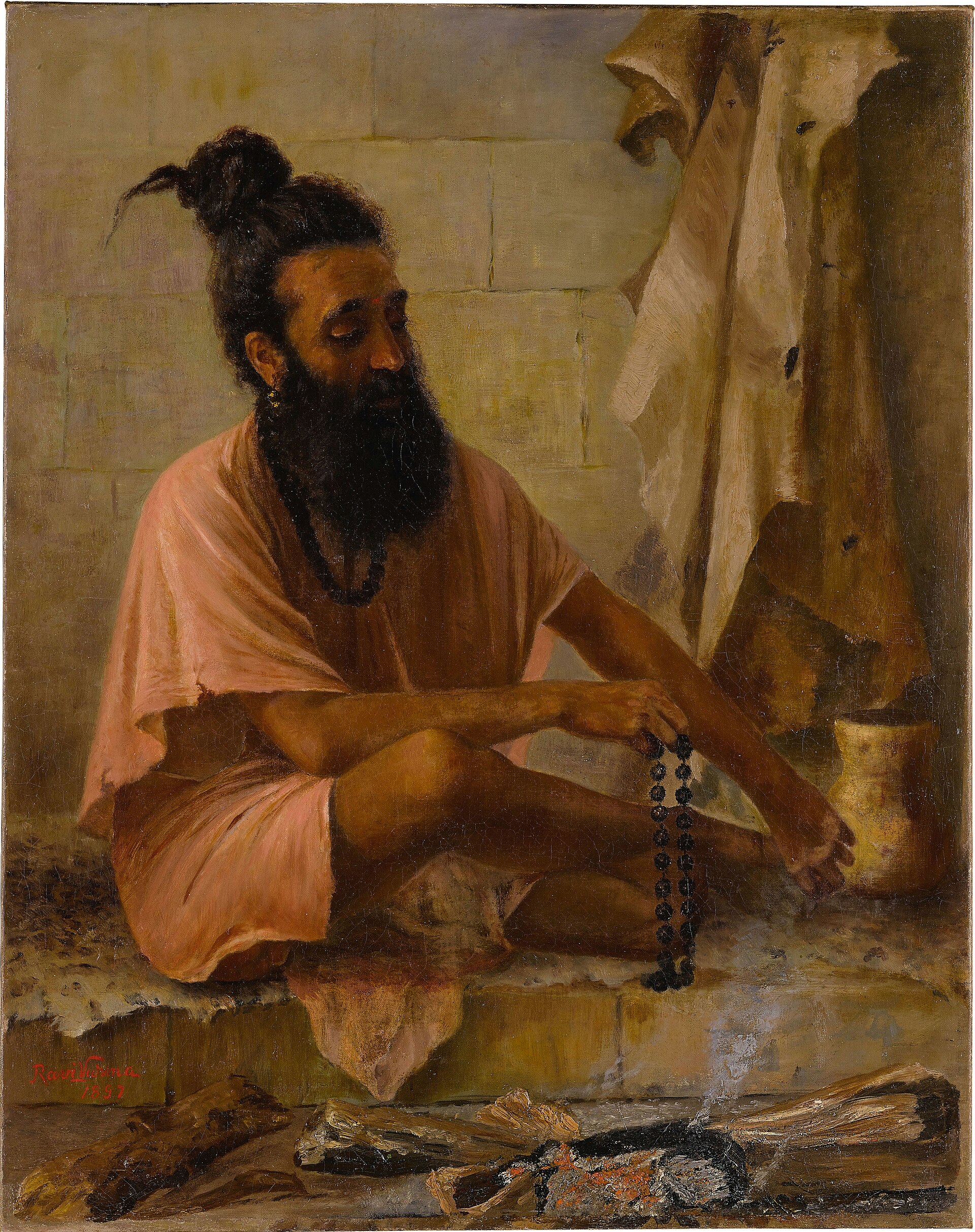
    Image: Viśvāmitra in meditation, painting by Raja Ravi Varma, 1897. Raja Ravi Varma, Public domain, via Wikimedia Commons. A later imagining, painted some three thousand years after the hymns.

    Two rivers came down like mares unreined;
    a poet spoke, and the waters bowed.
    A verse he made for the god who moves:
    it is said each dawn aloud.

    The Rivers in Flood

    Of a poet who spoke to the waters, and a host that crossed.

    In the days of the hymns, two rivers came down out of the mountains in flood. The hymn names them Vipāś and Śutudrī, the Beas and the Sutlej, and likens them to racing mares let off the rein, and to mother cows licking a calf. On the bank the Bharata warriors waited with their wagons and their chariots; and there was no bridge.

    Then a poet stepped forward and spoke to the water. In Ṛgveda 3.33 he says: “Rest for my inspired speech, O holy ones, for a moment in your courses… Desiring help I, son of Kuśika, have made the invocation.” But the rivers were not moved. Indra dug their channels, they answered, and Savitar drives them on: “The flood in spate is not to be hindered. The poet entreats the streams; what does he want?”

    So he praised them. He told again Indra’s great deed, the slaying of the serpent that held the waters back; and the rivers gave way. “Low, like a nursing mother, will I bend me,” one of them promises in Griffith’s translation. And then the end of it: “The warrior host, the Bharatas, fared over.” The poet closes like a careful wagoner. He asks the water to go easy on the yoke-pins and the harness, and that the oxen come to no harm.

    I am the son of Kuśika, and the tradition names me Viśvāmitra. Hear how it was at the ford. I did not command the waters, for Indra cut their roads. I praised them, and I asked. And they bent low, as a mother bends, and the Bharatas went over.

    Tradition names this poet Viśvāmitra. A later hymn in the same book says it plainly: “When Viśvāmitra was Sudās’s escort, then Indra through the Kuśikas grew friendly” (RV 3.53.9).


    A Family Book in the Land of Rivers

    Of the Kuśikas, the Seven Rivers, and a chief named Sudās.

    The Ṛgveda holds more than a thousand hymns in ten books (maṇḍalas). They were made and handed on by mouth long before anyone wrote them down. At its core lie the “family books”, 2 to 7, and each belongs to a lineage of poets. Book 3 belongs to Viśvāmitra and his kin. The hymns call them the Kuśikas, and also simply “the Viśvāmitras” (3.53.13).

    No firm dates can be given him. The Ṛgveda is usually set around 1500–1000 BCE, with the family books among its older layers. Those figures are estimates, and the debates about the text’s origins go on; this chapter takes no side. The land is far clearer. These are the rivers of the north-west and the Punjab, later called the Sapta Sindhu, the “Seven Rivers”: a world of cattle and chariots, of soma and rival clans.

    In Book 3 Viśvāmitra stands beside Sudās Paijavana, chief of the Bharatas. One verse seems to tell of a royal horse set free in Sudās’s name, perhaps an early horse sacrifice (3.53.11). The next makes a proud claim: “This prayer of Viśvāmitra keeps secure the race of Bharatas” (3.53.12).

    Enter Vasiṣṭha, carefully

    Sudās appears also in Book 7, which belongs to the house of Vasiṣṭha. There he has another priest and fights another battle. RV 7.18, 7.33 and 7.83 tell of the Battle of the Ten Kings (dāśarājña): an alliance of tribes falls upon Sudās on the Paruṣṇī (the Ravi), and is defeated. “So in the fight with the Ten Kings, Vasiṣṭhas! did Indra help Sudās through your devotions,” says 7.33. Book 3 never names the battle.

    From these hymns many scholars conclude that Viśvāmitra was the Bharatas’ priest first, and that Vasiṣṭha took his place. Some go further. Macdonell and Keith’s Vedic Index (1912) thought Viśvāmitra was dismissed and then joined Sudās’s enemies. Michael Witzel (1995) suggested he might have gathered the alliance out of revenge. Britannica’s survey of the period states this as fact.

    Yet the hymns themselves never say so. Hermann Oldenberg denied long ago that the feud appears in the Ṛgveda. Stephanie Jamison, co-translator of the standard modern English version, sees “no evidence at all” for it. Four curse verses at the end of 3.53 were later called the “Vasiṣṭha-hating” verses, but they name no enemy. In short: the Ṛgveda binds both priestly houses to one king, and a rivalry between them is a modern inference. The open feud first appears in later Vedic prose, beginning with brief notes in the Taittirīya Saṃhitā.


    The Verse That Did Not Die

    Of a prayer to Savitar, kept for three thousand years.

    One verse has kept Viśvāmitra’s name alive for some three thousand years. In a modest hymn in Book 3 there is a group of three verses to Savitar, the god who sets things moving. One of them is RV 3.62.10:

    “May we attain that excellent glory of Savitar the God: so may he stimulate our prayers.” (Griffith)

    This is the Gāyatrī, also called the Sāvitrī. Later Hindu tradition made it the heart of daily prayer, and taught it at initiation. Jamison notes drily that it lies “buried in this not particularly noteworthy hymn”.

    I made many verses for the gods of my people. One I made for Savitar, who stirs all things to motion: may we attain his excellent glory, and may he stir our prayers. In later ages it was taught at initiation and said in the daily prayer.

    The Kuśika poets were skilled craftsmen besides. Jamison observes that the poet of the river hymn keeps pressing Vedic grammar to express fine distinctions of time, a thing that seems especially marked in his work.


    The Making of a Legend

    Of a cow, a king, a heaven built to spite the gods, and a daughter named Śakuntalā.

    Then legend took him. Everything that follows is later tradition, not Ṛgvedic evidence.

    • Late Vedic prose. In the Aitareya Brāhmaṇa, a text centuries younger than the hymns, a boy called Śunaḥśepa is sold to be sacrificed. He frees himself by praising the gods. Viśvāmitra, one of the priests at the rite, adopts him and renames him Devarāta, “god-given”.
    • The epics. In the Rāmāyaṇa and the Mahābhārata, Viśvāmitra is a Kṣatriya king, son of Gādhi. He tries to take Vasiṣṭha’s wish-granting cow (Śabalā in the Rāmāyaṇa, Nandinī in the Mahābhārata). Vasiṣṭha’s spiritual power defeats his army, and the humbled king turns to fierce austerities until even Vasiṣṭha must call him a brahmarṣi, a Brahmin seer.
    • More epic wonders. He builds a new heaven for King Triśaṅku, whom the gods would not admit in his mortal body. Britannica sums this up as “a new universe with its own galaxies to spite the gods”. Indra sends the apsaras Menakā to distract him, and their daughter is Śakuntalā, later made famous by Kālidāsa. In the Rāmāyaṇa he takes the young Rāma and Lakṣmaṇa to guard his sacrifice from demons, gives them divine weapons and leads them towards Mithilā and Sītā.

    Honour to You

    Of the first namaste, and a prayer for the road home.

    The rivers’ answer ends with námas te, “honour to you” (RV 3.33.8). Jamison notes that it is one of only two places in all the Ṛgveda where the phrase appears. The earliest namaste on record, then, is a river greeting a poet.

    Near the end of 3.53 the poet is troubled also for his cart: “Strong be the pair of oxen, firm the axles, let not the pole slip nor the yoke be broken… Safe may we be until we reach our homes and rest us and unyoke.”


    What we actually know, and what we don’t

    What the text gives us. Book 3, attributed to Viśvāmitra and the Kuśikas. The river-crossing hymn (3.33), which names the Bharatas and a “son of Kuśika”. Hymn 3.53, which ties Viśvāmitra to Sudās by name. The Gāyatrī (3.62.10). A separate Vasiṣṭha book in which the same king wins the Battle of the Ten Kings.

    What scholars infer. That Viśvāmitra served Sudās before Vasiṣṭha did, and that the crossing was part of a Bharata advance through the eastern Punjab. Both are reasonable readings. A rivalry between the priests, and any part Viśvāmitra played in the battle, remain disputed.

    What we don’t have. Dates, rather than rough ranges. Any way to separate one historical man from the family of poets who used his name. Any Ṛgvedic basis for the stolen cow, the king who became a Brahmin, Menakā or Triśaṅku.

    Imagined voice: the italic passages in which Viśvāmitra speaks in the first person are imagined. They are built only from the texts and studies named here, add no events, and are not quotations.


    Sources (lightly noted)

    1. Stephanie W. Jamison & Joel P. Brereton, The Rigveda (Oxford University Press, 2014), with Jamison’s online commentary on Book III (UCLA, rev. 2026): readings of 3.33, 3.53 and 3.62.10; scepticism about a Ṛgvedic feud; námas te.
    2. Jonathan Slocum (with Karen Thomson), “Rigveda III, 33, 4–8”, Vedic Online, Linguistics Research Center, University of Texas at Austin: translation used for the rivers’ dialogue.
    3. Ralph T. H. Griffith, The Hymns of the Rigveda (1896): older translation quoted for 3.33.10–12, 3.53, 3.62.10 and 7.33.
    4. Michael Witzel, “Ṛgvedic History: Poets, Chieftains and Polities”, in G. Erdosy (ed.), The Indo-Aryans of Ancient South Asia (1995): Viśvāmitra as Sudās’s earlier priest; the revenge hypothesis.
    5. A. A. Macdonell & A. B. Keith, Vedic Index of Names and Subjects (1912), “Vasiṣṭha”: the older rivalry reconstruction, Oldenberg’s dissent, the later Vedic prose sources.
    6. Encyclopaedia Britannica, “India: The early Vedic period” and the “Vishvamitra” topic page.

    Myth and text flagged throughout: the cold open follows RV 3.33; the rivalry is marked as inference; Brāhmaṇa and epic stories are labelled as later tradition; all dates are approximate.
  • Bimbisāra: The King Who Married His Way Toward Empire

    Bimbisāra: The King Who Married His Way Toward Empire

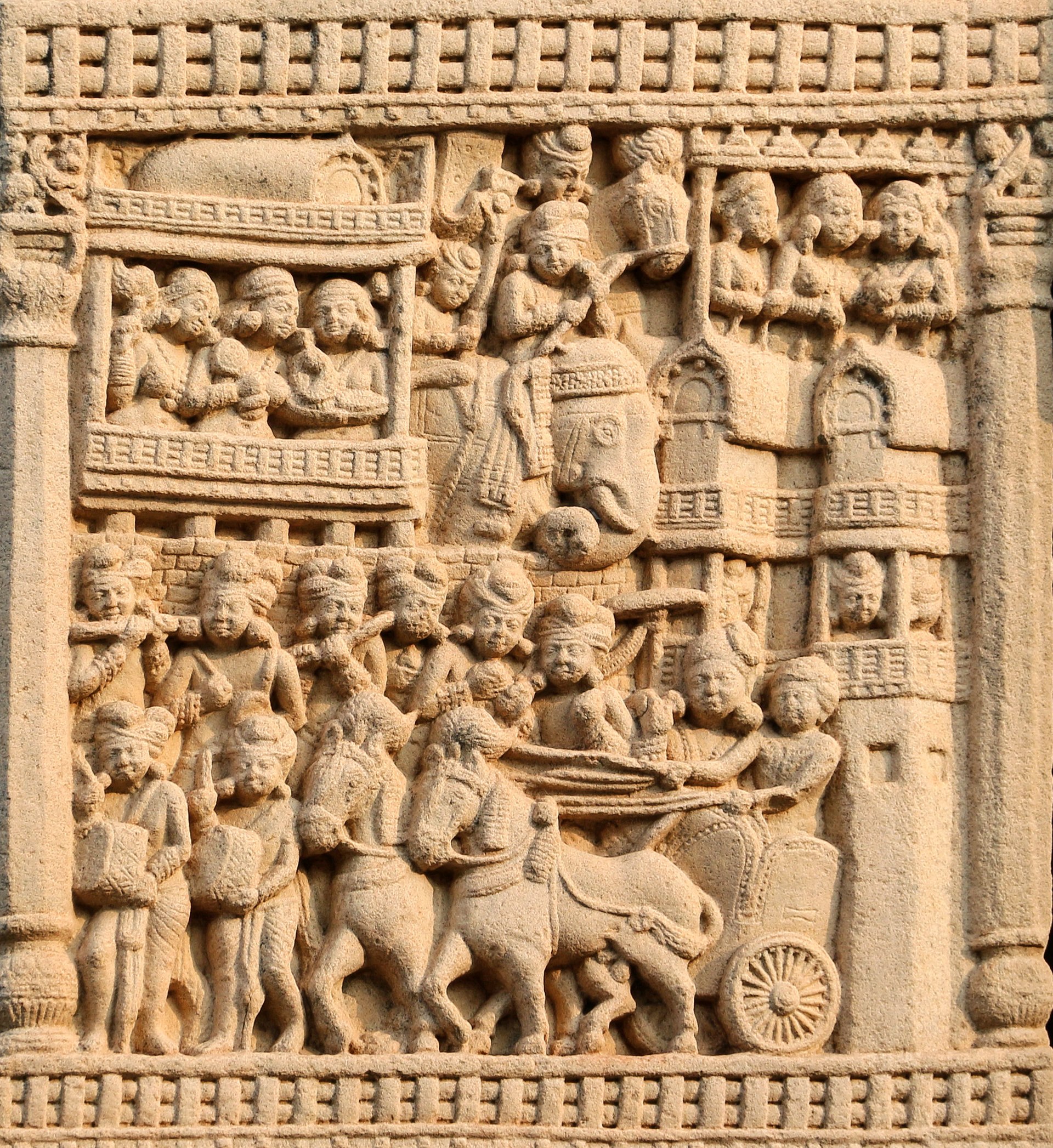
    Image: Royal procession leaving Rājagṛha, Great Stupa, Sanchi, 1st century BCE, possibly Bimbisāra or Ajātaśatru visiting the Buddha. Bernard Gagnon, CC BY-SA 3.0, via Wikimedia Commons.

    Water from a golden jar,
    a grove of bamboo given;
    brides to the west, a sword to the east,
    and a son at the end unforgiven.

    The Golden Jar

    Of a grove given among the hills, and a king who made in-laws of his neighbours.

    There is a valley ringed by bare hills, and in the dusk the cooking-smoke rises from it. There, it is told, a young king poured water from a golden jar upon another man’s hands. In Buddhist memory the one who received it was the Buddha, and the gift was a grove of bamboo, Veluvana; and Magadha’s capital, Rājagṛha (today’s Rajgir in Bihar), became one of the first great royal shelters of a new teaching. Whether that evening passed just as the Vinaya tells it, we cannot prove. In early Magadha kings and merchants and wandering teachers rubbed shoulders; and there a ruler named Bimbisāra (Seniya / Śreṇika in Jain tradition) learned to turn neighbours into in-laws, before he turned some of them into subjects.


    The Great Realms

    Of the Ganges plain in the age of rival kingdoms, and of a king whose dates will not hold still.

    Bimbisāra belongs to the world of the mahājanapadas, the “great realms” of the late Vedic and early historic Ganges plain. Magadha, in what is now west-central Bihar, lay on fertile soil, and on trade routes running east towards the delta and west towards the older ritual heartlands. Britannica sets him among Magadha’s early kings of the Haryanka line, and by convention dates his reign to around the mid-sixth to early fifth century BCE (c. 543–c. 491 BCE in the older “long” chronology). Those numbers are traditional labels. Scholars who prefer a later date for the Buddha’s death (often near c. 400 BCE) must slide Bimbisāra and his son Ajātaśatru into the later fifth century.

    Buddhist Pali sources call him Seniya Bimbisāra, son of Bhattiya, anointed young (the Mahāvaṃsa even says at fifteen), and reigning long from Rājagaha. Jain texts know him as Śreṇika / Seṇiya of Rājagṛha, and fold him into Mahāvīra’s orbit. The Purāṇas muddle his house with the later Śiśunāgas; but historians since Geiger and Bhandarkar have mostly preferred the Buddhist distinction of a Haryaṅka line, a name echoed also in Aśvaghoṣa’s Buddhacarita. Of his ancestry little is told. What thickens the record is policy.

    It was an age of rival kingdoms: Magadha, Kosala, Avanti, the Vṛji confederacy at Vaiśālī, each watching the others across the river crossings. And Bimbisāra’s answer, as H. C. Raychaudhuri and V. A. Smith long argued from the literary evidence, was alliance by marriage, and conquest where it served.


    Brides and a Sword

    Of queens from Kosala and Vaiśālī, and the taking of Aṅga.

    From Kosala he took Kosaladevī, sister of Pasenadi / Prasenajit in the Buddhist telling, and with her a grant of revenue in Kāśī as “bath money.” So one hostile frontier fell quiet. From the Licchavis of Vaiśālī he wedded Cellanā / Chellanā, linked in Jain tradition to the house of King Ceṭaka, and so, in some tellings, to Mahāvīra’s mother’s kin. So another frontier was softened. A Madra princess named Khemā appears among further consorts; later storytellers multiplied his wives into the hundreds.

    I am Bimbisāra, king in Rājagaha, and I will tell you how a kingdom is guarded. Not every gate is held with spears. I took a bride from Kosala, and a bride from the Licchavis of Vaiśālī, and those borders slept. Then, with no knife at my back, I turned my face to the east.

    With those neighbours less free to strike him from behind, he turned east and took Aṅga (eastern Bihar), whose capital Campā held the river trade. Britannica treats that conquest as the decisive early step that “laid the foundations” for Magadha’s later course under the Nandas and Mauryas. He sought friends far off as well. He sent the physician Jīvaka to treat King Pradyota of Ujjain (both men have chapters of their own still to come), and he received embassies from Gandhāra.

    His court lay in Rājagṛha among the hills. Later pilgrims and Buddhist lore name Bimbisāra as the builder or shaper of the city; but the earth is less certain. Survey work at Rajgir warns that the famous “walls” are no simple defensive ring of the mid-first millennium, that the valley may have been lived in centuries earlier, and that the place shown to visitors as “Bimbisāra’s Jail” is likely a much later monastic complex.


    Five Wishes

    Of a king in the Cane Grove, and a patron claimed by two faiths.

    Buddhist texts make him a devoted patron. In the Pabbajā Sutta tradition he meets the future Buddha as a young renunciant, offers him a place at court, and draws from him a promise: that he will return when awakened. After the awakening, the Vinaya tells, the Buddha came to Rājagaha and stayed in the Cane Grove (Laṭṭhivana), and the king went out to him with a great company of brahmins and householders of Magadha. He heard the teaching, became a sotāpanna (stream-enterer), and spoke to the Buddha as a layman speaks to a monk, calling him bhante, “sir”. In Brahmali’s translation he says: “Sir, when I was a prince, I had five wishes, and they have now been fulfilled.” The first was to be anointed king; the second, that a fully awakened one might come into his kingdom. Then he took a golden ceremonial vessel (bhiṅkāra) and gave the Bamboo Grove, Veluvana, to the Sangha, a royal gift echoed later in the chronicles of Sri Lanka. For decades after, in these tales, he keeps the uposatha and supports the monks.

    Jain tradition claims him no less warmly. As Śreṇika he becomes a follower of Mahāvīra (sometimes by way of Queen Cellanā), visits the samavasaraṇa, and is promised rebirth as a tīrthaṅkara yet to come. Both faiths remembered the court of Magadha as their own, and told his story in their own way.


    The Son

    Of a father imprisoned, and an end told in more ways than one.

    Buddhist commentarial tradition tells that Ajātaśatru, urged on by Devadatta, imprisoned and starved his father after an abdication; Jain accounts also tell of imprisonment and a tragic end, sometimes framed as suicide under passion and karma. Britannica’s short entry follows the murder version. These are legendary tales, told with a moral purpose. Firmer is the aftermath the stories try to explain: Ajātaśatru’s wars with Kosala, and his later pressure on the Vṛji/Licchavi confederacy.

    When I was a prince I had five wishes, and I lived to see them all fulfilled. I poured the water from the golden vessel and gave away my Bamboo Grove. Yet the tellers say the last walls I knew were the walls my son set round me.


    Who Can Stop the Bleeding

    Of a sick king, mocking queens, and a physician who would take no gold.

    Among the Vinaya’s scenes of court life is Jīvaka the physician. When Bimbisāra suffers a fistula and his robes are stained, the queens mock him: a flash of palace cruelty so small it seems overheard. Jīvaka heals him with a single anointing. The king would heap ornaments upon the doctor, who refuses them, and is made physician to the court and to the Buddha’s community instead. Elsewhere the same Jīvaka is sent west to heal a rival king.


    What we actually know, and what we don’t

    What the traditions give us. Buddhist Vinaya, suttas, and chronicles present Seniya Bimbisāra as Magadha’s king at Rājagaha, contemporary and patron of the Buddha, annexer of Aṅga, husband of Kosaladevī (and others), succeeded by Ajātaśatru after a patricidal drama. Jain literature presents Śreṇika as Mahāvīra’s devotee and Cellanā’s husband. Britannica summarises the political core: Aṅga annexed; foundations for later Magadhan–Mauryan expansion; friendship with the Buddha; succession by Ajātaśatru.

    What archaeology allows. Rajgir was a major early historic centre; Northern Black Polished Ware and related material support urban occupation in the relevant centuries. Monuments labelled “Bimbisāra’s” on tourist boards (notably the “jail”) should not be trusted as Haryanka-period prisons. Xuanzang’s seventh-century CE travelogue is centuries later than the king.

    What we do not have. No contemporary royal inscription naming Bimbisāra. No agreed absolute dates independent of the Buddha/Mahāvīra chronologies. No way to adjudicate which religion’s conversion story is “the” biography. The shrewd king of the alliances and the Aṅga war is historically plausible in outline; the golden jar, the starved cell, and the future tīrthaṅkara are colours tradition painted onto him.

    Imagined voice: the italic passages in which Bimbisāra speaks in the first person are imagined. They are built only from the texts and studies named here, add no events, and are not quotations.


    Sources (lightly noted)

    1. Encyclopaedia Britannica, “Bimbisara” and “Magadha” — traditional dates, Aṅga annexation, Haryanka line, Buddha patronage, Ajātaśatru succession.
    2. Chirantani Das, “Rājagṛha supreme seat (b): King Bimbisāra,” in Settlement in Early Historic Ganga Plain (Wisdom Library) — Pali, Jain, and Purāṇic synthesis on marriages, Aṅga, and diplomacy (citing Raychaudhuri, Geiger, Law, Smith).
    3. Dictionary of Pali Proper Names (Malalasekera / palikanon.com), “Bimbisāra” — Vinaya and commentarial narratives: Veluvana, Kosaladevī, Jīvaka, Ajātaśatru legend.
    4. H. C. Raychaudhuri, Political History of Ancient India — classic reconstruction of Magadhan expansion and alliances.
    5. Buddha-chronology scholarship (reviews of Heinz Bechert’s dating project; median chronology near c. 400 BCE) — why absolute dates remain mobile.
    6. Archaeological caution on Rajgir (open academic survey/thesis material on Rajgir and hinterland) — “Bimbisāra’s Jail” as later monastic site; fortification complexity.
    7. Vinaya, Mahāvagga I.22 (Khandhaka 1), Pāli text and trans. Bhikkhu Brahmali, SuttaCentral: the Cane Grove, the five wishes, the address bhante and the golden vessel (sovaṇṇamaya bhiṅkāra).

    Myth and text flagged throughout: cold open dramatises a Vinaya scene; patricide and conversion stories are labelled as Buddhist/Jain tradition; absolute dates marked as uncertain.

  • Gārgī Vācaknavī: The Woman Who Asked What the World Is Woven On

    Gārgī Vācaknavī: The Woman Who Asked What the World Is Woven On

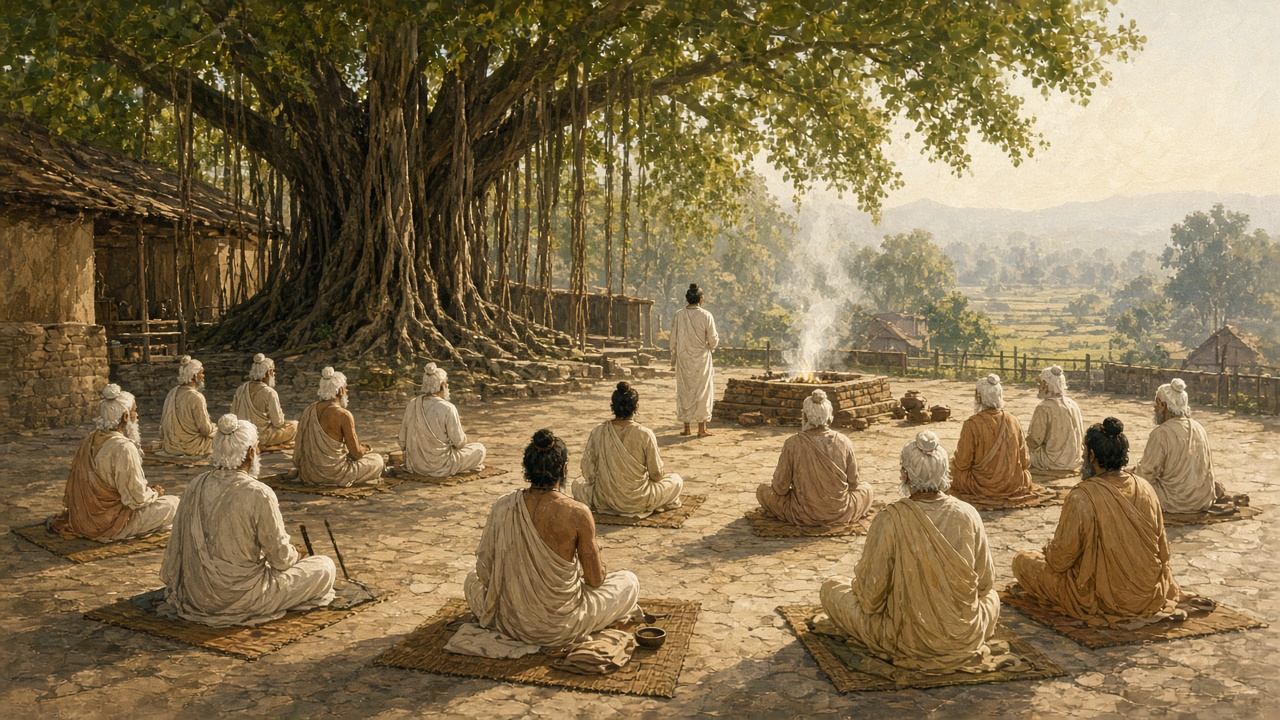
    AI illustration: a debate under a banyan tree in Videha (an imaginative reconstruction).

    Warp upon woof, and the shuttle goes;
    on what is the last thread laid?
    Two arrows drawn in the court of the king,
    and a woman who was not afraid.

    The Cows with Golden Horns

    Of a contest in Videha, and a prize half jest and half challenge.

    Long ago, in the eastern kingdom of Videha, between the rivers and the forest, there was a royal courtyard where the smoke of the sacrifice still hung upon the air. A thousand cows stood fidgeting in a line, and on each pair of horns pieces of gold had been fastened: a prize so splendid that it was half a jest and half a provocation. For King Janaka wished to know who among the visiting Brahmins was the most learned. And before the contest had well begun, the sage Yājñavalkya, sure of himself to the point of cheek, turned to his pupil Sāmaśravas, calling him somya, “my dear”, as a teacher calls a pupil, and bade him drive the herd home. The other scholars were not amused.

    Then one of them rose. She was not a king, nor a court priest, nor one of the famed western Brahmins out of Kuru-Pañcāla. She was Gārgī Vācaknavī, and she was about to ask the most dangerous question in that place: on what is the whole world woven, warp and woof?

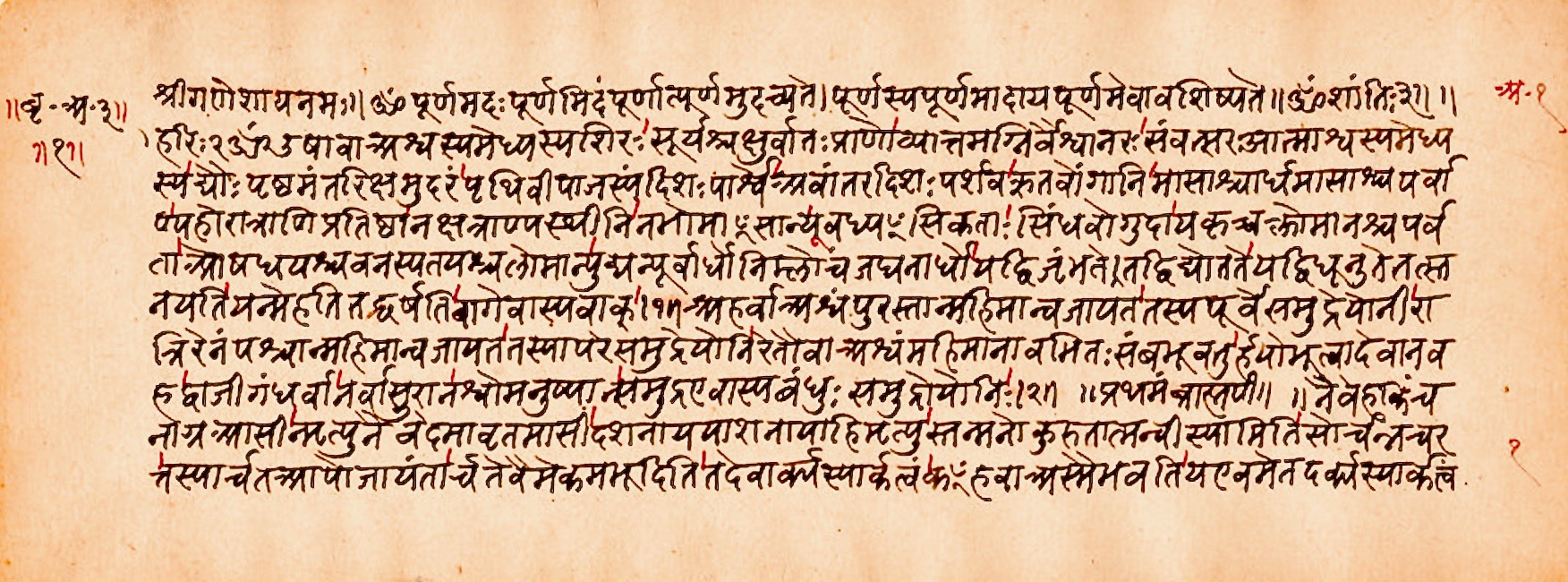
    A page of a Sanskrit manuscript of the Bṛhadāraṇyaka Upaniṣad in Devanagari script
    Image: Bṛhadāraṇyaka Upaniṣad, the text that records Gārgī's questions, in a Sanskrit manuscript (Schoenberg Center, Penn Library). Ms Sarah Welch, CC BY-SA 4.0, via Wikimedia Commons.

    A Voice in the Late Vedic World

    Of a book older than most, and a name that is a small biography.

    We meet Gārgī in the Bṛhadāraṇyaka Upaniṣad (3.6 and 3.8), one of the oldest and longest of the principal Upaniṣads. Scholars such as Patrick Olivelle set its early layers in the centuries before the Buddha, often around the seventh to sixth century BCE; yet Olivelle himself warns that to date these texts more finely than “a few centuries” is a house of cards. The scene is laid in Videha, roughly northern Bihar and southern Nepal, an eastern kingdom sometimes held as a frontier by the older ritual heartlands. And Janaka, a royal title as much as a personal name in tradition, hosts a brahmodya: a public contest of philosophy, sharp as any duel, but fought with questions.

    Her name is itself a small biography. Gārgī marks her as of the lineage of the sage Garga; Vācaknavī has long been heard as “the eloquent one,” from vāc, speech, or else as “daughter of Vacaknu,” as you parse it. Either way, the text presents her as a brahmavādinī: one entitled to speak of brahman, the ultimate. Among seven men who challenge Yājñavalkya she stands; and she alone challenges him twice.

    The older Vedic world had been thick with sacrifice and priestly craft. But the Upaniṣads record a turning inward, to new questions: what is the self (ātman)? What is the absolute (brahman)? Britannica and the standard surveys set Yājñavalkya at the heart of that turning in the Bṛhadāraṇyaka. And it was Gārgī’s questions that drew from him, in that court, the teaching of the Imperishable.

    Of her childhood nothing is recoverable, nor her birth, nor any trace in the ground. She comes onto the page fully formed: a voice in a debate. Let her be held as a figure of the Upaniṣadic age, almost certainly rooted in a real world of learning that included women, rather than as a life we can chart.


    The Ladder of Questions

    Of water and air and the worlds beyond, and a warning in the hall.

    Her first assault was a ladder of woven questions. Since this whole world is woven back and forth on water, she asked, on what then is water woven? On air, said Yājñavalkya. And air? On the intermediate worlds. And those? On the sun, the moon, the stars, the worlds of the gods, of Indra, of Prajāpati, of brahman. Each answer was a rung, and each new question climbed higher. And when she asked on what the worlds of brahman themselves are woven, Yājñavalkya stopped her cold: do not ask too many questions, Gārgī, or your head will shatter apart.

    In Vedic debate “head-shattering” is a known idiom for overreaching, for pressing inquiry past the method the tradition allows. Other challengers in the same chapter also fall silent, and one man’s head, famously, does shatter. Gārgī too fell silent, for a while.

    I am Gārgī, of the line of Garga, and I will tell you how I held my peace. He bade me ask no further, and I asked no further. I watched the others rise and fail, one by one, while the gold glinted on the horns of the king’s cows. And all that while I was shaping my next questions, as one shapes an arrow.


    Two Arrows

    Of a challenger who returned, and the Imperishable.

    Then she came back.

    She turned to the whole assembly. Brāhmaṇā bhagavantaḥ, she began, “honoured Brahmins”: she would put two questions to him, and if he could answer them, none of them would ever defeat him. She framed her challenge even in the speech of war, like a fierce warrior of Kāśī or Videha rising with two deadly arrows.

    The weaving image returned. On what is everything woven, above heaven, below earth, past, present and future? On space (ākāśa), said Yājñavalkya. Gārgī’s reply, in Olivelle’s translation, lands with a dry sparkle: all honour to you; you have cleared that up for me. Then the second arrow: on what is space woven?

    Yājñavalkya answered with the akṣara, the Imperishable. Neither coarse nor fine is it, neither short nor long; without shadow, without darkness; not the seen but that which sees; not the heard but that which hears. At its command sun and moon keep their stations. And on this Imperishable, he said, space itself is woven back and forth.

    Then Gārgī turned to the Brahmins and told them, in effect, to pay their respects and walk away, for none of them would beat him in debate. The cows, and the gold, went with Yājñavalkya.

    The gold went home with him, and the cows with it. I did not grieve for them. I had asked what the world is woven on, and in that hall, before the king, the answer had been spoken aloud.


    The Shuttle and the Silence

    Of a weaver’s word, and a pause before the second rising.

    The picture she chose was a weaver’s. Warp and woof, back and forth, the shuttle crossing and crossing again: every household in that courtyard knew the sight. Gārgī took it and asked it of the whole world. If all things are woven, they are woven on something; and she asked what that something was, and then what that was woven on.

    After the warning of the shattered head she said nothing more. She sat while the other challengers rose and failed. Then she rose again, with two questions in place of a ladder of them, and this time Yājñavalkya answered to the end.


    What we actually know, and what we don’t

    What the text gives us. Gārgī Vācaknavī appears by name in Bṛhadāraṇyaka Upaniṣad 3.6 and 3.8, at Janaka’s assembly in Videha, as Yājñavalkya’s fiercest and only double challenger. Her questions drive the dialogue toward the Imperishable (akṣara). Olivelle’s translations are the modern English scholarly standard.

    What later tradition adds. Later tellings sometimes make her a lifelong celibate, a composer of Ṛgvedic hymns, a “navaratna” of Janaka’s court, or a dialogue partner in the much later Yoga Yājñavalkya. Treat those as legend or separate literary traditions unless a primary early source is cited. The Upaniṣad itself does not give us her biography.

    What we do not have. No inscription, no independent contemporary chronicle, no fixed birth year. We cannot prove she “really said” every sentence attributed to her any more than we can for Socrates in Plato. What we can say, carefully, is that the composers of one of India’s oldest philosophical books found it natural and important to stage a woman as the debate’s keenest cross-examiner. That choice itself is evidence of a late Vedic intellectual world wider than caricature allows.

    Imagined voice: the italic passages in which Gārgī speaks in the first person are imagined. They are built only from the texts and studies named here, add no events, and are not quotations.


    Sources (lightly noted)

    1. Bṛhadāraṇyaka Upaniṣad 3.6 and 3.8 — primary dialogue (Patrick Olivelle, Upaniṣads / The Early Upaniṣads).
    2. Patrick Olivelle, “Gargi Vachaknavi…” (ThePrint, 3 Jan 2024) — concise scholarly retelling by a leading Upaniṣad translator.
    3. Encyclopaedia Britannica, entries on Yājñavalkya and the Upaniṣads — dating, teachings, and the Bṛhadāraṇyaka’s place among early Upaniṣads.
    4. Brian Black, The Character of the Self in Ancient India (SUNY Press, 2007) — priests, kings, and women in the early Upaniṣads.
    5. Steven E. Lindquist, “Gender at King Janaka’s Court…” (Journal of Indian Philosophy, 2008) — gender and debate dynamics in BU 3.
    6. Ethan Mills, “Learning from Gārgī’s Silence” (Indian Philosophy Blog, 2020) — accessible discussion of the silences, citing Olivelle.
    7. Bṛhadāraṇyaka Upaniṣad, Sanskrit text with Śaṅkara’s commentary, GRETIL (Göttingen Register of Electronic Texts in Indian Languages): the pupil Sāmaśravas and the address somya (3.1.2); Gārgī’s address brāhmaṇā bhagavantaḥ (3.8.1).

    Myth and text flagged throughout: the cold open dramatises the Upaniṣadic scene; biographical colour beyond the text is marked as later tradition or unknown.