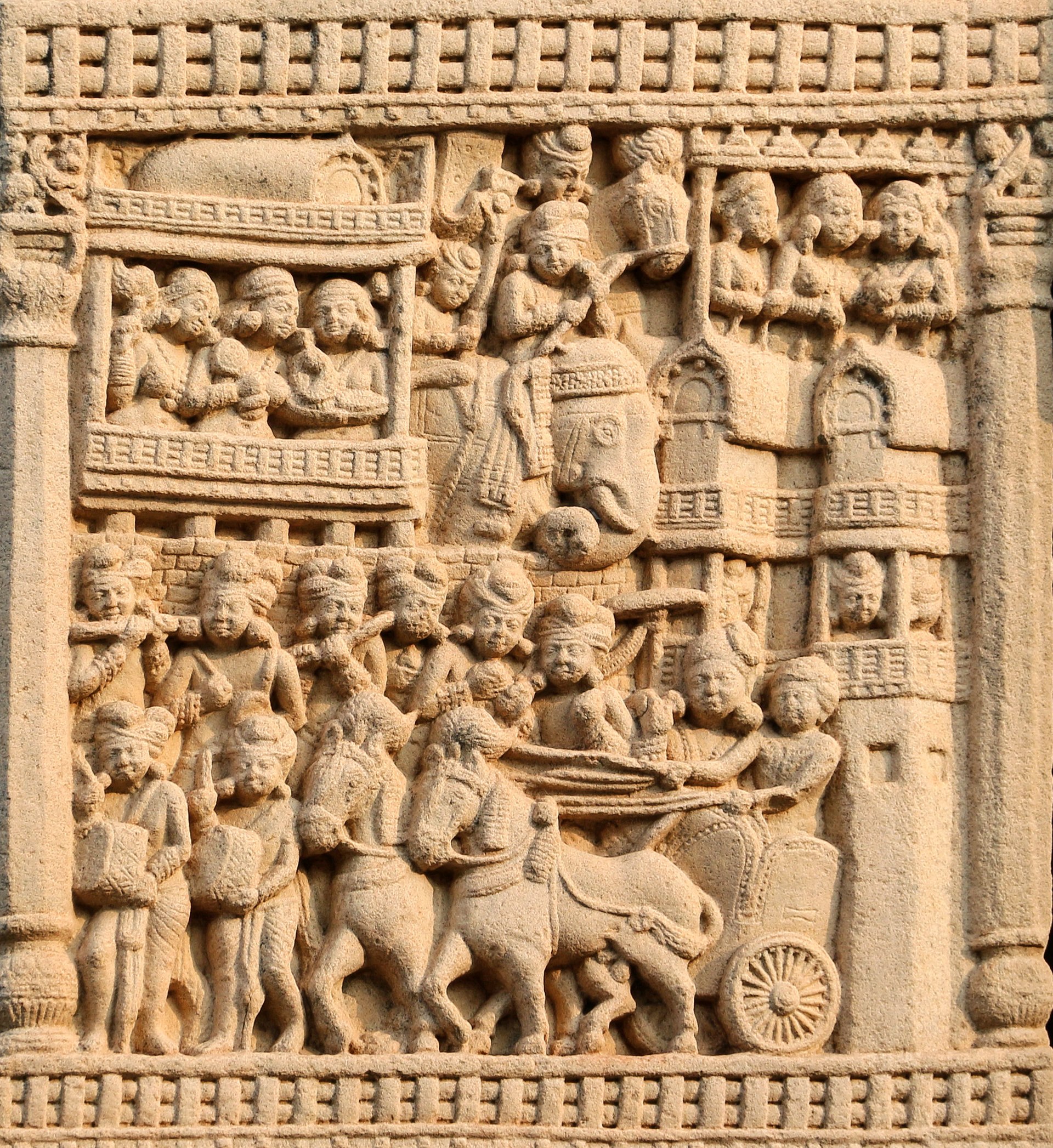
Image: Royal procession leaving Rājagṛha, Great Stupa, Sanchi, 1st century BCE, possibly Bimbisāra or Ajātaśatru visiting the Buddha. Bernard Gagnon, CC BY-SA 3.0, via Wikimedia Commons.
Water from a golden jar,
a grove of bamboo given;
brides to the west, a sword to the east,
and a son at the end unforgiven.
The Golden Jar
Of a grove given among the hills, and a king who made in-laws of his neighbours.
There is a valley ringed by bare hills, and in the dusk the cooking-smoke rises from it. There, it is told, a young king poured water from a golden jar upon another man’s hands. In Buddhist memory the one who received it was the Buddha, and the gift was a grove of bamboo, Veluvana; and Magadha’s capital, Rājagṛha (today’s Rajgir in Bihar), became one of the first great royal shelters of a new teaching. Whether that evening passed just as the Vinaya tells it, we cannot prove. In early Magadha kings and merchants and wandering teachers rubbed shoulders; and there a ruler named Bimbisāra (Seniya / Śreṇika in Jain tradition) learned to turn neighbours into in-laws, before he turned some of them into subjects.
The Great Realms
Of the Ganges plain in the age of rival kingdoms, and of a king whose dates will not hold still.
Bimbisāra belongs to the world of the mahājanapadas, the “great realms” of the late Vedic and early historic Ganges plain. Magadha, in what is now west-central Bihar, lay on fertile soil, and on trade routes running east towards the delta and west towards the older ritual heartlands. Britannica sets him among Magadha’s early kings of the Haryanka line, and by convention dates his reign to around the mid-sixth to early fifth century BCE (c. 543–c. 491 BCE in the older “long” chronology). Those numbers are traditional labels. Scholars who prefer a later date for the Buddha’s death (often near c. 400 BCE) must slide Bimbisāra and his son Ajātaśatru into the later fifth century.
Buddhist Pali sources call him Seniya Bimbisāra, son of Bhattiya, anointed young (the Mahāvaṃsa even says at fifteen), and reigning long from Rājagaha. Jain texts know him as Śreṇika / Seṇiya of Rājagṛha, and fold him into Mahāvīra’s orbit. The Purāṇas muddle his house with the later Śiśunāgas; but historians since Geiger and Bhandarkar have mostly preferred the Buddhist distinction of a Haryaṅka line, a name echoed also in Aśvaghoṣa’s Buddhacarita. Of his ancestry little is told. What thickens the record is policy.
It was an age of rival kingdoms: Magadha, Kosala, Avanti, the Vṛji confederacy at Vaiśālī, each watching the others across the river crossings. And Bimbisāra’s answer, as H. C. Raychaudhuri and V. A. Smith long argued from the literary evidence, was alliance by marriage, and conquest where it served.
Brides and a Sword
Of queens from Kosala and Vaiśālī, and the taking of Aṅga.
From Kosala he took Kosaladevī, sister of Pasenadi / Prasenajit in the Buddhist telling, and with her a grant of revenue in Kāśī as “bath money.” So one hostile frontier fell quiet. From the Licchavis of Vaiśālī he wedded Cellanā / Chellanā, linked in Jain tradition to the house of King Ceṭaka, and so, in some tellings, to Mahāvīra’s mother’s kin. So another frontier was softened. A Madra princess named Khemā appears among further consorts; later storytellers multiplied his wives into the hundreds.
I am Bimbisāra, king in Rājagaha, and I will tell you how a kingdom is guarded. Not every gate is held with spears. I took a bride from Kosala, and a bride from the Licchavis of Vaiśālī, and those borders slept. Then, with no knife at my back, I turned my face to the east.
With those neighbours less free to strike him from behind, he turned east and took Aṅga (eastern Bihar), whose capital Campā held the river trade. Britannica treats that conquest as the decisive early step that “laid the foundations” for Magadha’s later course under the Nandas and Mauryas. He sought friends far off as well. He sent the physician Jīvaka to treat King Pradyota of Ujjain (both men have chapters of their own still to come), and he received embassies from Gandhāra.
His court lay in Rājagṛha among the hills. Later pilgrims and Buddhist lore name Bimbisāra as the builder or shaper of the city; but the earth is less certain. Survey work at Rajgir warns that the famous “walls” are no simple defensive ring of the mid-first millennium, that the valley may have been lived in centuries earlier, and that the place shown to visitors as “Bimbisāra’s Jail” is likely a much later monastic complex.
Five Wishes
Of a king in the Cane Grove, and a patron claimed by two faiths.
Buddhist texts make him a devoted patron. In the Pabbajā Sutta tradition he meets the future Buddha as a young renunciant, offers him a place at court, and draws from him a promise: that he will return when awakened. After the awakening, the Vinaya tells, the Buddha came to Rājagaha and stayed in the Cane Grove (Laṭṭhivana), and the king went out to him with a great company of brahmins and householders of Magadha. He heard the teaching, became a sotāpanna (stream-enterer), and spoke to the Buddha as a layman speaks to a monk, calling him bhante, “sir”. In Brahmali’s translation he says: “Sir, when I was a prince, I had five wishes, and they have now been fulfilled.” The first was to be anointed king; the second, that a fully awakened one might come into his kingdom. Then he took a golden ceremonial vessel (bhiṅkāra) and gave the Bamboo Grove, Veluvana, to the Sangha, a royal gift echoed later in the chronicles of Sri Lanka. For decades after, in these tales, he keeps the uposatha and supports the monks.
Jain tradition claims him no less warmly. As Śreṇika he becomes a follower of Mahāvīra (sometimes by way of Queen Cellanā), visits the samavasaraṇa, and is promised rebirth as a tīrthaṅkara yet to come. Both faiths remembered the court of Magadha as their own, and told his story in their own way.
The Son
Of a father imprisoned, and an end told in more ways than one.
Buddhist commentarial tradition tells that Ajātaśatru, urged on by Devadatta, imprisoned and starved his father after an abdication; Jain accounts also tell of imprisonment and a tragic end, sometimes framed as suicide under passion and karma. Britannica’s short entry follows the murder version. These are legendary tales, told with a moral purpose. Firmer is the aftermath the stories try to explain: Ajātaśatru’s wars with Kosala, and his later pressure on the Vṛji/Licchavi confederacy.
When I was a prince I had five wishes, and I lived to see them all fulfilled. I poured the water from the golden vessel and gave away my Bamboo Grove. Yet the tellers say the last walls I knew were the walls my son set round me.
Who Can Stop the Bleeding
Of a sick king, mocking queens, and a physician who would take no gold.
Among the Vinaya’s scenes of court life is Jīvaka the physician. When Bimbisāra suffers a fistula and his robes are stained, the queens mock him: a flash of palace cruelty so small it seems overheard. Jīvaka heals him with a single anointing. The king would heap ornaments upon the doctor, who refuses them, and is made physician to the court and to the Buddha’s community instead. Elsewhere the same Jīvaka is sent west to heal a rival king.
What we actually know, and what we don’t
What the traditions give us. Buddhist Vinaya, suttas, and chronicles present Seniya Bimbisāra as Magadha’s king at Rājagaha, contemporary and patron of the Buddha, annexer of Aṅga, husband of Kosaladevī (and others), succeeded by Ajātaśatru after a patricidal drama. Jain literature presents Śreṇika as Mahāvīra’s devotee and Cellanā’s husband. Britannica summarises the political core: Aṅga annexed; foundations for later Magadhan–Mauryan expansion; friendship with the Buddha; succession by Ajātaśatru.
What archaeology allows. Rajgir was a major early historic centre; Northern Black Polished Ware and related material support urban occupation in the relevant centuries. Monuments labelled “Bimbisāra’s” on tourist boards (notably the “jail”) should not be trusted as Haryanka-period prisons. Xuanzang’s seventh-century CE travelogue is centuries later than the king.
What we do not have. No contemporary royal inscription naming Bimbisāra. No agreed absolute dates independent of the Buddha/Mahāvīra chronologies. No way to adjudicate which religion’s conversion story is “the” biography. The shrewd king of the alliances and the Aṅga war is historically plausible in outline; the golden jar, the starved cell, and the future tīrthaṅkara are colours tradition painted onto him.
Imagined voice: the italic passages in which Bimbisāra speaks in the first person are imagined. They are built only from the texts and studies named here, add no events, and are not quotations.
Sources (lightly noted)
- Encyclopaedia Britannica, “Bimbisara” and “Magadha” — traditional dates, Aṅga annexation, Haryanka line, Buddha patronage, Ajātaśatru succession.
- Chirantani Das, “Rājagṛha supreme seat (b): King Bimbisāra,” in Settlement in Early Historic Ganga Plain (Wisdom Library) — Pali, Jain, and Purāṇic synthesis on marriages, Aṅga, and diplomacy (citing Raychaudhuri, Geiger, Law, Smith).
- Dictionary of Pali Proper Names (Malalasekera / palikanon.com), “Bimbisāra” — Vinaya and commentarial narratives: Veluvana, Kosaladevī, Jīvaka, Ajātaśatru legend.
- H. C. Raychaudhuri, Political History of Ancient India — classic reconstruction of Magadhan expansion and alliances.
- Buddha-chronology scholarship (reviews of Heinz Bechert’s dating project; median chronology near c. 400 BCE) — why absolute dates remain mobile.
- Archaeological caution on Rajgir (open academic survey/thesis material on Rajgir and hinterland) — “Bimbisāra’s Jail” as later monastic site; fortification complexity.
- Vinaya, Mahāvagga I.22 (Khandhaka 1), Pāli text and trans. Bhikkhu Brahmali, SuttaCentral: the Cane Grove, the five wishes, the address bhante and the golden vessel (sovaṇṇamaya bhiṅkāra).
Myth and text flagged throughout: cold open dramatises a Vinaya scene; patricide and conversion stories are labelled as Buddhist/Jain tradition; absolute dates marked as uncertain.