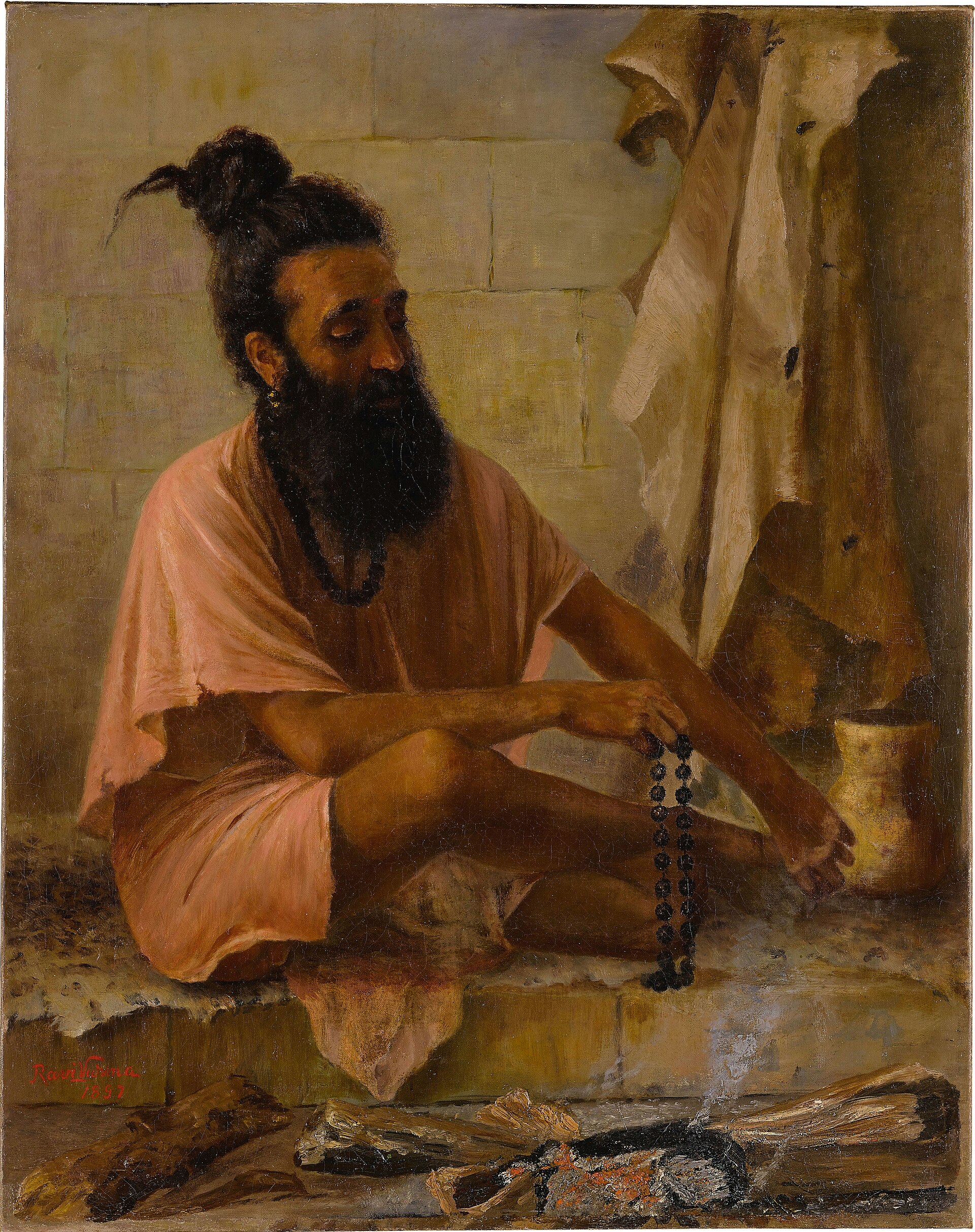
Image: Viśvāmitra in meditation, painting by Raja Ravi Varma, 1897. Raja Ravi Varma, Public domain, via Wikimedia Commons. A later imagining, painted some three thousand years after the hymns.
Two rivers came down like mares unreined;
a poet spoke, and the waters bowed.
A verse he made for the god who moves:
it is said each dawn aloud.
The Rivers in Flood
Of a poet who spoke to the waters, and a host that crossed.
In the days of the hymns, two rivers came down out of the mountains in flood. The hymn names them Vipāś and Śutudrī, the Beas and the Sutlej, and likens them to racing mares let off the rein, and to mother cows licking a calf. On the bank the Bharata warriors waited with their wagons and their chariots; and there was no bridge.
Then a poet stepped forward and spoke to the water. In Ṛgveda 3.33 he says: “Rest for my inspired speech, O holy ones, for a moment in your courses… Desiring help I, son of Kuśika, have made the invocation.” But the rivers were not moved. Indra dug their channels, they answered, and Savitar drives them on: “The flood in spate is not to be hindered. The poet entreats the streams; what does he want?”
So he praised them. He told again Indra’s great deed, the slaying of the serpent that held the waters back; and the rivers gave way. “Low, like a nursing mother, will I bend me,” one of them promises in Griffith’s translation. And then the end of it: “The warrior host, the Bharatas, fared over.” The poet closes like a careful wagoner. He asks the water to go easy on the yoke-pins and the harness, and that the oxen come to no harm.
I am the son of Kuśika, and the tradition names me Viśvāmitra. Hear how it was at the ford. I did not command the waters, for Indra cut their roads. I praised them, and I asked. And they bent low, as a mother bends, and the Bharatas went over.
Tradition names this poet Viśvāmitra. A later hymn in the same book says it plainly: “When Viśvāmitra was Sudās’s escort, then Indra through the Kuśikas grew friendly” (RV 3.53.9).
A Family Book in the Land of Rivers
Of the Kuśikas, the Seven Rivers, and a chief named Sudās.
The Ṛgveda holds more than a thousand hymns in ten books (maṇḍalas). They were made and handed on by mouth long before anyone wrote them down. At its core lie the “family books”, 2 to 7, and each belongs to a lineage of poets. Book 3 belongs to Viśvāmitra and his kin. The hymns call them the Kuśikas, and also simply “the Viśvāmitras” (3.53.13).
No firm dates can be given him. The Ṛgveda is usually set around 1500–1000 BCE, with the family books among its older layers. Those figures are estimates, and the debates about the text’s origins go on; this chapter takes no side. The land is far clearer. These are the rivers of the north-west and the Punjab, later called the Sapta Sindhu, the “Seven Rivers”: a world of cattle and chariots, of soma and rival clans.
In Book 3 Viśvāmitra stands beside Sudās Paijavana, chief of the Bharatas. One verse seems to tell of a royal horse set free in Sudās’s name, perhaps an early horse sacrifice (3.53.11). The next makes a proud claim: “This prayer of Viśvāmitra keeps secure the race of Bharatas” (3.53.12).
Enter Vasiṣṭha, carefully
Sudās appears also in Book 7, which belongs to the house of Vasiṣṭha. There he has another priest and fights another battle. RV 7.18, 7.33 and 7.83 tell of the Battle of the Ten Kings (dāśarājña): an alliance of tribes falls upon Sudās on the Paruṣṇī (the Ravi), and is defeated. “So in the fight with the Ten Kings, Vasiṣṭhas! did Indra help Sudās through your devotions,” says 7.33. Book 3 never names the battle.
From these hymns many scholars conclude that Viśvāmitra was the Bharatas’ priest first, and that Vasiṣṭha took his place. Some go further. Macdonell and Keith’s Vedic Index (1912) thought Viśvāmitra was dismissed and then joined Sudās’s enemies. Michael Witzel (1995) suggested he might have gathered the alliance out of revenge. Britannica’s survey of the period states this as fact.
Yet the hymns themselves never say so. Hermann Oldenberg denied long ago that the feud appears in the Ṛgveda. Stephanie Jamison, co-translator of the standard modern English version, sees “no evidence at all” for it. Four curse verses at the end of 3.53 were later called the “Vasiṣṭha-hating” verses, but they name no enemy. In short: the Ṛgveda binds both priestly houses to one king, and a rivalry between them is a modern inference. The open feud first appears in later Vedic prose, beginning with brief notes in the Taittirīya Saṃhitā.
The Verse That Did Not Die
Of a prayer to Savitar, kept for three thousand years.
One verse has kept Viśvāmitra’s name alive for some three thousand years. In a modest hymn in Book 3 there is a group of three verses to Savitar, the god who sets things moving. One of them is RV 3.62.10:
“May we attain that excellent glory of Savitar the God: so may he stimulate our prayers.” (Griffith)
This is the Gāyatrī, also called the Sāvitrī. Later Hindu tradition made it the heart of daily prayer, and taught it at initiation. Jamison notes drily that it lies “buried in this not particularly noteworthy hymn”.
I made many verses for the gods of my people. One I made for Savitar, who stirs all things to motion: may we attain his excellent glory, and may he stir our prayers. In later ages it was taught at initiation and said in the daily prayer.
The Kuśika poets were skilled craftsmen besides. Jamison observes that the poet of the river hymn keeps pressing Vedic grammar to express fine distinctions of time, a thing that seems especially marked in his work.
The Making of a Legend
Of a cow, a king, a heaven built to spite the gods, and a daughter named Śakuntalā.
Then legend took him. Everything that follows is later tradition, not Ṛgvedic evidence.
- Late Vedic prose. In the Aitareya Brāhmaṇa, a text centuries younger than the hymns, a boy called Śunaḥśepa is sold to be sacrificed. He frees himself by praising the gods. Viśvāmitra, one of the priests at the rite, adopts him and renames him Devarāta, “god-given”.
- The epics. In the Rāmāyaṇa and the Mahābhārata, Viśvāmitra is a Kṣatriya king, son of Gādhi. He tries to take Vasiṣṭha’s wish-granting cow (Śabalā in the Rāmāyaṇa, Nandinī in the Mahābhārata). Vasiṣṭha’s spiritual power defeats his army, and the humbled king turns to fierce austerities until even Vasiṣṭha must call him a brahmarṣi, a Brahmin seer.
- More epic wonders. He builds a new heaven for King Triśaṅku, whom the gods would not admit in his mortal body. Britannica sums this up as “a new universe with its own galaxies to spite the gods”. Indra sends the apsaras Menakā to distract him, and their daughter is Śakuntalā, later made famous by Kālidāsa. In the Rāmāyaṇa he takes the young Rāma and Lakṣmaṇa to guard his sacrifice from demons, gives them divine weapons and leads them towards Mithilā and Sītā.
Honour to You
Of the first namaste, and a prayer for the road home.
The rivers’ answer ends with námas te, “honour to you” (RV 3.33.8). Jamison notes that it is one of only two places in all the Ṛgveda where the phrase appears. The earliest namaste on record, then, is a river greeting a poet.
Near the end of 3.53 the poet is troubled also for his cart: “Strong be the pair of oxen, firm the axles, let not the pole slip nor the yoke be broken… Safe may we be until we reach our homes and rest us and unyoke.”
What we actually know, and what we don’t
What the text gives us. Book 3, attributed to Viśvāmitra and the Kuśikas. The river-crossing hymn (3.33), which names the Bharatas and a “son of Kuśika”. Hymn 3.53, which ties Viśvāmitra to Sudās by name. The Gāyatrī (3.62.10). A separate Vasiṣṭha book in which the same king wins the Battle of the Ten Kings.
What scholars infer. That Viśvāmitra served Sudās before Vasiṣṭha did, and that the crossing was part of a Bharata advance through the eastern Punjab. Both are reasonable readings. A rivalry between the priests, and any part Viśvāmitra played in the battle, remain disputed.
What we don’t have. Dates, rather than rough ranges. Any way to separate one historical man from the family of poets who used his name. Any Ṛgvedic basis for the stolen cow, the king who became a Brahmin, Menakā or Triśaṅku.
Imagined voice: the italic passages in which Viśvāmitra speaks in the first person are imagined. They are built only from the texts and studies named here, add no events, and are not quotations.
Sources (lightly noted)
- Stephanie W. Jamison & Joel P. Brereton, The Rigveda (Oxford University Press, 2014), with Jamison’s online commentary on Book III (UCLA, rev. 2026): readings of 3.33, 3.53 and 3.62.10; scepticism about a Ṛgvedic feud; námas te.
- Jonathan Slocum (with Karen Thomson), “Rigveda III, 33, 4–8”, Vedic Online, Linguistics Research Center, University of Texas at Austin: translation used for the rivers’ dialogue.
- Ralph T. H. Griffith, The Hymns of the Rigveda (1896): older translation quoted for 3.33.10–12, 3.53, 3.62.10 and 7.33.
- Michael Witzel, “Ṛgvedic History: Poets, Chieftains and Polities”, in G. Erdosy (ed.), The Indo-Aryans of Ancient South Asia (1995): Viśvāmitra as Sudās’s earlier priest; the revenge hypothesis.
- A. A. Macdonell & A. B. Keith, Vedic Index of Names and Subjects (1912), “Vasiṣṭha”: the older rivalry reconstruction, Oldenberg’s dissent, the later Vedic prose sources.
- Encyclopaedia Britannica, “India: The early Vedic period” and the “Vishvamitra” topic page.
Myth and text flagged throughout: the cold open follows RV 3.33; the rivalry is marked as inference; Brāhmaṇa and epic stories are labelled as later tradition; all dates are approximate.