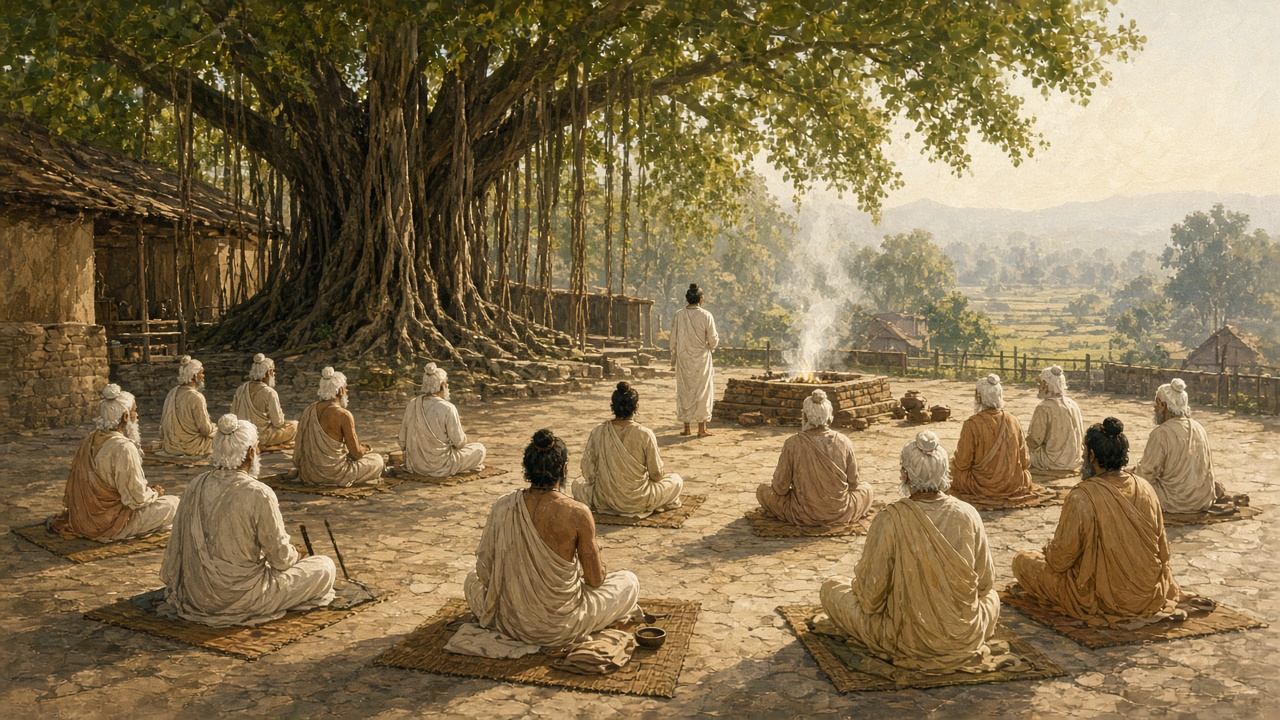
AI illustration: a debate under a banyan tree in Videha (an imaginative reconstruction).
Warp upon woof, and the shuttle goes;
on what is the last thread laid?
Two arrows drawn in the court of the king,
and a woman who was not afraid.
The Cows with Golden Horns
Of a contest in Videha, and a prize half jest and half challenge.
Long ago, in the eastern kingdom of Videha, between the rivers and the forest, there was a royal courtyard where the smoke of the sacrifice still hung upon the air. A thousand cows stood fidgeting in a line, and on each pair of horns pieces of gold had been fastened: a prize so splendid that it was half a jest and half a provocation. For King Janaka wished to know who among the visiting Brahmins was the most learned. And before the contest had well begun, the sage Yājñavalkya, sure of himself to the point of cheek, turned to his pupil Sāmaśravas, calling him somya, “my dear”, as a teacher calls a pupil, and bade him drive the herd home. The other scholars were not amused.
Then one of them rose. She was not a king, nor a court priest, nor one of the famed western Brahmins out of Kuru-Pañcāla. She was Gārgī Vācaknavī, and she was about to ask the most dangerous question in that place: on what is the whole world woven, warp and woof?
A Voice in the Late Vedic World
Of a book older than most, and a name that is a small biography.
Gārgī’s debate is among the oldest records of its kind. The text that keeps it is usually set, in its early layers, in the centuries before the Buddha, often around the seventh to sixth century BCE, though no one can date these texts more finely than to within “a few centuries”. The scene is laid in Videha, roughly northern Bihar and southern Nepal, an eastern kingdom sometimes held as a frontier by the older ritual heartlands. And Janaka, a royal title as much as a personal name in tradition, hosts a brahmodya: a public contest of philosophy, sharp as any duel, but fought with questions.
Her name is itself a small biography. Gārgī marks her as of the lineage of the sage Garga; Vācaknavī has long been heard as “the eloquent one,” from vāc, speech, or else as “daughter of Vacaknu,” as you parse it. Either way, the text presents her as a brahmavādinī: one entitled to speak of brahman, the ultimate. Among seven men who challenge Yājñavalkya she stands; and she alone challenges him twice.
The older Vedic world had been thick with sacrifice and priestly craft. Now came a turning inward, to new questions: what is the self (ātman)? What is the absolute (brahman)? Yājñavalkya stood at the heart of that turning. And it was Gārgī’s questions that drew from him, in that court, the teaching of the Imperishable.
Of her childhood nothing is recoverable, nor her birth, nor any trace in the ground. She comes onto the page fully formed: a voice in a debate. Let her be held as a figure of the Upaniṣadic age, almost certainly rooted in a real world of learning that included women, rather than as a life we can chart.
The Ladder of Questions
Of water and air and the worlds beyond, and a warning in the hall.
Her first assault was a ladder of woven questions. Since this whole world is woven back and forth on water, she asked, on what then is water woven? On air, said Yājñavalkya. And air? On the intermediate worlds. And those? On the sun, the moon, the stars, the worlds of the gods, of Indra, of Prajāpati, of brahman. Each answer was a rung, and each new question climbed higher. And when she asked on what the worlds of brahman themselves are woven, Yājñavalkya stopped her cold: do not ask too many questions, Gārgī, or your head will shatter apart.
In Vedic debate “head-shattering” is a known idiom for overreaching, for pressing inquiry past the method the tradition allows. Other challengers in the same chapter also fall silent, and one man’s head, famously, does shatter. Gārgī too fell silent, for a while.
I am Gārgī, of the line of Garga, and I will tell you how I held my peace. He bade me ask no further, and I asked no further. I watched the others rise and fail, one by one, while the gold glinted on the horns of the king’s cows. And all that while I was shaping my next questions, as one shapes an arrow.
Two Arrows
Of a challenger who returned, and the Imperishable.
Then she came back.
She turned to the whole assembly. Brāhmaṇā bhagavantaḥ, she began, “honoured Brahmins”: she would put two questions to him, and if he could answer them, none of them would ever defeat him. She framed her challenge even in the speech of war, like a fierce warrior of Kāśī or Videha rising with two deadly arrows.
The weaving image returned. On what is everything woven, above heaven, below earth, past, present and future? On space (ākāśa), said Yājñavalkya. Gārgī’s reply lands with a dry sparkle: all honour to you; you have cleared that up for me. Then the second arrow: on what is space woven?
Yājñavalkya answered with the akṣara, the Imperishable. Neither coarse nor fine is it, neither short nor long; without shadow, without darkness; not the seen but that which sees; not the heard but that which hears. At its command sun and moon keep their stations. And on this Imperishable, he said, space itself is woven back and forth.
Then Gārgī turned to the Brahmins and told them, in effect, to pay their respects and walk away, for none of them would beat him in debate. The cows, and the gold, went with Yājñavalkya.
The gold went home with him, and the cows with it. I did not grieve for them. I had asked what the world is woven on, and in that hall, before the king, the answer had been spoken aloud.
The Shuttle and the Silence
Of a weaver’s word, and a pause before the second rising.
The picture she chose was a weaver’s. Warp and woof, back and forth, the shuttle crossing and crossing again: every household in that courtyard knew the sight. Gārgī took it and asked it of the whole world. If all things are woven, they are woven on something; and she asked what that something was, and then what that was woven on.
After the warning of the shattered head she said nothing more. She sat while the other challengers rose and failed. Then she rose again, with two questions in place of a ladder of them, and this time Yājñavalkya answered to the end.
What we actually know, and what we don’t
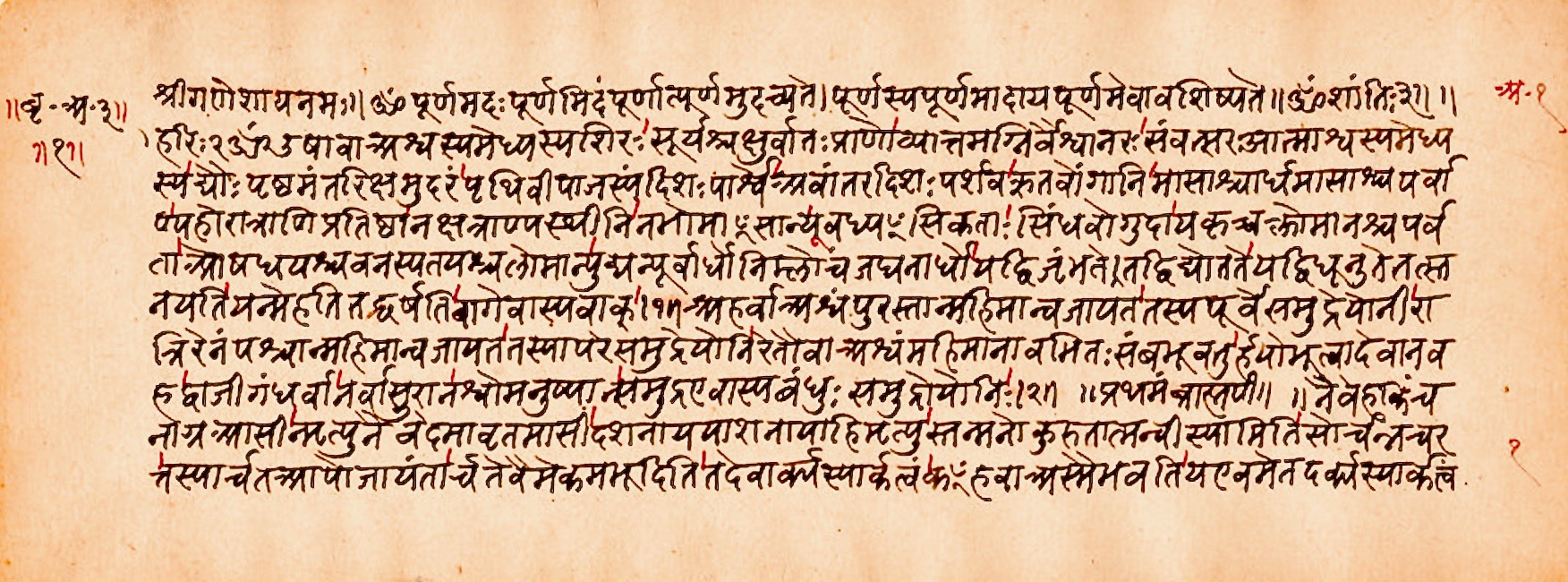
What the text gives us. Gārgī Vācaknavī appears by name in Bṛhadāraṇyaka Upaniṣad 3.6 and 3.8, at Janaka’s assembly in Videha, as Yājñavalkya’s fiercest and only double challenger. Her questions drive the dialogue toward the Imperishable (akṣara). Olivelle’s translations are the modern English scholarly standard.
What later tradition adds. Later tellings sometimes make her a lifelong celibate, a composer of Ṛgvedic hymns, a “navaratna” of Janaka’s court, or a dialogue partner in the much later Yoga Yājñavalkya. Treat those as legend or separate literary traditions unless a primary early source is cited. The Upaniṣad itself does not give us her biography.
What we do not have. No inscription, no independent contemporary chronicle, no fixed birth year. We cannot prove she “really said” every sentence attributed to her any more than we can for Socrates in Plato. What we can say, carefully, is that the composers of one of India’s oldest philosophical books found it natural and important to stage a woman as the debate’s keenest cross-examiner. That choice itself is evidence of a late Vedic intellectual world wider than caricature allows.
Where the story’s details come from. Gārgī’s questions are in the Bṛhadāraṇyaka Upaniṣad 3.6 and 3.8, quoted in Patrick Olivelle’s translation. The dating of its early layers is Olivelle’s, as is the warning that to date these texts more finely than “a few centuries” is a house of cards. Encyclopaedia Britannica and the standard surveys place Yājñavalkya at the centre of the Upaniṣadic turn inward.
Imagined voice: the italic passages in which Gārgī speaks in the first person are imagined. They are built only from the texts and studies named here, add no events, and are not quotations.
Sources (lightly noted)
- Bṛhadāraṇyaka Upaniṣad 3.6 and 3.8 — primary dialogue (Patrick Olivelle, Upaniṣads / The Early Upaniṣads).
- Patrick Olivelle, “Gargi Vachaknavi…” (ThePrint, 3 Jan 2024) — concise scholarly retelling by a leading Upaniṣad translator.
- Encyclopaedia Britannica, entries on Yājñavalkya and the Upaniṣads — dating, teachings, and the Bṛhadāraṇyaka’s place among early Upaniṣads.
- Brian Black, The Character of the Self in Ancient India (SUNY Press, 2007) — priests, kings, and women in the early Upaniṣads.
- Steven E. Lindquist, “Gender at King Janaka’s Court…” (Journal of Indian Philosophy, 2008) — gender and debate dynamics in BU 3.
- Ethan Mills, “Learning from Gārgī’s Silence” (Indian Philosophy Blog, 2020) — accessible discussion of the silences, citing Olivelle.
- Bṛhadāraṇyaka Upaniṣad, Sanskrit text with Śaṅkara’s commentary, GRETIL (Göttingen Register of Electronic Texts in Indian Languages): the pupil Sāmaśravas and the address somya (3.1.2); Gārgī’s address brāhmaṇā bhagavantaḥ (3.8.1).
Myth and text flagged throughout: the cold open dramatises the Upaniṣadic scene; biographical colour beyond the text is marked as later tradition or unknown.