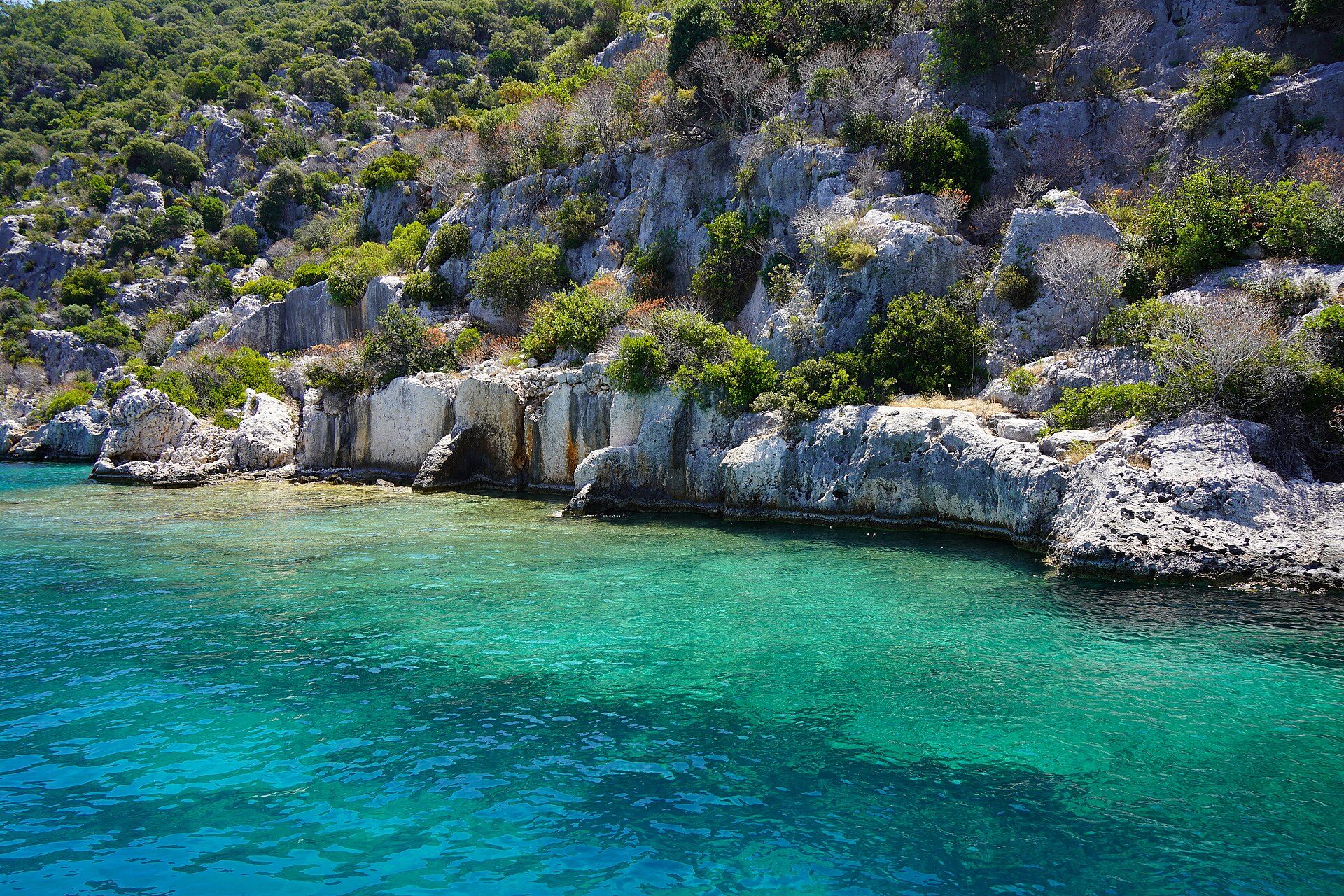
Featured image: the shore of Kekova Island in Antalya province, where the ruins of a much later town lie half under the sea. The Bronze Age wreck was found off this island. Photo: JamesDavidShoots, Wikimedia Commons, CC BY-SA 4.0.
This week’s roundup covers 10 to 17 October 2026: a Bronze Age cargo off the Turkish coast, two colossal statues of Ramesses II found by a farmer in the Nile Delta, a Roman fort beneath a Welsh legend, a 13,800-year-old home in Alaska and the megaliths of Mudumal, where digging is due to begin next month. Each item links to its source.
India and South Asia
A dig is planned at the Mudumal menhirs
Telangana’s Department of Heritage has invited tenders to excavate the Mudumal Megalithic Menhirs in Narayanpet district, an 80-acre landscape near the Krishna River that India placed on UNESCO’s Tentative List in 2025. The site holds about 80 standing stones, each 3 to 5 metres tall, along with thousands of smaller alignment stones and megalithic stone circles. Some of the menhirs appear to line up with sunrise and sunset at the solstices, and cup marks on the rocks have been read as constellations, among them Ursa Major, the Saptarshi Mandala. Estimates of the site’s age run from about 3,000 to 4,000 years. The contract is worth ₹39.97 lakh and must be finished within four months. Work is expected to begin in the second week of November, with samples going to CSIR-CCMB in Hyderabad for DNA study and to a laboratory in the United States for radiocarbon dating. Source: The Hindu; Deccan Chronicle, 14 October.
Radar over Ujjain’s giant stupa
A joint team from the Archaeological Survey of India, the Madhya Pradesh archaeology department and MANIT Bhopal has run a ground-penetrating radar survey over Vaishya Tekri, a mound outside Ujjain. Digging there stopped in the late 1930s after a reported gas leak left some labourers unconscious. The Gwalior State archaeology report for 1938–39 called the buried structure “perhaps the biggest known” stupa, about 350 feet across and at least 100 feet high, against roughly 120 feet by 54 for the Great Stupa at Sanchi, and dated it to the Mauryan period, around the 3rd century BCE. The state government hopes the radar results will open the way to a new excavation. Source: The Times of India.
A burial chamber and carved footprints in Kasaragod
In Madikkai panchayat in Kerala’s Kasaragod district, the local researcher Satheesan Kaliyam has found a megalithic burial chamber in a laterite quarry at Theerthankara, partly damaged by mining, and two footprints carved into laterite rock at Kannamkulampara. Dr Nandakumar Koroth of Nehru Arts and Science College, Kanhangad, visited both sites and confirmed the chamber as megalithic and the engravings as man-made. The archaeologist Ajith Kumar notes that carved footprints are known from other sites and may stand for the souls of the dead or sacred spirits in local belief, though he cautions that some rock markings can be natural. Source: The Hindu, 15 October.
The Mediterranean and Egypt
The world’s oldest known shipwreck, off Kekova
Divers led by Professor Hakan Öniz of Akdeniz University have found what they describe as the oldest shipwreck yet known, 30 metres down on a slope off Kekova Island in Antalya province. None of the hull survives, but the team recovered three stone anchors and more than 30 amphorae, two-handled jars with a central ridge and flat base that match Early Bronze Age types from Egypt and the Levant dated to 4,400 to 4,700 years ago. The ship was about 10 metres long and probably sailed from the eastern Mediterranean coast, bound perhaps for Troy or Minoan Crete. Some jars still hold a glossy residue. “It could be olive oil, it could be wine, it could be tree resins,” said Dr Karin Sowada of Macquarie University. The previous record holder, off the Greek island of Dokos, is about 4,200 years old. The finds will go on show in Antalya’s new Mediterranean Underwater Archaeology Museum. Source: BBC News, 14 October.
Two colossal statues of Ramesses II in the Delta
A farmer working his land at Behbeit el-Hagar in Gharbia governorate turned up a pink granite block and reported it. The block, 1.3 metres long, carries two of Ramesses II’s royal titles, King of Upper and Lower Egypt and Son of Ra. Rescue excavations by the Supreme Council of Antiquities then uncovered a head of the king 1.6 metres high, wearing the Double Crown, with part of a back pillar bearing his Horus name; the ministry estimates the whole statue stood about 8.5 metres with its base. Close by lay most of a second statue, 2.4 metres long and missing its legs and base, whose king wears the nemes headdress and is thought to be Ramesses too. Behbeit el-Hagar is also the site of a later temple of Isis. The minister, Sherif Fathy, went to the village on 14 October to honour the farmer, Khaled al-Shahat, and his wife. Source: Ahram Online, 13 October; CBS News.
Britain
A Roman fort below Frenni Fawr
In The Dream of Macsen Wledig, one of the medieval Welsh tales of the Mabinogion, the emperor Magnus Maximus pitches camp at Frenni Fawr, the easternmost peak of the Preseli Hills. Dr Mark Merrony of the University of Oxford spotted the outline of a fort on satellite images about 3.5 kilometres south-west of the summit in 2024, and this year’s first season of excavation has confirmed it. The fort measures 180 by 150 metres, has the rounded “playing-card” shape of a Roman auxiliary base and may have held about 500 soldiers. Finds include Roman tile, pottery, clay floors, wagon ruts, an iron stylus and two coins of the late 4th century, the period of Maximus himself. Geophysics shows what may be a headquarters building with a commander’s house beside it. “If Magnus Maximus was there, there must have been an army there,” Merrony said. The coins fit the legend’s date, though nothing yet ties the fort to Maximus by name. Source: The Guardian, 12 October.
The Americas
A 13,800-year-old home in Alaska
A paper in Science Advances on 14 October, led by Kelly Graf, describes the earliest occupation at Shégˊ Xdaltthˊíˊ (“They Were There” in an Athabascan language), about 55 kilometres south-east of Fairbanks. Around 13,800 years ago people left a hearth, a small pit and the stain of a wooden post, probably from a lean-to or early tent house, which the authors put forward as the oldest dwelling in the Western Hemisphere. Bone needles, an antler pendant, stone tools and an earth oven full of charcoal and animal bones came from the same level, and some of the animal bones may belong to the earliest domesticated dogs in the Americas. Source: Live Science, 16 October.
A sun-watching plaza in the Sierra Norte de Puebla
Mexico’s National Institute of Anthropology and History (INAH) has confirmed that Grupo E, or Tetelihtic, at Teteles de Ávila Castillo in Puebla was laid out as a solar observatory more than 2,500 years ago, in the Middle Preclassic. It is the first complex of this kind recorded outside the Maya area, and resembles the type site at Uaxactún in Guatemala, which is about twice its size. A courtyard lies between a long eastern platform, 90 by 40 metres, and a smaller western one, 46 by 27 metres, that served as the viewing point. From there the sunrise can be followed through the equinoxes and solstices. The archaeologist Alberto Diez Barroso says the alignments also seem to mark the start of the calendar year in February and the harvest in October. Source: INAH bulletin (Spanish); Mexico News Daily, 15 October.
New research
A spear wound in a Neanderthal shoulder blade
A Cambridge-led team writing in Scientific Reports argues that a round hole in the shoulder blade of Shanidar A, a Neanderthal found in 2020 in Shanidar Cave in Iraqi Kurdistan, was made by a sharpened wooden spear. If so, it is the earliest known case of lethal violence with a wooden spear in the human fossil record, and the first evidence for such spears in the prehistoric Middle East. The bones also show a severe facial injury from earlier in life, and the researchers think this Neanderthal was cared for before the fatal wound. Shanidar A brings the burial cluster in that part of the cave to five individuals, four adults and an infant, in a space only about 1.5 metres long. Source: University of Cambridge, 15 October.
Books
Charlemagne’s empire, without the rosy glow
James T. Palmer’s Charlemagne’s Dream: The Rise and Fall of the Carolingian Empire (Hachette, 2026) tells the story of the empire that claimed Rome’s mantle in the West in four parts, from rapid growth to a failure to build lasting institutions of shared rule. Reviewing it on 13 October, the historian David M. Perry calls it a great read and praises Palmer’s clarity in steering through a family tree crowded with Pepins, Louis and Charleses. Source: Drafting the Past, 13 October.
Caesar, the civil wars and Livia
In the October issue of History Today, Kyle Harper reviews three recent books on the end of the Roman Republic: David Potter’s Master of Rome: A Life of Julius Caesar (Oxford University Press, £22.99), Giusto Traina’s The Roman World War: From the Ides of March to Cleopatra’s Suicide, and Caitlin C. Gillespie’s Livia: Mother of Rome. He finds Potter’s the most conventional of the three and Traina’s the most original and ambitious, and reads Gillespie’s life of Livia as a reminder of how much a men-only view of the period leaves out. Source: History Today, October 2026.
Last week’s news is in the roundup for 3 to 10 October. If we have missed a story, send it through the contact page and we will look at it for next Saturday.