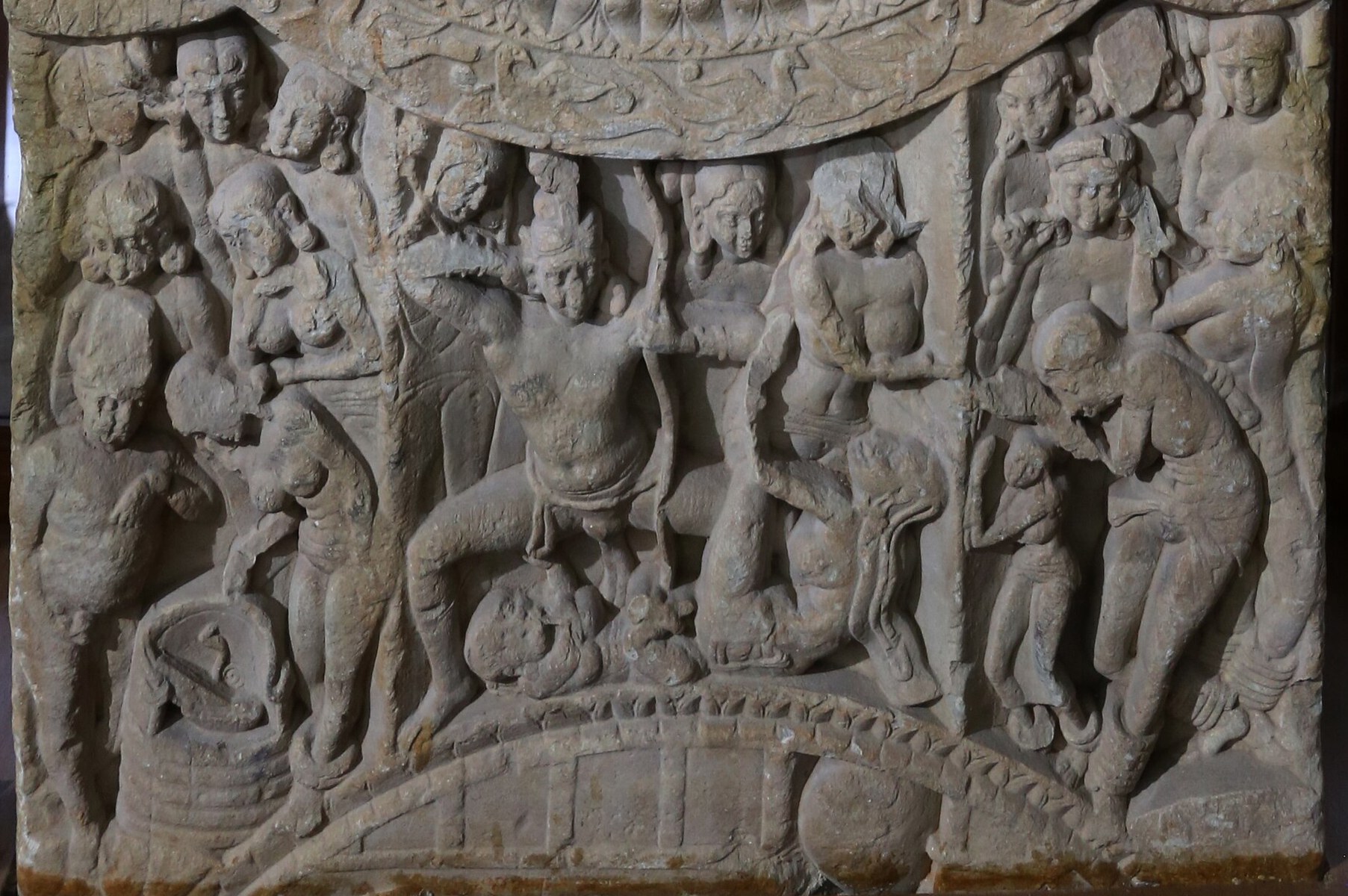
Image: Relief from the Amaravati stupa, about the 2nd century CE, identified as King Udayana and his queens; at its centre a crowned man draws a bow among the women of a palace. Government Museum, Chennai. Photograph by Sailko, CC BY 3.0, via Wikimedia Commons, cropped. A depiction made some six centuries after his time.
Born in a storm in the fork of a tree,
he called the wild herds with a three-stringed lute;
he lost a queen to fire in his own halls,
and owned to an old monk that his heart was not his own.
The Bird and the Banyan
Of a queen in a crimson blanket, a storm at night, and a hermit’s lute.
In those days, where the Yamunā runs broad towards the Ganges, stood Kosambī, chief city of the Vatsas, and its king was Parantapa. Later tellers say that one morning he sat in the sun with his queen, great with child, who wore his crimson blanket and had slipped his signet ring onto her finger. Then a monster bird came down out of the sky, taking her for a piece of meat, and bore her away to a great banyan tree in the Himālaya country.
There, in the fork of the tree, with a storm rising from the four quarters, she gave birth at dawn to a son, and named him Udayana. In the Pāli tongue he is Udena. A hermit named Allakappa lived near that tree, and he took the mother and child to his hermitage. When the boy was grown, Allakappa gave him a lute for charming elephants and taught him the spells: strike one string and the herd would flee, strike another and the leader of the herd would come and offer his back.
One night the hermit read in the stars that Parantapa was dead. So the youth sat on the lowest branch of the banyan, struck the string, and the lord of the elephants knelt for him. He whispered in its ear, “I am the son of King Parantapa of Kosambī. Take me and give me the sovereignty which I have inherited from my father.” With thousands of elephants behind him he came to the city. The citizens opened their gates only when he named the old king’s generals and showed them the blanket and the ring, and they anointed him king.
The Lute at Ujjenī
Of a wooden beast, a curtain, and coins strewn on the road.
Readers of the Pradyota chapter know the next tale: how the fierce king of Ujjenī took Udayana with a wooden elephant that would not heed his lute, and set him to teach the charm to his daughter Vāsuladattā behind a curtain. One day Udayana lifted the fringe. “I am Vāsuladattā, daughter of the king,” she said. So they fled together on the she-elephant Bhaddavatī, scattering gold and silver on the road behind them, and at Kosambī he made her his chief consort.
A Girl Going Down to the River
Of a festival, a sealed house, and a daughter’s counsel.
In Kosambī lived the rich man Ghosaka, who had taken as his daughter a girl named Sāmāvatī. On a festival day, when daughters of good families go on foot to bathe in the river, she went down with her companions through the palace court. Udayana saw her from his window. “Whose are those dancing girls?” he asked.
“Nobody’s dancing girls, your majesty.”
He sent for her at once. Ghosaka refused, so the king sealed his house and turned him out of doors. When Sāmāvatī came back from bathing she said to him, “When one who is a king commands, you should not say: ‘We do not give.’” So Ghosaka gave her, with all her women, and the king raised her to the dignity of chief consort.
A third queen he took also, Māgandiyā, whose father had once offered her in marriage to the Buddha himself and been refused. She did not forget it. The king spent seven days by turns with each of his three consorts.
The Snake in the Lute
Of flowers bought for eight coins, and an arrow that turned back.
Every day, it is told, the king gave Sāmāvatī eight coins for flowers. One day her serving-woman Khujjuttarā heard the Buddha teach at the gardener’s house, came home with flowers for all eight coins, and confessed that she had long kept four for herself. Sāmāvatī did not scold her. “My good woman, you have drunk the Deathless. Give me thereof to drink also.” So Khujjuttarā taught the women of the palace what she had heard.
Māgandiyā learned of it, and plotted. She hid a snake in the hollow of the king’s elephant-lute, and on the night he lay in Sāmāvatī’s rooms she let it out upon the bed and cried treason. The king took up his horn-bow, which needed a thousand men to string, set a poisoned arrow to it, and shot at Sāmāvatī’s breast. Through the power of her loving-kindness, the story says, the arrow turned back. “Indeed this senseless, lifeless arrow knows her goodness, but I, who am a human being, know it not,” he thought, and he knelt at her feet and begged her to be his refuge. “Do not go for refuge to me,” she answered, and bade him go for refuge to the Buddha.
He granted her a boon, and at her asking the Buddha sent Ānanda to teach the women of the palace.
I am Udayana of Kosambī, and I will tell you what is told of the night I drew my bow on Sāmāvatī. A snake came out of my own lute onto her bed, and I believed she meant my death. I shot at her breast with a poisoned arrow, and they say it turned back by the way it had gone. I knelt and asked her to be my refuge. She told me to go for refuge to the one in whom she had gone for refuge.
Red Ants in the Park
Of a monk under a sal tree, and a king roused from sleep.
In the king’s park the monk Piṇḍola Bhāradvāja used to pass the heat of the day. Later tellers say that once Udayana came there after seven days of drinking and fell asleep in a woman’s arms, and the rest went to sit about the monk. The king woke and was told. “Out on it, I’ll have the fellow devoured by red ants!” he cried, and had a basket of red ants broken over him. But Piṇḍola rose into the air and was gone.
The Mind Is Wanton
Of young monks with black hair, and a king who told the truth.
At another time Piṇḍola was staying near Kosambī in Ghosita’s monastery, and King Udena came to him in peace and sat to one side. He called the monk bho, “worthy sir”, and was called mahārāja, “Great King”. “Worthy Bhāradvāja,” the king began, and asked by what cause young monks “with pristine black hair, blessed with youth, in the prime of life” could keep the pure life all their days.
The monk answered with the Buddha’s words: “think of women your mother’s age as your mother. Think of women your sister’s age as your sister. And think of women your daughter’s age as your daughter.”
“But worthy Bhāradvāja, the mind is wanton.”
So Piṇḍola gave him a second teaching, to look on the body itself, from the soles of the feet up and the tips of the hair down, wrapped in skin. The king said that was easy for those who were well trained. “Sometimes I plan to focus on something as ugly, but only its beauty comes to mind.”
Then the monk gave the third teaching: to guard the doors of the senses, and not to get caught up in the features and details of what is seen. At this the king was glad. “This is the real cause,” he said, and he told the monk of the antepura, the women’s quarters of his palace. “For sometimes I too enter the harem with unprotected body, speech, mind, mindfulness, and sense faculties. At those times powerful thoughts of desire get the better of me.” When he went in guarded, they did not. And he asked to be remembered “as a lay follower who has gone for refuge for life.”
I am Udayana, and I will tell you what I asked Bhāradvāja in Ghosita’s monastery. I asked him how young monks with black hair keep the pure life all their days. He gave me three answers. To the first I said that the mind is wanton. To the second I said that when I try to see a thing as ugly, its beauty comes to me. The third was to guard the doors of the senses, and that one I knew to be true, for I had entered my women’s quarters both guarded and unguarded.
Fire in the Royal Compound
Of five hundred women, and a question brought to the Buddha.
Now while King Udena was visiting a park, his royal compound burned down. Five hundred women died, with Queen Sāmāvatī at their head. The monks who heard of it on their almsround came to the Buddha at Ghosita’s monastery and asked him, “Sir, where have those laywomen been reborn in the next life?” He told them that some had entered the stream, some would return once and some not at all. “None of those laywomen died without some fruit of the practice.” And he spoke a verse: “The world is caught up in delusion, but is looked on as making sense.”
Later tellers say Māgandiyā’s uncle wrapped the pillars in oil-soaked cloths, barred the doors and set the fire, and that Sāmāvatī told her women as the flames rose, “Therefore be heedful.” The king, they say, tricked Māgandiyā into boasting of it and put her and all her kin to a cruel death.
A Thousand Robes
Of a boat upstream, and nothing wasted.
The Buddha passed away, and Udayana lived on. After the Master’s death Ānanda came by boat upstream to Kosambī with five hundred monks and sat under a tree near the king’s uyyāna, his pleasure park. The women of the palace said to the king, calling him deva, “Your Majesty”, that their teacher, the ayya Ānanda, “noble one”, was near, and the king let them go. They heard him teach and gave him five hundred upper robes.
The king grumbled. “Is he starting up as cloth merchant or setting up shop?” Then he went himself and asked Ānanda what he would do with so many. The new robes would go to monks whose robes were worn out, Ānanda said, and the worn robes would pass down through bedspreads, mattress covers, floor covers, doormats and dustcloths, until at last they were cut up and mixed with mud to smear the floors. “These Sakyan monastics are clever at putting things to use; nothing is wasted,” the king thought, and gave five hundred more.
Tales in Avanti
Of village elders, and a king on the stage.
Of Udayana’s death nothing is told. Later tellers name a son of his, but whether that son reigned after him no one can say.
Centuries later a poet, sending a cloud on a lover’s errand over the land of Avanti, spoke of its village elders, versed in the tales of Udayana. Playwrights set him on the stage. In one play his minister spread word that Vāsavadattā had died in a fire, so that he would wed a princess of Magadha, and he saw his lost queen as though in a dream. In others he loved a princess hidden among the queen’s maids. Storytellers made him the father of a prince foretold to rule the sky-farers, and gathered a whole ocean of tales about his house.
The truth behind the tale
Udayana, Udena in Pāli (Utena in the Udāna), is one of the few kings of the Buddha’s time named in the early texts. SN 35.127 records his talk with Piṇḍola Bhāradvāja at Ghosita’s monastery and his going for refuge. Udāna 7.10 records the fire in which Sāmāvatī and five hundred women died, and names no culprit. The Vinaya (Cullavagga 11) sets the gift of robes to Ānanda after the Buddha’s death. AN 1.260–261 name Khujjuttarā and Sāmāvatī among the foremost laywomen. Spoken lines from these are quoted from Bhikkhu Sujato’s and Bhikkhu Brahmali’s translations, some shortened.
Everything else is commentary and later legend. His birth in the banyan, Allakappa and the lute, the wooden elephant and the flight with Vāsuladattā, the winning of Sāmāvatī, Khujjuttarā’s flowers, Māgandiyā’s snake, the arrow that turned back, the blame for the fire and Māgandiyā’s punishment come from the story-cycle of the Dhammapada commentary, compiled around the 5th century CE, quoted from E. W. Burlingame’s translation as revised by Ānandajoti Bhikkhu. The red ants are from the opening of the Mātaṅga Jātaka (no. 497) in W. H. D. Rouse’s translation; other commentaries summarised by Malalasekera tell it with the women giving Piṇḍola their robes. The son Bodhi is named in the Jātaka commentary; the Bodhi of MN 85 is not called Udena’s son in the sutta itself.
The Sanskrit tradition calls him Udayana or Vatsarāja. Kālidāsa’s Meghadūta (1.30) mentions the village elders of Avanti versed in Udayana tales. Bhāsa’s Svapnavāsavadatta, whose date is disputed, tells of the false report of Vāsavadattā’s death and his marriage to Padmāvatī of Magadha. Harṣa’s 7th-century Ratnāvalī and Priyadarśikā tell of the hidden princesses, and Somadeva’s 11th-century Kathāsaritsāgara makes his son Naravāhanadatta the destined king of the vidyādharas, the sky-farers.
Kosambī is the ruined city at Kosam on the Yamunā, dug by G. R. Sharma of Allahabad University from 1949. Inside its walls lay a monastery that an inscription of about the 1st century CE names as Ghoṣitārāma. Sharma dated the great rampart very early; others place it in the 7th to 5th centuries BCE, and the dating is still argued. No inscription names Udayana. If he lived, he was a contemporary of the Buddha, whose dates are disputed: about 480 to 400 BCE on the chronology many scholars now favour, or some eighty years earlier on the older reckoning.
Imagined voice: the italic passages in which Udayana speaks in the first person are imagined. They are built only from the texts and studies named here, add no events, and are not quotations.
Sources
- Bhikkhu Sujato (trans.), Saṃyutta Nikāya 35.127, With Bhāradvāja, SuttaCentral. Quotations in the scene with Piṇḍola.
- Bhikkhu Sujato (trans.), Udāna 7.10, King Udena, SuttaCentral. Quotations in the scene of the fire.
- Bhikkhu Brahmali (trans.), Vinaya Khandhaka 21 (Cullavagga 11), On the Five Hundred, SuttaCentral. The robes given to Ānanda after the Buddha’s death; quotations in that scene.
- Bhikkhu Sujato (trans.), Aṅguttara Nikāya 1.258–267, SuttaCentral. Khujjuttarā and Sāmāvatī among the foremost laywomen.
- Pāli texts, SuttaCentral (Mahāsaṅgīti edition): bho, mahārāja and antepura (SN 35.127); deva, ayya and uyyāna (Vinaya Khandhaka 21); antepura and upāsikā (Ud 7.10).
- E. W. Burlingame (trans.), rev. Ānandajoti Bhikkhu, Dhammapada Commentary 2.1, The Story about Udena, Ancient Buddhist Texts. The birth, Allakappa, Vāsuladattā, Sāmāvatī, Khujjuttarā, Māgandiyā, the arrow and the fire; all quotations in the first four scenes and in the later account of the fire.
- W. H. D. Rouse (trans.), in E. B. Cowell (ed.), The Jātaka IV (1901), No. 497, Mātaṅga-Jātaka, sacred-texts.com. The red ants.
- G. P. Malalasekera, Dictionary of Pāli Proper Names, “Udena”, palikanon.com. Variant telling of the red ants, the son Bodhi, Udena outliving the Buddha.
- Kālidāsa, Meghadūta 1.30, Sanskrit text, GRETIL (udayanakathākovidagrāmavṛddhān).
- A. C. Woolner and Lakshman Sarup (trans.), Thirteen Trivandrum Plays Attributed to Bhāsa (1930–31), for Svapnavāsavadatta; plot as summarised in “Svapnavasavadattam”, Wikipedia. Harṣa’s Ratnāvalī, Wikipedia; G. K. Nariman, A. V. Williams Jackson and C. J. Ogden (trans.), Harṣa’s Priyadarśikā (Columbia University Press, 1923).
- C. H. Tawney (trans.), The Kathá Sarit Ságara, or Ocean of the Streams of Story (1880–84), the frame story of Udayana and Naravāhanadatta.
- A. Ghosh, “Buddhist Inscription from Kausambi”, Epigraphia Indica 34. The inscription naming Ghoṣitārāma.
- Rashmi Jha and Atul Tripathi, “Situating Kaushambi”, Ancient Asia 16 (2025): 121–146. G. R. Sharma’s excavations and the Ghositārāma complex.
- “Kosambi”, Wikipedia. The disputed dating of the rampart (G. R. Sharma; James Heitzman).