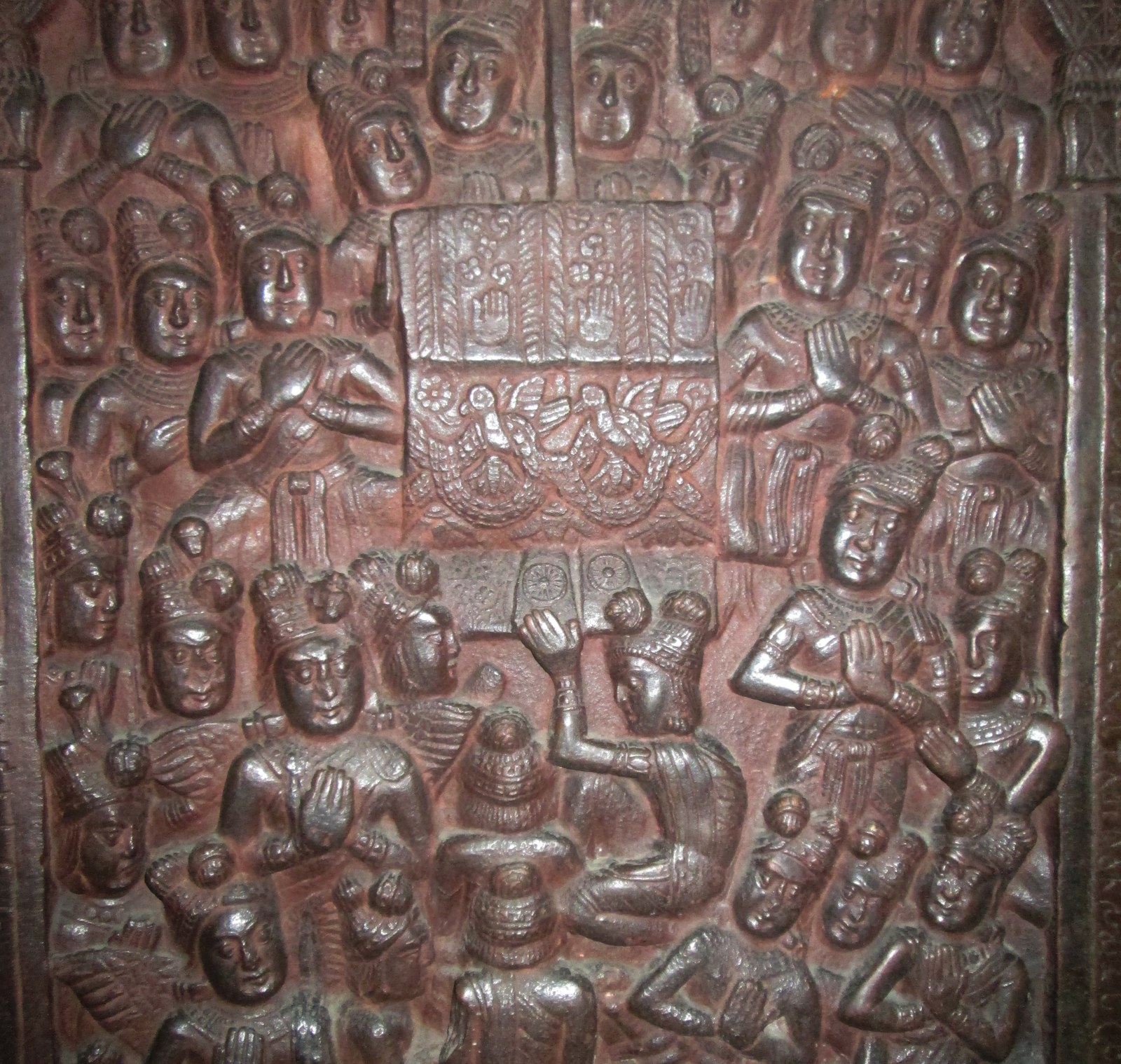
Image: Ajātasattu worships the Buddha, railing-pillar relief from the Bharhut stupa, about the 2nd to 1st century BCE; the Buddha is shown only by an empty seat beneath a parasol, with footprints below, and the king kneels before it among his court. Indian Museum, Kolkata. Photograph by Ānandajoti Bhikkhu, CC0, via Wikimedia Commons, cropped. A depiction made some three centuries after his time.
A dagger bound against the thigh at noon,
a kingdom given for the asking;
a moon on the river of torches,
and a grove where no one coughed.
The Boy with the Snake for a Belt
Of a prince on a terrace, and a guest who came by wonder.
In those days Bimbisāra ruled Magadha from Rājagaha among its hills, and his son was Ajātasattu. Men called the prince Vedehiputta, son of the lady of Videha, and that name went with him all his days. He was young, and the road before him was bright.
It is told that a monk named Devadatta, who hungered for honour, looked about him for a patron and thought, “Prince Ajātasattu is young and has a bright future.” So he came to Rājagaha. There, by a wonder, he took the shape of a small boy wearing a snake as a belt and appeared in the prince’s lap.
The prince shrank back. “Are you afraid of me, prince?” said the boy.
“I am. Who are you?”
“I’m Devadatta.”
“If you’re Venerable Devadatta, please appear in your own form.”
Then the boy was gone, and a monk stood before him in robe and with bowl. From that day the prince waited on Devadatta morning and evening, with five hundred carriages and an offering of five hundred dishes of food. He called him ayya, “noble sir”, as a prince might call a holy man.
A Dagger at Noon
Of a short life and a long one, and a father who asked a question.
After a time Devadatta came to the prince with soft words. “In the past, prince, people were long-lived, but now they’re short-lived. It’s possible that you might die while still a prince. So then, kill your father and become the king. And I’ll kill the Buddha and take his place.”
Ajātasattu thought that so mighty a monk must know what he spoke of. He bound a dagger to his thigh, and in the heat of the day, fearful and shaking, he went in haste into the antepura, the inner royal compound. The king’s officers saw how wildly he moved. They seized him, searched him, and found the blade.
They asked him what he was up to, calling him kumāra, “prince”.
“I wish to kill my father.”
“Has anyone encouraged you?”
“Venerable Devadatta.”
Then the officers fell to quarrelling. Some would have put the prince to death with Devadatta and all the monks besides; some would have spared the monks; and some said the king must be told, and they would do as he said. So they brought the young man before Bimbisāra.
The old king heard them out. Then he turned to his son. “Why do you want to kill me?”
“I want to rule, sir.” The prince called him deva, which is how a subject speaks to a king.
“If you want to rule, the kingdom is yours.” And there and then Bimbisāra handed the rule of Magadha to the prince.
I am Ajātasattu of Magadha, and I will tell you of the day I went into my father’s house with a blade against my thigh. I was afraid, and my hands showed it, and his men took the dagger from me before I came near him. When he asked me why, I told him I wanted to rule. He gave me the kingdom with a sentence. Long afterwards, before the Blessed One, I called what I did to my father a mistake.
A Father in the Dark
Of a cell, a mother’s craving, and a finger that would not heal.
The story of the abdication ends there, with a gift. Yet the king himself later spoke of the life of his father as a thing he had taken, and later tellers fill in what lies between. They say Devadatta was not content while Bimbisāra lived, for the old king had been among the Buddha’s greatest friends. So, they say, Bimbisāra was shut away and wasted by hunger and torment until he died. It is said that on that same day a son, Udāyibhadda, was born to Ajātasattu, and that Bimbisāra’s queen, the prince’s own mother and a sister of Pasenadi of Kosala, died of grief.
The same tellers looked back before the prince’s birth. They say his mother, while she carried him, craved to drink blood from her husband’s arm, and the king let her; and so, they say, the child was called Ajātasattu, the unborn enemy. When the baby had a festering boil on his little finger, Bimbisāra took the finger into his mouth to soothe him, and when the boil burst, for love of the child, he would not spit it out, and swallowed it.
The Jains tell a tale of the same shape. They call the prince Kūṇika and his mother Cellanā. In their telling the infant was cast out of the palace and left by a refuse heap, and a cock pecked his little finger. Bimbisāra ran out, lifted him, and sucked the bleeding finger day after day until it healed, and from that sore finger the boy took his name.
Uncle and Nephew
Of a village in Kāsi, and a captive let go.
Readers of the Pasenadi chapter know what followed. Later tellers say the revenue of a village in Kāsi had come to Magadha with the dead queen as her dowry, and that Pasenadi took it back. So Ajātasattu marched into Kāsi with an army of four divisions, elephants, horse, chariots and foot. In one battle he beat his uncle, and Pasenadi withdrew to Sāvatthī. When the Buddha heard of it he said, “Victory breeds enmity; the defeated sleep badly.”
In another battle Pasenadi broke the army of Magadha and took his nephew alive. “Even though I’ve never betrayed this King Ajātasattu, he betrayed me. Still, he is my nephew,” the old king thought, and let him go with his life.
The Night of the Komudī Moon
Of six teachers named, a silent physician, and five hundred elephants.
It was the uposatha, the holy day, at the Komudī full moon, the fifteenth day of the fourth month, and the king sat on the upper terrace of his palace among his ministers. The moon lay white over the hills. “Oh, sirs, this moonlit night is so very delightful,” he said, calling them bho, “sirs”. “Now, what ascetic or brahmin might I pay homage to today, paying homage to whom my mind might find peace?”
One by one his ministers named six famous masters, and to each the king said nothing. Readers of the Jīvaka chapter know who sat silent near him. “But my dear Jīvaka, why are you silent?” the king asked, using samma, a friend’s word. And the physician told him that the Buddha was staying in his own mango grove with twelve hundred and fifty monks.
So five hundred she-elephants were made ready, with women seated on them, and the king mounted his bull elephant. With torches borne beside him he went out from Rājagaha in all his state. But as the grove drew near, fear fell on him and the hair rose on his body. “My dear Jīvaka, I hope you’re not deceiving me!” he cried. “I hope you’re not turning me over to my enemies!” For in so great a gathering there was no sound of coughing, nor any noise at all.
“Do not fear, Great King,” said Jīvaka. “Go forward, Great King, go forward! Those are lamps shining in the pavilion.”
So the king rode as far as the ground allowed, then went on foot to the door. Before him sat the monks, silent “like a still, clear lake”, and the Buddha against the central column, facing east. And the first thought that rose in the king was of his own child. “May my son, Prince Udāyibhadda, be blessed with such peace as the Saṅgha of mendicants now enjoys!”
“Has your mind gone to one you love, Great King?” the Buddha asked, calling him mahārāja.
“I love my son, sir, Prince Udāyibhadda.” He called the Buddha bhante, “sir”, as laymen did.
I am Ajātasattu, and I will tell you what I saw in the pavilion that night. I had come in fear of a trap, among torches and elephants. Inside sat twelve hundred and fifty men and none of them made a sound. I looked at them and thought of no kingdom and no enemy. I thought of my son Udāyibhadda, and I wished him that same stillness.
The King Is Broken
Of bakers and barbers, and a confession made by lamplight.
Then the king asked his question. Bakers and barbers, garland-makers and potters, archers and charioteers all see the fruits of their trades in this very life. He asked whether the Buddha could point out a fruit of the ascetic life that was likewise seen here and now. He told how he had put that question to the six masters, and how one had answered him as a man who, asked about a mango, speaks of a breadfruit. The Buddha answered at length, and the night wore on.
When it was done, the king spoke. “Excellent, sir! Excellent!” he said, and went for refuge to the Buddha, the teaching and the Saṅgha. Then he laid down what he had carried. “I made a mistake, sir. It was foolish, stupid, and unskillful of me to take the life of my father, a just and principled king, for the sake of authority.”
“Indeed, Great King, you made a mistake,” the Buddha answered. “But since you have recognized your mistake for what it is, and have dealt with it properly, I accept it.” Then the king said that he had many duties, bowed, and went out, keeping the Buddha on his right.
When he had gone, the Buddha turned to the monks. “The king is broken, mendicants, he is ruined.” If he had not taken the life of his father, the vision of the Dhamma would have arisen in him there, in that very seat. Later tellers add that from the day of his father’s death the king had been haunted by terrible dreams, and that after that night in the grove he slept.
The Seven Ways of the Vajjis
Of a brahmin minister, a fan, and a fort beside the Ganges.
Yet the king did not lay down the sword. North of the Ganges lay the Vajjis, who ruled themselves in assemblies, and Ajātasattu said, “I shall wipe out these Vajjis, so mighty and powerful!” He sent his chief minister, the brahmin Vassakāra, to the Vulture’s Peak, to bow in his name and to remember well what the Buddha said, “For Realized Ones say nothing that is not so.”
Ānanda stood behind the Buddha, fanning him. The Buddha asked him whether the Vajjis met often and in harmony, kept their ancient decrees, honoured their elders, carried off no women of the clans, tended their shrines, and sheltered holy men. Ānanda had heard that they did. So long as they did, the Buddha said, they could expect growth, not decline. Vassakāra understood. “King Ajātasattu cannot defeat the Vajjis in war, unless by bribery or by sowing dissension,” he said, and went his way.
Afterwards, at the village of Pāṭali on the Ganges, the ministers Sunidha and Vassakāra were building a citadel to keep the Vajjis out. The Buddha said that a great city would rise there, Pāṭaliputta, and that it would face three threats, “from fire, flood, and dissension.” Later tellers say that Vassakāra did sow that dissension, and that within a few years the king fell on Vesālī and took it.
A Share of the Relics
Of a vat of sweetness, a stone mound, and a son.
The Buddha passed away at Kusinārā among the Mallas, and Ajātasattu sent his claim. “The Buddha was an aristocrat and so am I. I too deserve a share of the Buddha’s relics. I will build a monument for them and conduct a memorial service.” His share was given, and he built a monument for it.
Later tellers say his ministers feared the news would break his heart, so they had him sit in a vat of the four sweet things, as though to ward off an evil dream, and told him gently; and he fainted, and they told him again. They say the monument stood at Rājagaha, and that when the monks gathered at Rājagaha to recite the teachings together, the king gave them his protection.
Of his end the old texts say almost nothing. A later chronicle says his son Udāyibhadda killed him, the same son for whom he had wished peace by lamplight in the mango grove; and later tellers add that the king had feared it, and had secretly hoped the boy would become a monk.
The truth behind the tale
Ajātasattu appears often in the early Pāli texts. The Sāmaññaphala Sutta (DN 2) gives the Komudī night, the visit to Jīvaka’s mango grove, his wish for his son Udāyibhadda, and his own confession that he took his father’s life; the Buddha’s verdict “The king is broken” comes from its close. The opening of the Mahāparinibbāna Sutta (DN 16) gives the embassy of Vassakāra, the seven principles of the Vajjis and the citadel at Pāṭali; its last chapter gives the relic claim. SN 3.14 and 3.15 record the two battles with Pasenadi. Quotations from these are from Bhikkhu Sujato’s translations, some shortened.
The Vinaya’s chapter on schism (Cullavagga 7) tells of Devadatta’s wonder of the snake-belted boy, the dagger at noon and Bimbisāra’s abdication, quoted from Bhikkhu Brahmali’s translation. It is an early monastic account but full of marvels, and it ends with the abdication; it says nothing of a killing, which the king’s confession in DN 2 assumes. The imprisonment and starving of Bimbisāra, the birth of Udāyibhadda on the day of his death, the queen’s grief, the blood-craving, the meaning of his name as the unborn enemy, the boil on the finger, the terrible dreams and the sleep after the visit, the vat of sweets and the king’s patronage of the First Council all come from the 5th-century commentaries, here taken from Malalasekera’s summaries in the Dictionary of Pāli Proper Names. The fall of Vesālī comes from the same commentaries. The killing of Ajātasattu by Udāyibhadda is told in the Sri Lankan chronicle Mahāvaṃsa (4.1), which gives him a reign of thirty-two years.
The Jain tradition, in which he is Kūṇika, son of Cellanā, is given here only through a summary of the Jain texts (chiefly the Nirayāvaliyā and the Aupapātika), and the Jain sources themselves were not checked for this chapter. In the Jain story he held Mahāvīra in the highest esteem. The commentaries make his mother a Kosalan princess, the sister of Pasenadi, and explain vedehī in his title as meaning a wise woman; the Jains make his mother Cellanā of Vesālī.
His reign is usually placed in the 5th century BCE: about 492 to 460 BCE on the older reckoning, or about 405 to 373 BCE on the later chronology for the Buddha that many scholars now favour. No inscription of his own reign survives. A relief from the stupa at Bharhut, carved some three centuries later, shows him worshipping the Buddha.
Imagined voice: the italic passages in which Ajātasattu speaks in the first person are imagined. They are built only from the texts and studies named here, add no events, and are not quotations.
Sources
- Bhikkhu Sujato (trans.), Dīgha Nikāya 2, The Fruits of the Ascetic Life, SuttaCentral. The Komudī night, the visit, the confession; quotations in the scenes of the moonlit night and the confession.
- Bhikkhu Sujato (trans.), Dīgha Nikāya 16, The Great Discourse on the Buddha’s Extinguishment, SuttaCentral. Vassakāra and the Vajjis, the citadel at Pāṭali, the relic claim.
- Bhikkhu Brahmali (trans.), Vinaya Khandhaka 17 (Cullavagga 7), On schism, SuttaCentral. Devadatta’s wonder, the dagger and the abdication; quotations in the first two scenes.
- Bhikkhu Sujato (trans.), Saṃyutta Nikāya 3.14 and 3.15, Battle, SuttaCentral. The battles with Pasenadi.
- Pāli texts, SuttaCentral (Mahāsaṅgīti edition): kumāra, ayya, antepura and deva (Vinaya Khandhaka 17); bho, samma, mahārāja, bhante, Komudī and uposatha (DN 2).
- G. P. Malalasekera, Dictionary of Pāli Proper Names (1937–38), “Ajātasattu”, Ancient Buddhist Texts edition. Commentary traditions: the death of Bimbisāra, Udāyibhadda’s birth, the Kāsi village, the dreams, the vat of sweets, the relic stupa, the First Council, the fall of Vesālī, the killing by Udāyibhadda (Mahāvaṃsa 4.1) and the thirty-two-year reign.
- “Ajatashatru”, Wikipedia. Summary of the Jain tradition (Kūṇika, Cellanā, the sore finger), the commentary version of the boil, and the two proposed reign dates.