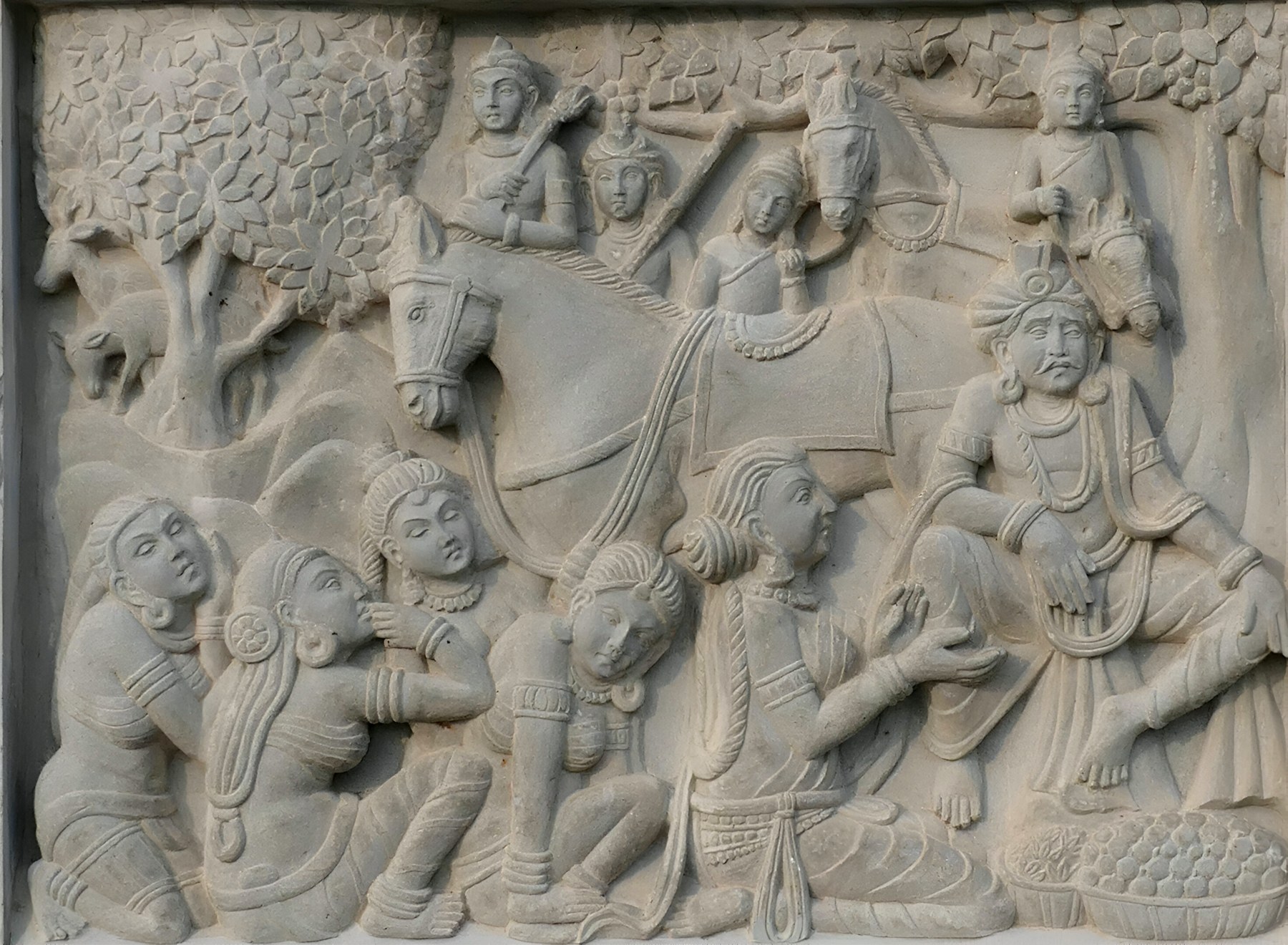
Image: The King of Kosala and Queen Mallikā, modern drum relief at the Buddhavanam stupa, Telangana; the weary king sits by his horse while young women kneel near him in a garden. Photograph by Ānandajoti Bhikkhu, CC BY-SA 4.0, via Wikimedia Commons. A modern depiction of the commentary legend.
Three handfuls of gruel at the garden gate,
a weary rider and a horse’s bridle;
a question asked upstairs in the evening,
and none in all the quarters dearer than the self.
Three Portions of Gruel
Of a garland-maker’s daughter, a basket, and a smile.
In those days Sāvatthī was the chief city of Kosala, and Pasenadi was its king. Among the women of his house was one named Mallikā, and the oldest discourses know her as his queen, devī in their tongue. Of where she came from they say nothing. That is left to later tellers, and what they tell is legend.
It is told that she was the daughter of the chief of the garland-makers of Kosala, good and fair to look on. When she was sixteen she went out one day towards the flower garden with her companions, carrying in a basket three portions of sour gruel, kummāsa, for her meal. On the way she met the Buddha. She gave him all three portions and bowed down before him in great joy.
The Buddha smiled. Ānanda asked him why, and the Buddha said that this girl would be chief queen of Kosala that very day.
The Rider in the Flower Garden
Of a lost battle, a girl singing, and a heap of jewels.
Readers of the Ajātasattu chapter know that Pasenadi fought his nephew over Kāsi, and once was beaten. Later tellers say that it was on that very day that he came riding home defeated, and passing the flower garden he heard a girl’s voice and turned in. Mallikā saw him coming and saw that he was weary, and she took hold of his horse’s bridle.
The king asked, and learned that she was not married. So he got down, and rested a while with his head in her lap. Then he went into the town with her and left her at her father’s house. In the evening he sent a chariot for her, and with great honour and pomp brought her to the palace, set her on a heap of jewels, and anointed her chief queen.
Upstairs in the Longhouse
Of a king’s question, a queen’s answer, and a verse.
Here the older word begins. Once King Pasenadi was upstairs in the royal longhouse with Queen Mallikā, and he turned to her.
“Mallikā, is there anyone more dear to you than yourself?”
She called him mahārāja, “Great King”, and gave him the plain truth. “No, Great King, there isn’t. But is there anyone more dear to you than yourself?”
“For me also, Mallikā, there’s no one.”
Then the king came down the stairs of the longhouse and went to the Buddha, bowed, sat to one side, and told him what had passed. And the Buddha spoke a verse:
“Having explored every quarter with the mind, one finds no one dearer than oneself. Likewise for others, each holds themselves dear; so one who desires self-knowledge would harm no other.”
A Daughter
Of a whisper at the Buddha’s side.
Another day the king was sitting with the Buddha when a man came up and whispered in his ear, calling him deva, “Your Majesty”. “Your Majesty, Queen Mallikā has given birth to a daughter.” And the king was disappointed.
The Buddha saw it, and spoke to him in verse. “Well, some women are better than men, O ruler of the people.” Wise and virtuous, he said, such a woman may bear a son who becomes a hero, “O lord of the land”, and the son of such a blessed lady may even rule the realm.
The daughter’s name is not given there. The king had one daughter whom he loved, the princess Vajirī, and she was most likely this child.
The Mirror and the Gift
Of four kinds of women, and a queen who looked at herself.
At one time the Buddha was staying in Jeta’s Grove, the park that Anāthapiṇḍika had bought for him outside Sāvatthī. Queen Mallikā went out to him, bowed, and sat down to one side, and she called him bhante, “sir”, as lay followers did.
“What is the cause, sir, what is the reason why in this life some ladies are ugly, unattractive, and bad-looking; and poor, with few assets and possessions; and insignificant?” And she asked why some were plain and yet rich, some lovely and yet poor, and some both lovely and rich.
The Buddha told her of a woman who loses her temper at a little criticism, of one who gives nothing to ascetics and brahmins, food, drink, clothing, garlands, lamps, and of one who is jealous of the honour paid to others. Anger, he said, comes back as ugliness, meanness as poverty, and jealousy as a small place in the world, and their opposites as their opposites.
Mallikā listened, and then she spoke of herself. “Sir, in another life I must have been irritable and bad-tempered.” For now, she said, she was plain to look at. But she must have given, for now she was rich; and she must not have been jealous, for now she was honoured. “In this royal court I command maidens of the aristocrats, brahmins, and householders.” From that day, she promised, she would not lose her temper even when heavily criticised, she would give, and she would envy no one. And she asked the Buddha to remember her as a lay follower gone for refuge for life.
I am Mallikā of Sāvatthī, and I will tell you what I said in Jeta’s Grove. I asked the Blessed One why some women are fair and some plain, some rich and some poor. When he had answered, I told him that I must once have been quick to anger, for I am not fair to look upon. I must once have given, for I am rich. I must not have been jealous, for the daughters of nobles and brahmins wait on me. I promised him I would give, and keep my temper, and envy no one.
Born from the Beloved
Of a grieving father, gamblers at dice, and a brahmin sent with a question.
In Sāvatthī a householder’s only child died. He could not work or eat, and went to the cremation ground crying, “Where are you, my only child?” When he came to the Buddha, the Buddha told him that our loved ones are a source of sorrow, lamentation, pain, sadness and distress. The man would not have it. Loved ones are a source of joy and happiness, he said, and some gamblers playing dice near by agreed with him.
Word of it came at last into the royal compound. “Mallikā, your ascetic Gotama said this,” said the king, and repeated the saying.
“If that’s what the Buddha said, Great King, then that’s how it is.”
The king was nettled. “You’re just like a pupil who agrees with everything their tutor says,” he said. “Go away, Mallikā, get out of here!”
She did not argue. She called the brahmin Nāḷijaṅgha and sent him to the Buddha, to bow in her name and ask whether he had truly said it. “Remember well how the Buddha answers and tell it to me. For Realized Ones say nothing that is not so.”
“Yes, ma’am,” said the brahmin, calling her bhotī, “lady”. The Buddha told him that he had said it, and told him of men and women of Sāvatthī driven out of their minds by the death of mother, father, brother, sister, son, daughter, husband or wife.
When Nāḷijaṅgha brought back the answer, Mallikā went to the king. “What do you think, Great King? Do you love Princess Vajirī?”
“Indeed I do, Mallikā.”
“If she were to decay and perish, would sorrow, lamentation, pain, sadness, and distress arise in you?”
“If she were to decay and perish, my life would fall apart.”
“This is what the Buddha was referring to,” said Mallikā. She asked him of Queen Vāsabhā, and of his son, General Viḍūḍabha. And then she asked, “Do you love me?”
“Indeed I do love you, Mallikā.”
“If I were to decay and perish, would sorrow, lamentation, pain, sadness, and distress arise in you?”
“If you were to decay and perish, my life would fall apart.”
Last she asked him of the realms of Kāsi and Kosala, and he said that by their bounty he had sandalwood from Kāsi and wore garlands, fragrance and makeup, and that if they perished his life would fall apart. “This is what the Buddha was referring to,” she said.
“It’s incredible, Mallikā, it’s amazing, how far the Buddha sees with penetrating wisdom, it seems to me. Come, Mallikā, rinse my hands.” Then the king rose, arranged his robe over one shoulder, raised his joined palms towards where the Buddha was, and three times spoke homage to him.
I am Mallikā, and I will tell you how I answered my husband when he sent me away. I did not answer him at all that day. I sent a brahmin to the Blessed One to ask if he had truly said that loved ones bring sorrow. When the answer came back, I went to the king and asked him about our daughter, and about Vāsabhā, and Viḍūḍabha, and myself, and his two kingdoms. Each time he told me his life would fall apart. Then he asked me for water to rinse his hands.
The Hall among the Ebony Trees
Of a park for debate, and lessons in the women’s quarters.
The queen had a park of her own at Sāvatthī, and in it a hall with a single long room, hedged by ebony trees, where wanderers of every sect came to argue their teachings. Once three hundred wanderers were staying there with their teacher Poṭṭhapāda, and one morning the Buddha, finding it too early to walk for alms in the city, went there to visit them.
Later tellers say that Mallikā and Queen Vāsabhā both wished to learn the teaching, and that at the king’s asking the Buddha sent Ānanda to the palace to teach them. Ānanda found Mallikā an apt and ready pupil, they say, careful in her lessons.
A Whisper at the Buddha’s Side
Of drooping shoulders, and five things no one can have.
Mallikā died before her husband. One day King Pasenadi was sitting with the Buddha in Jeta’s Grove when a man came up and whispered in his ear, as a man had whispered once before of a daughter born. “Your Majesty, Queen Mallikā has passed away.”
The king sat with his shoulders drooping, downcast, with nothing to say. And the Buddha spoke to him of five things that cannot be had by any ascetic or brahmin or god or anyone in the world: that what is liable to grow old should not grow old, that what is liable to sickness should not sicken, that what is liable to death should not die, that what is liable to end should not end, and that what is liable to perish should not perish. Sorrowing and lamenting, he said, does not do even a little bit of good.
The truth behind the tale
Mallikā appears by name in several early Pāli discourses, all quoted here from Bhikkhu Sujato’s translations, some shortened. SN 3.8 and its twin, Udāna 5.1, give the question of who is dearest and the Buddha’s verse. SN 3.16 gives the birth of a daughter and the verses on women. AN 4.197 gives her own question about beauty and wealth and her taking of refuge. MN 87 gives the quarrel over “loved ones are a source of sorrow”, Nāḷijaṅgha’s errand and her questions to the king. AN 5.49 gives the news of her death and the five things that cannot be had. DN 9 places the wanderer Poṭṭhapāda in “Mallikā’s single-halled monastery for philosophical debates, hedged by pale-moon ebony trees”.
MN 87 names Princess Vajirī as a daughter whom the king loves, and Malalasekera notes that she is spoken of as his only daughter; SN 3.16 does not name the girl, so linking the two is likely but not stated. Her birth as a garland-maker’s daughter, the three portions of gruel, the Buddha’s smile and prophecy, the meeting with the defeated king, the heap of jewels, and Ānanda’s lessons in the palace come from the 5th-century commentaries on the Jātaka, the Saṃyutta and the Dhammapada, here taken from Malalasekera’s summaries in the Dictionary of Pāli Proper Names. The same commentaries add a tale of a hidden misdeed that brought her, at death, seven days in hell before rebirth in the Tusita heaven; it is left out of the story here.
She lived in the Buddha’s time, whose dates are disputed: about 480 to 400 BCE on the chronology many scholars now favour, or some eighty years earlier on the older reckoning. No inscription or object names her.
Imagined voice: the italic passages in which Mallikā speaks in the first person are imagined. They are built only from the texts and studies named here, add no events, and are not quotations.
Sources
- Bhikkhu Sujato (trans.), Saṃyutta Nikāya 3.8, With Queen Mallikā and 3.16, A Daughter, SuttaCentral. Quotations in the scenes upstairs and of the daughter.
- Bhikkhu Sujato (trans.), Udāna 5.1, Who is More Dear?, SuttaCentral. The twin of SN 3.8.
- Bhikkhu Sujato (trans.), Aṅguttara Nikāya 4.197, Queen Mallikā, SuttaCentral. Quotations in the scene in Jeta’s Grove.
- Bhikkhu Sujato (trans.), Majjhima Nikāya 87, Born From the Beloved, SuttaCentral. Quotations in the scene of the quarrel.
- Bhikkhu Sujato (trans.), Aṅguttara Nikāya 5.49, The King of Kosala, SuttaCentral. The news of her death.
- Bhikkhu Sujato (trans.), Dīgha Nikāya 9, With Poṭṭhapāda, SuttaCentral. Mallikā’s hall for debates.
- Pāli texts, SuttaCentral (Mahāsaṅgīti edition): devī (AN 4.197, SN 3.16), mahārāja (SN 3.8), deva (SN 3.16), bhante (AN 4.197), bhotī (MN 87).
- G. P. Malalasekera, Dictionary of Pāli Proper Names (1937–38), “Mallikā”, Ancient Buddhist Texts edition. The commentary legends: her birth, the gruel (kummāsa, after the Kummāsapiṇḍa Jātaka, no. 416), the defeated king, the jewels, Ānanda’s lessons, the seven days in hell; Vajirī as the only daughter.