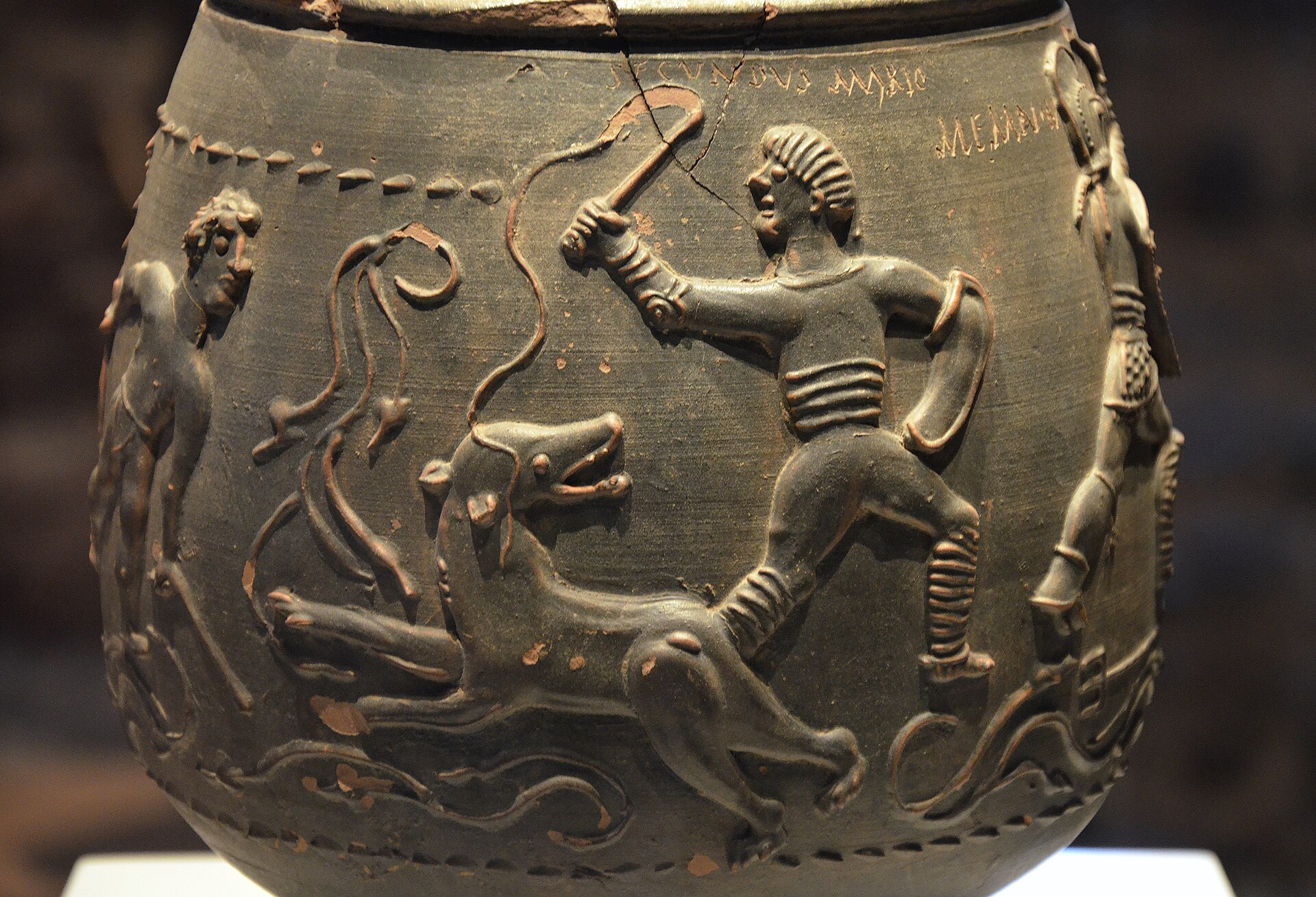
Featured image: the Colchester Vase, made around AD 175 and found in a Roman grave at West Lodge, Colchester, in 1848, now in Colchester Castle Museum. New isotope work suggests the man whose ashes it held grew up in the Mediterranean. Photo: Carole Raddato, Wikimedia Commons, CC BY-SA 2.0.
This week’s roundup covers 21 to 28 November 2026: a Chola Ayyanar in a Perambalur field, faded Brahmi letters on a boulder near Hyderabad, a great limestone foundation in Alexandria’s royal quarter, the tunnels under Hagia Sophia, a man from the Mediterranean buried in the Colchester Vase, a bronze neck ring from the ice of the Lötschen Pass, long breastfeeding at Himera, a hundred hand axes in the Kalahari, a varied menu in Western Australia 45,000 years ago, and a new book on archaeology and faith. Each item links to its source.
India and South Asia
A Chola Ayyanar at Poolambadi
A seated stone figure of Ayyanar, the village guardian deity of Tamil Nadu, has turned up in a farm field beside the Arumbavur to Poolambadi road in Veppanthattai taluk, Perambalur district. It stands 68 centimetres high and 51 wide; the god holds a weapon in his right hand and wears matted hair, palm-leaf earrings, necklaces, a sacred thread and anklets, though the face and body are worn. R Kalaikkovan of the Dr M Rajamanikkanar Centre for Historical Research in Tiruchy dates it to the later Chola period, probably the 11th or 12th century. M Selvapandian, who found it during a field study, thinks an Ayyanar temple stood here about a thousand years ago before the land went under the plough. A smaller female figure nearby, shown in a pose of worship, may portray a royal woman who helped found the temple. Source: The New Indian Express, 24 November.
Red letters near Ghar-e-Mubarak
On 21 November members of the Kotha Telangana Charitra Brundam, Save Rocks and Climate Front Telangana found faded red-painted letters on a boulder wall on a hill near the Ghar-e-Mubarak Dargah and the Manchirevula Forest Trek Park, on the edge of Hyderabad, where rock art and Palaeolithic tools had already been recorded. Sriramoju Haragopal, president of the Brundam, reads the surviving traces as ‘Vi’ in Brahmi of the first century AD, and ‘Ta’, ‘Tarah’, ‘(Ku)shta Charu’ and ‘Duru’ in Telugu-Kannada script of the seventh century. Rain has washed away much of the pigment, and the group wants the site protected and studied. Source: Siasat, 21 November.
Egypt and the Near East
A foundation in Alexandria’s royal quarter
At the Shallalat Gardens, in the Royal Quarter of ancient Alexandria, the Hellenic Research Institute of Alexandrian Civilization has uncovered a square foundation of limestone blocks, a tunnel and a surrounding wall. A committee of the Supreme Council of Antiquities led by Ayman Ashmawy concluded that the foundation probably carried a tall building, perhaps a funerary one, and suggested a link with the royal tomb that Strabo says Ptolemy IV Philopator, who reigned from 222 to 205 BC, built in the city. The identification is still a working idea, and excavation continues. Source: Archaeology, 25 November.
Under Hagia Sophia
Some 3,000 tons of debris have been cleared from more than 1,300 feet (about 400 metres) of tunnels beneath the Vezir Garden and West Garden of Hagia Sophia, the church finished in 537 under Justinian I. Turkey’s culture and tourism minister, Mehmet Nuri Ersoy, said the tunnels probably belonged to the city’s drainage system. Damaged vaults have been repaired and stretches braced with stainless steel. A section of nearly 600 feet (about 180 metres) running parallel to the entrance may once have joined a Roman road, and in the Vezir Garden the work exposed an underground burial structure that may be older than the church itself. Source: Archaeology, 24 November.
Britain and Europe
A Mediterranean man in the Colchester Vase
A Durham-led team has combined strontium and lead isotope analysis on cremated bone for the first time in Roman Britain, testing remains from 22 burials at Colchester, the Roman Camulodunum and the first capital of Britannia. Several of the dead grew up outside Britain, three of them in Mediterranean regions such as Italy, Spain or Lebanon. One of these was the man whose ashes lay in the Colchester Vase, painted with gladiators and animal hunts, and the team suggests he may have trained gladiators or paid for the games. Joanna Moore, Janet Montgomery and Geoff Nowell worked with colleagues from the University of Reading and York Museums Trust; the study is in Royal Society Open Science. Durham announced it on 18 November. Source: Durham University, 18 November; Archaeology, 23 November.
A neck ring from the Lötschen Pass
Retreating ice in the Lötschen Pass, high in the Bernese Alps, has given up a rigid bronze neck ring with small loops at its ends. The Archaeological Service of the Canton of Bern dates it to between 2000 and 1700 BC and thinks it was left as an offering to a deity, more than 8,500 feet (about 2,600 metres) above sea level. Similar rings come from graves on the far side of the mountains by Lake Thun, a sign that people crossed the Alpine passes regularly some 4,000 years ago. Source: Archaeology, 23 November.
Weaning at Himera
Carbon and nitrogen isotopes in the bones of 27 women and 58 children from Himera, the Greek colony on the north coast of Sicily, suggest that 2,500 years ago babies there began on solid food at about three months but were not fully weaned until they were nearly four, a pattern also seen at Apollonia Pontica on the Black Sea. The town’s mixed population of Sicilians, Phoenicians and Greeks seems to have raised its children in the Greek way. Laurie Reitsema of the University of Georgia notes that the study looks at children who died young despite years of breastfeeding, so the pattern may reflect cases where it did not save them. Source: Archaeology, 24 November.
Africa and Australia
Hand axes in the Kalahari
Close to 100 Acheulean hand axes have been found in the Okwa Valley in the Kalahari Desert of Botswana, many of them near the shoreline of an ancient body of water from a time when rivers and lakes crossed the region. “The dense bush limits access to many locations and hinders systematic archaeological surveying,” said Mirosław Masojć of the University of Wrocław, which is why this part of the Kalahari remains so little explored. The team plans to compare the tools with Acheulean finds to the north and in South Africa. Source: Archaeology, 25 November.
A varied menu 45,000 years ago
Tiina Manne of the University of Queensland and colleagues have studied animal bones from Barrow Island, then joined to the mainland, and Riwi, a rock shelter on the edge of the Great Sandy Desert, both in Western Australia. Some 45,000 years ago people on Barrow Island ate wallabies, turtles and reef fish, keeping only the richest cuts, while at Riwi they took wallaby, echidna, possum, flying fox, snakes and lizards. “In a land of unpredictable rainfall, a variety of foods signals ‘plenty’, and flexibility was the best strategy,” Manne said. The results sit well with First Nations oral histories of seasonal food, and they cut against the idea that hunter-gatherers widen their diets only when favourite foods run short. Source: Archaeology, 25 November.
New books
Shadows and Solid Things
Kristofer B. Zimmitti’s Shadows and Solid Things: A History of Religion and Archaeology in the Modern World (University of North Carolina Press, published 24 November) follows early excavators who dug with a sacred text in one hand, through accounts of work in Italy, Egypt, Iraq and Palestine, from Herculaneum to Babylon and the Moabite Stone, and asks how Protestants, Catholics, Jews, Muslims and Latter-day Saints took finds that confirmed or unsettled their scriptures. Source: University of North Carolina Press.
The previous week’s news is in the roundup for 14 to 21 November. If we have missed a story, send it through the contact page and we will look at it for the next roundup.