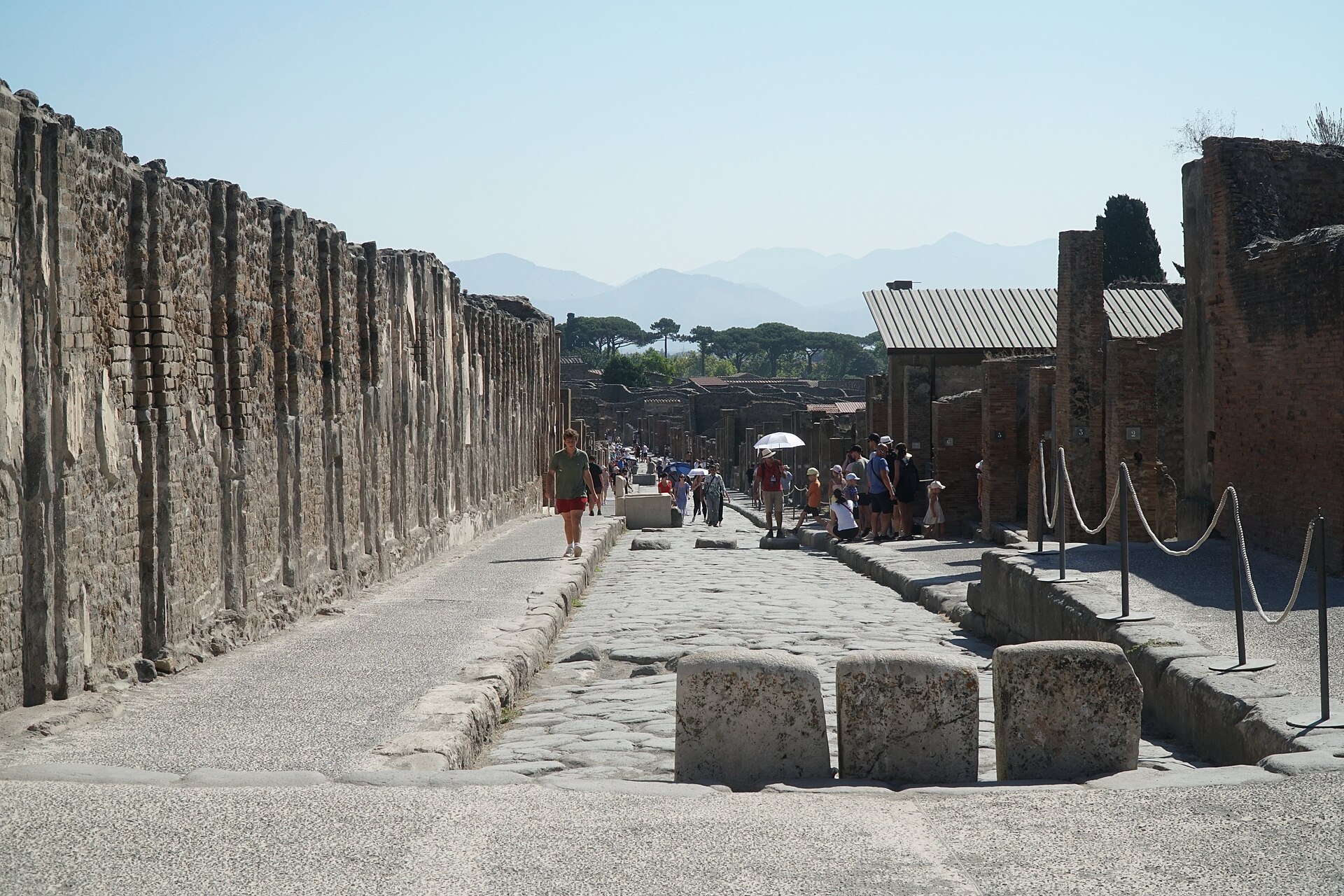
Featured image: the Via dell’Abbondanza, the main street of Pompeii, where this week’s household cupboard was found. Photo: Adam Harangozó, Wikimedia Commons, CC BY-SA 4.0.
This week’s roundup covers 24 to 31 October 2026: the Piprahwa relics carried to Tawang, a Pompeii cupboard with a child’s rattling necklace, a priest’s family tombs at Saqqara, a child’s sarcophagus at Tomis, Denisovans identified in northern China, heated charcoal in Chauvet Cave, eland collagen mixed with ochre, a Texas rock shelter and a Roman colour-changing glass made anew. Each item links to its source.
India and South Asia
The Piprahwa relics travel to Tawang
The bone relics of the Buddha from Piprahwa, kept at the National Museum in New Delhi, were flown by the Indian Air Force on 31 October to Gaden Namgyal Lhatse, Tawang Monastery, in Arunachal Pradesh. They go on public display there from 1 to 7 November, then at the TGL Monastery in Bomdila from 8 to 13 November and the Golden Pagoda in Namsai from 14 to 20 November, before returning to Delhi on 21 November. Piprahwa, in Siddharthnagar district of Uttar Pradesh, is linked with ancient Kapilavastu and the Shakyas. William Claxton Peppé dug its stupa in 1898 and found reliquaries with bone fragments, and the Archaeological Survey of India excavated more relics there between 1971 and 1977. Of the 22 bone fragments from the later digs, 20 are in the National Museum and two in the Indian Museum, Kolkata. Source: Press Information Bureau; DD News.
The Mediterranean and Africa
A household cupboard in Pompeii
In a house on the Via dell’Abbondanza that inscriptions suggest belonged to one Cornelius Maximus, archaeologists have excavated a wooden cupboard and its contents. It held a necklace of at least 24 crepundia, small amulets of bone, glass paste, earthenware and rock crystal, some showing the gods Bes and Mercury and others shaped as tiny hands, feet, pinecones and bunches of grapes. It was probably a child’s protective charm, and its rattle may have helped carers keep track of the child. With it were tweezers, a little glass bottle for perfume or ointment, an incense burner, cooking and other vessels, lead weights in a wooden box and a small woven container of 38 bronze coins. “It is also a place where the most ordinary objects restore the human dimension of the past,” said Gabriel Zuchtriegel, director of the Archaeological Park of Pompeii. Source: Archaeology, 30 October.
A priest’s family at Saqqara
The Czech Institute of Egyptology has found the offering chapel of Ikhetnefert, wife of the high priest Sabu, at his tomb in Saqqara, and has explored the neighbouring tomb of their son Ptahshepses, a 5th Dynasty official who served four kings and married a princess. Auguste Mariette worked here in the nineteenth century but left these tombs unfinished. Sabu’s tomb proves to have been more than 175 feet long, 90 feet wide and about 16 feet high. The chapel holds reliefs of Sabu and Ptahshepses and a false door showing Ikhetnefert with her husband and their sons Ptahshepses and Raneferef. Ptahshepses’ burial chamber was robbed in antiquity, but a limestone sarcophagus there still held human remains, suggesting a man who lived past 60. Source: Archaeology, 28 October.
A child’s sarcophagus at Tomis
Archaeologists from the Museum of National History and Archaeology in Constanța have uncovered an intact Roman sarcophagus in the necropolis of ancient Tomis on Romania’s Black Sea coast. It belonged to a young child and held a well-preserved wooden coffin, clothing, a coin, two pendants, traces of flower garlands and a clay toy rooster with a rattle. It lay beside the road from Tomis to Histria, which may help show how far the cemetery spread along it. Source: Archaeology, 29 October.
Eland collagen in 60,000-year-old ochre
At the Klipdrift Complex in South Africa’s De Hoop Nature Reserve, an international team has found animal collagen mixed into ochre-rich sediments about 60,000 years old. Protein analysis traced it to the common eland. People may have mixed eland products with powdered ochre, or worked ochre-treated hides at this cliffside site. Source: Archaeology, 26 October.
Europe and Asia
Denisovans identified at Xujiayao
A skull fragment and a jaw fragment found at Xujiayao in northern China in the 1970s belonged to Denisovans, according to a study led by Qiaomei Fu of the Chinese Academy of Sciences. The team found 18 proteins in the fossils, including a collagen variant known only in Denisovans, and compared 3D reconstructions of the bones with Neanderthals, modern humans and other hominins. The results point to low, fairly flat, thick-boned skulls with heavy brow ridges, and suggest that other East Asian fossils may also be Denisovan. Source: Archaeology, 27 October; Nature.
Heated charcoal and natural varnish in Chauvet Cave
Philippe Walter, Yohan Boulard and colleagues at Sorbonne University have studied the 37,000-year-old art of Chauvet Cave with ultraviolet fluorescence. The black lines of the Horses Panel lie under a thin skin of calcite that may have protected them like a varnish, while in the Alcove of the Lions calcite formed on bare rock but not on the drawings. An orange glow under some charcoal marks, including torch smears, matched only heated limestone and calcite in the laboratory, which suggests the artists drew with hot charcoal. Source: Archaeology, 30 October; ACS Omega.
The Lycurgus Cup’s colours made again
Lisa Hollands, a technician at the University of Sheffield, has reproduced the dichroic glass of the Lycurgus Cup, the 1,600-year-old Roman cage cup in the British Museum that shows jade green in reflected light and ruby red with light behind it. The effect comes from tiny particles of gold and silver in the glass. After advice from the Roman glass specialist Caroline Jackson and many trials of furnaces, materials and oxygen levels, she found a recipe, and the glass artist Elliot Walker has made a new sculpture of Lycurgus from it, to be shown next month. Source: Archaeology, 27 October.
Song tomb guardians return to China
Australia has returned to China the heads of two Northern Song statues of a civil and a military official, looted from the imperial mausoleums near Kaifeng. The civil official stood at the Yongchang Mausoleum and the military official at the Yongyu Mausoleum. The National Gallery of Australia bought them in 1995, and China asked for their return in 2025. Source: Archaeology, 30 October.
The Americas
Eight thousand years at Schaeffer Shelter
About 3,000 artefacts have come from Schaeffer Shelter in Ceta Canyon in the Texas Panhandle, a rock shelter first found in 1949. The archaeologist Brandon Tully estimates that some are 8,000 to 10,000 years old, though older objects may have been carried there later. Finds include a dolomite pendant, Southwestern pottery, turquoise and marine shell beads, some perhaps from Baja California or the Gulf Coast more than 500 miles away, with bison and deer bones and corn. “We’ve basically been able to prove this was a highway, essentially,” Tully said. Source: Archaeology, 29 October.
New books
Rome’s Age of Revolution
Tim Whitmarsh’s Rome’s Age of Revolution: Augustus, Empire and the Making of Christianity argues that the new faith spread along the roads and cultural networks that Augustus reorganised, and reads its earliest texts against the Roman world that carried them. Source: Jacobin review, 19 October.
The Shortest History of Egypt
Maria Golia’s The Shortest History of Egypt (Black Inc.) surveys 9,000 years, from the deep past of the Sahara to modern Cairo, and links the pharaohs to what came before and after. Source: Australian Book Review, October.
The previous week’s news is in the roundup for 17 to 24 October. If we have missed a story, send it through the contact page and we will look at it for the next roundup.