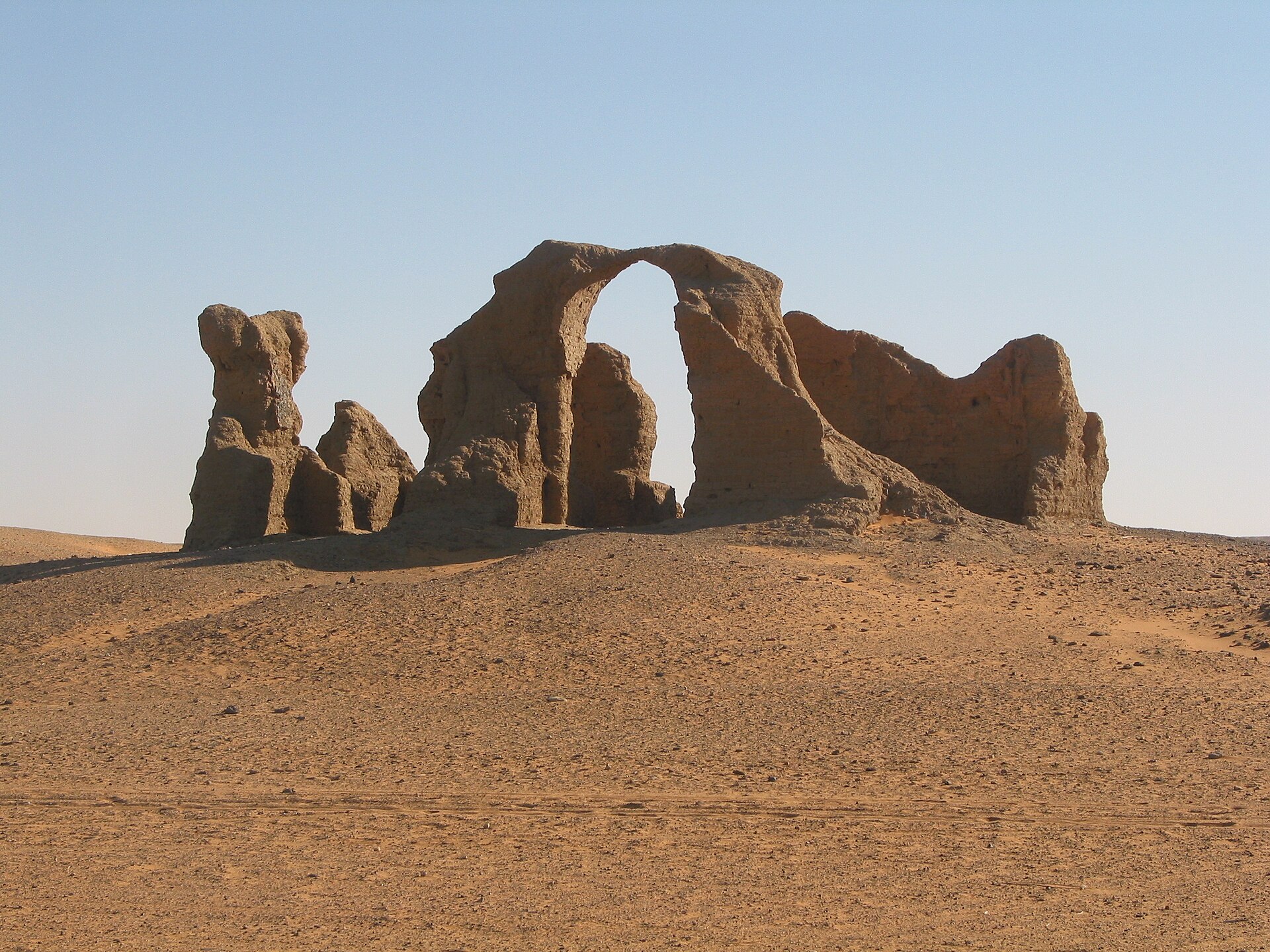
Featured image: the North Church at Old Dongola, Sudan, capital of the Nubian kingdom of Makuria. Photo: Nubian Image Archive, Wikimedia Commons, CC BY 2.0.
This week’s roundup covers 7 to 14 November 2026: a green light to dig for a giant Mauryan stupa at Ujjain, the floor of Nubia’s greatest cathedral, an Old Kingdom official who “never took anything from any man”, a Xiongnu tomb with Roman glass, ancient DNA and the Goths, warhorses in a fifth-century French cemetery, the last megalithic tombs of southern Iberia, mercury in Maya lakes, some of the oldest fired clay in the Near East and a new book on castles. Each item links to its source.
India and South Asia
Digging resumes for the Vaishya Tekri stupa
The Archaeological Survey of India has approved fresh excavation at Vaishya Tekri, a mound in Ujjain district, Madhya Pradesh, nearly ninety years after a dig there was abandoned in 1939 when a reported gas leak left several labourers unconscious. The Gwalior State archaeology report for 1938–39 called the monument “perhaps the biggest known” stupa, about 350 feet across and at least 100 feet high, against roughly 120 feet across for the Great Stupa at Sanchi. A punch-marked coin and an Avanti coin from the old trenches point to the Mauryan period, around the third century BC. Superintending archaeologist Shivakant Bajpai will direct the work, which follows a ground-penetrating radar survey of the mound. Source: The Times of India, 13 November.
Rock art across Tamil Nadu
Field surveys in Tamil Nadu reported three sets of rock art this week. In the Gudiyam forest of Tiruvallur district, a Yaakkai Trust team found paintings in red ochre, white and black, assigned to the Early Iron Age, along with a fourteenth-century inscription recording that a carpenter named Veera Gangathattan dug a spring. At Karadimalai in Villupuram district, red-ochre paintings of deer, a wild boar and a thorny plant are thought to be about 4,000 years old. At Puthur Hills in Virudhunagar district, white paintings of humans, animals and weapons, put at about 3,000 years old, were found in a rock shelter. Source: The Times of India, 9 November; The New Indian Express, 11 November; The New Indian Express, 11 November.
Egypt, Nubia and the Near East
The floor of Nubia’s great cathedral
Excavators in the Great Church of Jesus at Old Dongola in northern Sudan, capital of the Christian Nubian kingdom of Makuria, have reached a section of the cathedral’s original floor for the first time, along with the base of a vast staircase. The church measured about 154 by 187 feet and stood over six storeys high, and probably served as the seat of the Bishop of Dongola. The work is a joint project of the Polish Centre of Mediterranean Archaeology at the University of Warsaw and Sudan’s National Corporation for Antiquities and Museums. “The Great Church of Jesus appears to be a natural candidate for such a role in Nubia, and perhaps even in this part of Africa,” said expedition director Artur Obłuski, comparing it with Hagia Sophia as a building others copied. Source: Archaeology, 9 November; IFLScience.
Khuwy’s autobiography at Saqqara
Inscribed blocks from the tomb of Khuwy, an official buried around 2400 BC in the cemetery around the pyramid of the Fifth Dynasty king Djedkare Isesi at Saqqara, carry one of the earliest known autobiographies. Khuwy says he served under six administrative courts, names Djedkare and Queen Setibhor, boasts “I never took anything from any man”, and warns against harming the tomb. The text is incomplete and partly illegible. The study is published in the Journal of Egyptian Archaeology. Source: Archaeology, 9 November; Journal of Egyptian Archaeology.
Cats of Beni Hassan
A study of 131 skulls from mummified cats taken from Beni Hassan in the nineteenth century and now in the Natural History Museum in Vienna found gum disease in 26, missing teeth in 24 and healed or fatal injuries in 14. Wim Van Neer of the Royal Belgian Institute of Natural Sciences and colleagues suggest the animals were kept in crowded conditions, and that some fatal blows may have been the first step in mummification. Source: Archaeology, 13 November; Journal of Archaeological Science.
Fired clay 11,400 years old at Çemka Höyük
Forty-six fragments of fired clay from house floors at Çemka Höyük, near the Tigris in south-eastern Turkey, have been dated to about 11,400 years ago, among the oldest fired clay in the Near East. Some coated tennis-ball-sized organic objects; others come from thick-walled vessels built from slabs of straw-tempered clay. Black cores and reddish surfaces show short, incomplete firing, which the team, including Ergül Kodaş of Mardin Artuklu University and Rana Özbal of Koç University, read as early experiments. The paper is in Antiquity. Source: Archaeology, 12 November; Antiquity.
East Asia and the Steppe
Roman glass in a Xiongnu tomb
A 240-foot-long tomb in the Duurlig Nars cemetery in eastern Mongolia, dug by the National Museum of Korea, the Mongolian Academy of Sciences and the National Museum of Mongolia, held a lacquered carriage above the burial and more than 45 feet of stacked stone fill. Finds include a clear glass vessel with a handle thought to come from the Roman Empire, fifteen jade pieces resembling Han Chinese ritual discs, and a gourd-shaped silver harness pendant set with rock crystal like those from ancient tombs in what is now North Korea. Source: Archaeology, 12 November; La Brújula Verde.
Britain and Europe
Ancient DNA and the Goths
A Nature study of 712 newly sequenced ancient genomes finds that people of the Wielbark culture in northern Poland, about 2,000 years ago, descend mainly from eastern Scandinavian Bronze Age and Swedish Iron Age populations. The authors say this supports the Gothic origin story told by Jordanes in the sixth century, of a migration from Scandza. Later Goths sampled in Ukraine and Spain carry mostly local ancestry, which suggests Gothic identity spread partly by adoption. “We have to … admit the sources knew more than we thought they did,” Yale historian Noel Lenski told Science. The story, first reported on 4 November, drew wide discussion on X this week. Source: Nature; Science, 4 November.
Warhorses near Colmar
INRAP archaeologists have excavated a cemetery near Colmar in north-eastern France used between about AD 450 and 500, with the graves of 11 adults, three children and two horses buried in their harness. Women were buried with silver bird brooches and glass beads; men with a sword, shield and javelin, and one with a scramasax fitted with gold and garnet. Two men had unhealed stab wounds. Source: Archaeology, 10 November; Live Science.
The last megaliths of Cape Trafalgar
Radiocarbon dates show two stone tombs on Cape Trafalgar in Cádiz were used between about 1875 and 1625 BC, centuries after single graves had become usual in southern Iberia. They held at least 13 and seven people, with gold earrings, silver beads, an ivory comb and a copper arrowhead. Eduardo Vijande-Vila of the University of Cádiz and colleagues publish in PLOS One. Source: Archaeology, 13 November; PLOS One.
An early Christian stone under Rob Roy
3D imaging of Rob Roy MacGregor’s grave slab at Balquhidder shows a cross-like design, possibly a flabellum, and two small crosses in early Christian style, suggesting the stone was first carved for a cleric up to a thousand years before Rob Roy died in 1734. The sword, tongs and hunting scene were added in the fifteenth or sixteenth century. Source: Archaeology, 9 November; The National.
Frogs in the Fens, eaten by owls
More than 8,000 frog bones from a roundhouse ditch in the Cambridgeshire Fens, once linked to talk of an Iron Age frog cult, have been dated to about 1,700 years ago and show no cut marks. Paul Clarkson of Bournemouth University and colleagues match the breakage to short-eared owls and hen harriers. “The mystery of these frogs has been solved,” Clarkson said. Source: Bournemouth University, 10 November; Environmental Archaeology.
Noaillian hunters in Italy earlier than thought
New digging at Riparo Mochi, a rock shelter near the French border, recovered more than 7,500 artefacts, including a hearth ringed with marine shells dated to 30,000 to 30,800 years ago. Wear on Noailles burins shows their edges cut skin and meat. Fabio Santaniello of the University of Trento and colleagues say this puts Noaillian hunter-gatherers in northern Italy 2,000 to 3,000 years earlier than thought. Source: Archaeology, 11 November; Journal of Archaeological Science: Reports.
The Americas
Mercury in Maya lakes
Lake cores from Coba and Xcach on the Yucatán Peninsula show mercury spikes, at Coba from about AD 250 for some 150 years, and at Xcach between AD 125 and 200, around 250, and again between 535 and 820. The Maya used cinnabar, a mercury ore, as a red pigment. Matt Waters of Auburn University says levels exceeded modern limits for centuries and reached the lakes’ food chains. The study is in Science Advances. Source: Archaeology, 10 November.
A Nazca infant with cyclopia
A Nazca cemetery in southern Peru dated AD 325 to 440 held a ceramic vessel with two infant girls, not maternally related. One had cyclopia and an extra copy of chromosome 13, which may explain the condition, report Elsa Tomasto-Cagigao of the Pontifical Catholic University of Peru and colleagues in PNAS. Source: Archaeology, 12 November; PNAS.
El Niño without war in Lambayeque
A study of more than 1,600 people buried in Peru’s Lambayeque Valley between about 1500 BC and AD 1500 found no statistical link between El Niño stress and violent or accidental injuries. Thomas Snyder of New York University and Haagen Klaus of George Mason University suggest communities turned to the sea for food instead. Source: Archaeology, 13 November; Frontiers in Environmental Archaeology.
New books
Castles: A Fortified History of the World
Dan Jones’s new history of fortification (Viking, published 3 November in the US) runs from Troy, Iron Age hillforts and the walls of Constantinople to the nuclear age. Source: Altoona Mirror review, 13 November.
The previous week’s news is in the roundup for 31 October to 7 November. If we have missed a story, send it through the contact page and we will look at it for the next roundup.