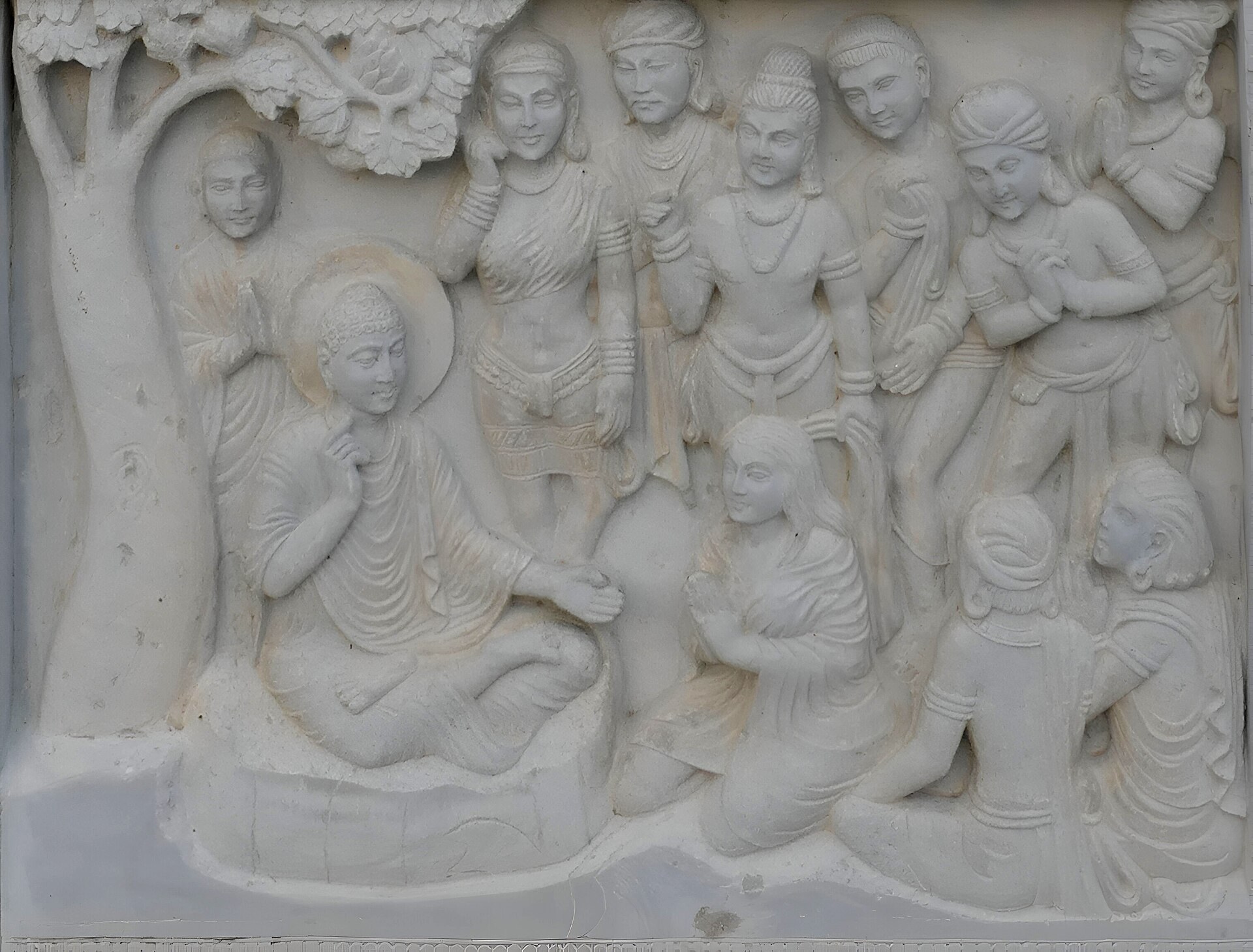
Image: Paṭācārā learns the truth from the Buddha, modern drum relief at the Buddhavanam stupa, Telangana. Photograph by Ānandajoti Bhikkhu, CC BY-SA 4.0, via Wikimedia Commons. A modern depiction of the commentary legend.
A tower of seven floors could not hold her;
a river in flood took all she had;
she poured a little water on the ground at dusk,
and drew the wick down into the dark.
The Girl on the Seventh Floor
Of a merchant’s daughter, a servant, and a waterpot at dawn.
In those days Sāvatthī was the chief city of the Kosalans, where Pasenadi ruled, as readers of his tale know. Among its merchants was one of very great wealth, and he had a daughter, and her name was Paṭācārā. She was exceedingly beautiful, so later tellers say. When she was about sixteen her parents gave her rooms at the top of a palace seven storeys high and set guards about her, so that no young man might come near.
Yet she loved a servant of that house. And when her parents promised her to a young man of her own standing and fixed the wedding day, she said to her lover, “if you really love me, don’t delay an instant, but find some way or other of getting me out of this place.”
So he waited for her at the city gate. Early in the morning she put on soiled garments, let down her hair, smeared her body with red powder, and took a waterpot in her hand, and went out among the slave-girls as though she were going to fetch water. The two went a long way off and made their home in a village. There the husband tilled the soil and gathered wood in the forest, and she who had once been waited upon fetched water, pounded the rice with her own hands, and did the cooking.
The Road to Sāvatthī
Of two births by the wayside, a storm out of season, and an anthill.
When her first child was near, she begged her husband to take her home. “Here I have no one to help me. But a mother and father always have a soft spot in their heart for their child.” He would not go, for he feared what her parents would do to him. So one day she shut the door of the house and set out alone, and he followed her. On the road the pains came upon her, and she bore a son in a clump of bushes. “What I set out to go home for is over,” she said, and they turned back.
When a second child was near it happened again, and she set out with her elder son on her hip. Then a storm arose out of due season. The sky blazed with lightning and the rain fell without ceasing. Her husband went with his axe to find stuff for a shelter, and as he cut brushwood growing on an anthill a poisonous snake slipped out and bit him, and he fell dead where he stood.
All night she crouched over her two sons in the wind and rain, and at dawn she set the newborn on her hip, gave the elder one of her fingers to hold, and said, “Come, dear child, your father has left us.” At the anthill she found him lying dead. “All on account of me,” she said, “my husband has died upon the road.”
The River in Flood
Of a hawk, a cry across the water, and smoke over the city.
She came to the river Aciravatī, swollen with the night’s rain. Too weak to carry both children, she left the elder on the near bank and bore the baby across, and laid him on a spread branch. She had barely reached midstream on her way back when a hawk stooped upon the child, taking him for a piece of meat. She raised both hands and screamed, “Begone, begone!” The elder boy saw her and heard her, and thinking she called him, he stepped into the water, and the current took him.
On the road she met a man coming from Sāvatthī, and she asked him of her father’s house. For a long time he would not answer. At last he told her that in the night the storm had overturned that house upon the rich man, his wife and his son. “Look there, my good woman! You can see the smoke now.”
Then her mind gave way. Her clothing fell from her and she knew it not, and she wandered round and round, weeping. Those who saw her yelled, “Crazy fool! Crazy fool!” and pelted her with rubbish and clods of earth.
In the Jeta Grove
Of a cloak thrown by a stranger, and the water of four oceans.
The Buddha was then dwelling at the Jeta Grove outside the city, in the park that readers of the Anāthapiṇḍika chapter know. He saw her coming from afar. When his disciples cried out to keep the madwoman away, he said, “Depart from me; forbid her not.” And when she came near he said to her, “Sister, return to your right mind.”
It is told that her wits returned in that moment. She saw that she was naked and crouched upon the ground, and a man threw her his cloak. Then she bowed at the Teacher’s feet. “Venerable Sir, be my refuge, be my support,” she said, and told him all that the night had taken.
The Buddha heard her out. He told her that through the long round of births she had shed for those she loved tears more abundant than the waters of the four oceans, and he gave her a verse: “Children are not a true refuge, nor fathers, and not kin.” As he spoke her grief grew less, and she asked to go forth. He sent her to the nuns, and she became a bhikkhunī, a nun.
Water Running Downhill
Of an evening, a foot-bath, and a lamp drawn down.
Her own verses are kept among the songs of the elder nuns, and they tell of no storm and no river. They begin with men in the fields. “Plowing the fields, sowing seeds in the ground, providing for partners and children, young men acquire wealth.” She had kept the precepts, she says, and done the Teacher’s bidding, neither lazy nor restless, and still asked herself, “why then do I not achieve quenching?” The word was nibbāna, the quenching of a fire.
One evening she washed her feet and watched the water, “flowing from high ground to low.” Her mind grew still, “like a fine thoroughbred steed.” Then she took a lamp and went into her dwelling, looked over the bed, and sat on her cot. “Then, grabbing the pin, I drew out the wick.” The flame went out, and her release, she sings, “was like the quenching of the lamp.”
Later tellers add that she poured the water three times. The first ran a little way and sank into the earth, the second a little farther, the third farther still. She thought of beings who die in youth, in their prime and in old age. And they say the Teacher sent forth an image of himself to stand before her and spoke a verse: “One might live for a hundred years without seeing rise and fall, but a life of one day’s better for the one seeing rise and fall.”
I am Paṭācārā, and I will tell you of the evening I washed my feet. I had kept the precepts and done the Teacher’s bidding, and still I had not found the quenching. I watched the water run from high ground to low, and my mind grew steady as a good horse. Then I took my lamp into my dwelling and sat on my cot, and with a pin I drew down the wick. As the lamp was quenched, so was my heart set free.
Keeper of the Discipline
Of a nun first in the monastic law, and thirty who washed their feet.
In time the Buddha named those among his followers who stood first in some gift. Khemā, whose tale readers of these chronicles know, he named first in great wisdom. And first among the nuns “who have memorized the monastic law,” he said, “is Paṭācārā.” The word was vinayadhara, one who holds the vinaya, the discipline by which the Order lived.
She became a teacher of many. Thirty nuns remembered her words. “Do the Buddha’s bidding, you won’t regret it. Having quickly washed your feet, sit in a discreet place to meditate.” They did as she said. In the first watch of the night they recalled their past lives, in the middle watch they purified their clairvoyance, and “in the last watch of the night, they shattered the mass of darkness.” In the morning they bowed at her feet: “we shall abide honoring you, as the Thirty gods honor Indra, undefeated in battle.” Another nun, Uttarā, kept a line more of the same teaching: “Examine conditions as alien, not as self.”
Candā had been a childless widow without friends or kin, begging from house to house with bowl and staff for seven years. She saw a nun receiving food and drink and asked to go forth. “Out of sympathy for me, Paṭācārā gave me the going forth.” Then she urged her on to the highest goal, and Candā called her ayyā, “the lady”. “The lady’s advice was not in vain,” she sang.
The Mothers
Of women who had lost their sons, and an arrow drawn from the heart.
It is told also that five hundred women came to her who had each lost a son, and sat before her weeping. To each of them she spoke. “One whose path you do not know, not whence they came nor where they went; though they came from who knows where, you mourn that being, crying, ‘Oh my son!’” And again: “Unasked he came, he left without leave.”
They went forth under her, the story runs, and in time each of them sang, “Oh! For you have plucked the arrow from me, so hard to see, stuck in the heart.”
I am Paṭācārā, and I will tell you what I said to the mothers who came to me weeping for their sons. I told each of them that she did not know the path by which her son had come, nor the path by which he had gone. Unasked he came, and he left without leave. As he came, so he went. The thirty who washed their feet and sat apart did as I bade them, and so did Candā, who had begged for seven years.
Of the rest of Paṭācārā’s days, and of her death, nothing is told.
The truth behind the tale
The early Pāli texts on Paṭācārā are few. AN 1.238 ranks her first among the nuns who have memorized the monastic law. Her own verses, Therīgāthā 5.10 (verses 112–116), tell only of the foot-washing water and the lamp. Thig 5.11 (the thirty nuns), 7.1 (Uttarā) and 5.12 (Candā) credit her teaching, and Thig 6.1 is the song of five hundred nuns titled after her. Quotations from these are Bhikkhu Sujato’s translations, some shortened.
Everything in the first four scenes is commentary: the seven-storey palace, the servant, the storm, the deaths of husband, sons, parents and brother, her madness and the meeting at the Jeta Grove. It comes from the Dhammapada commentary (on verse 113), compiled around the 5th century CE, quoted here from E. W. Burlingame’s translation as revised by Ānandajoti Bhikkhu; the Therīgāthā and Aṅguttara commentaries tell it with small changes, and the Therī Apadāna, a later canonical collection, tells it too. The three pourings of water and the radiant image are from the same commentary. The scene of the mothers rests on the Therīgāthā commentary, which says the first four verses of Thig 6.1 were hers, spoken to grieving women.
Scholars have long noted a puzzle. The verses kept under the name of another nun, Kisāgotamī (Thig 10.1), speak in the first person of a husband dead on the road, a birth on the way home, two sons dead and parents and brother on one pyre. K. R. Norman suggested that the story has become attached to the wrong nun; Haoqin Zhong traces how Chinese and Tibetan versions give it to Kisāgotamī or Uppalavaṇṇā instead. The commentaries also disagree about her name: going about without a cloth (paṭa), “fallen conduct”, or, in the Dhammapada commentary, a happy demeanour.
If Paṭācārā lived, she was a contemporary of the Buddha, whose dates are disputed: about 480 to 400 BCE on the chronology many scholars now favour, or some eighty years earlier on the older reckoning. No inscription or find in the ground can be tied to her.
Imagined voice: the italic passages in which Paṭācārā speaks in the first person are imagined. They are built only from the texts and studies named here, add no events, and are not quotations.
Sources
- Bhikkhu Sujato (trans.), Therīgāthā 5.10, Paṭācārā, SuttaCentral. Quotations in the scene of the water and the lamp.
- Bhikkhu Sujato (trans.), Therīgāthā 5.11, Thirty Nuns, 5.12, Candā, 6.1, Five Hundred Students of Paṭācārā, 7.1, Uttarā and 10.1, Kisāgotamī, SuttaCentral.
- Bhikkhu Sujato (trans.), Aṅguttara Nikāya 1.235–247, SuttaCentral. Khemā foremost in great wisdom (AN 1.236), Paṭācārā foremost in the monastic law (AN 1.238).
- Pāli texts, SuttaCentral (Mahāsaṅgīti edition): nibbāna and the lamp (Thig 5.10); vinayadhara (AN 1.238, vinayadharānaṁ); ayyā (Thig 5.12, ayyāyovādo); bhikkhunī (Thig 5.11, 5.12).
- E. W. Burlingame (trans.), rev. Ānandajoti Bhikkhu, Dhammapada Commentary 8.12, The Story about the Elder Paṭācārā, Ancient Buddhist Texts. All quotations in the first four scenes, the three pourings of water and the verse of a hundred years.
- Dhammapāla, Therīgāthā-aṭṭhakathā, Pañcasatamattātherīgāthāvaṇṇanā (Pāli text, Thai edition, vol. 34). The grieving mothers and the attribution of Thig 6.1, verses 127–130, to Paṭācārā.
- Haoqin Zhong, “The Vicissitudes of the Story of Therī Paṭācārā: From Early Buddhism to the Mahāyāna”, Hualin International Journal of Buddhist Studies 6.1 (2023): 277–335. The overlap with Kisāgotamī’s verses, K. R. Norman’s proposal, the Apadāna and the commentaries’ explanations of her name.
- Hellmuth Hecker, trans. Sister Khema, Buddhist Women at the Time of the Buddha, Wheel 292/293 (Buddhist Publication Society, 1982), Access to Insight. A modern retelling of the commentary legend.