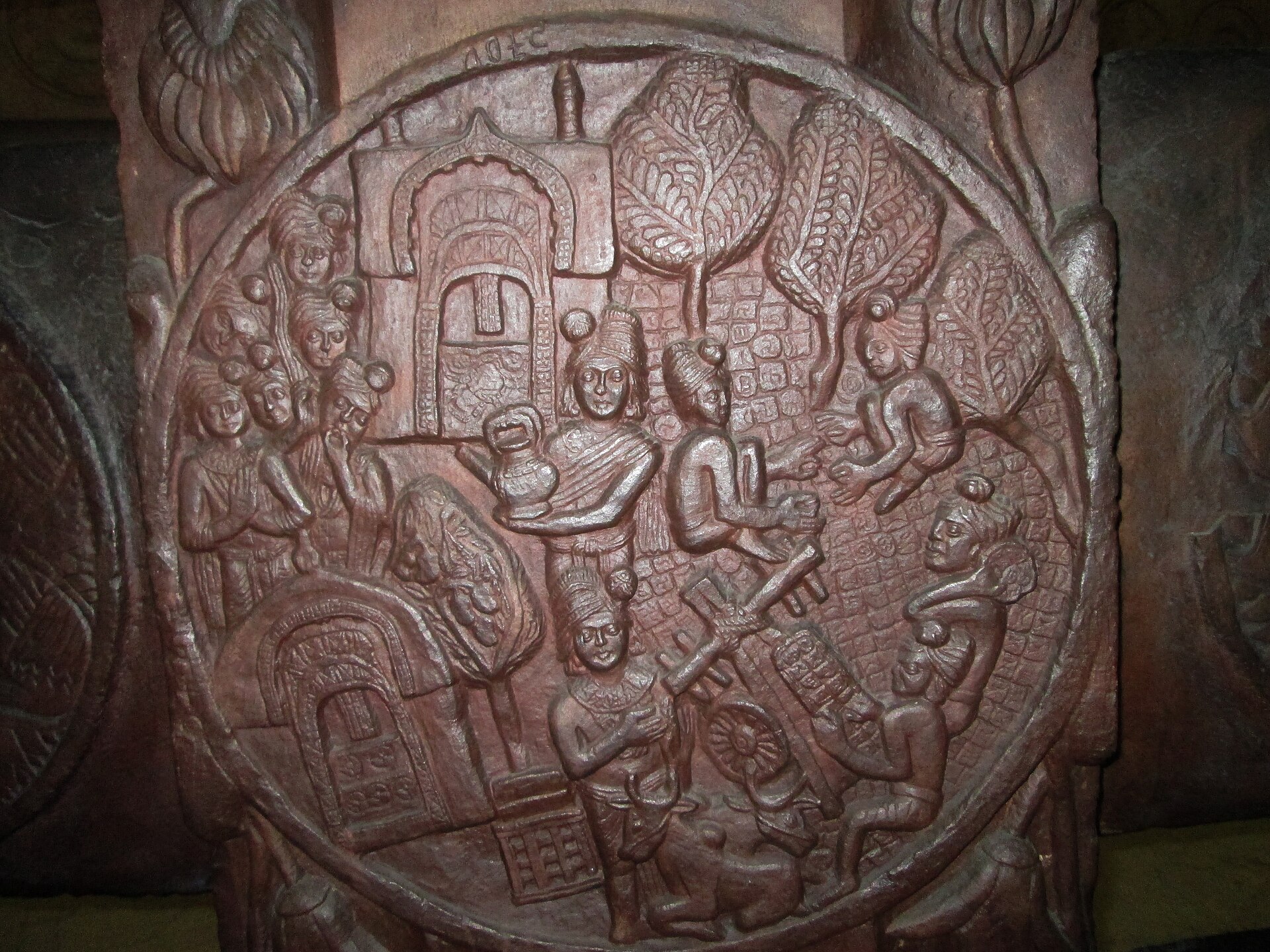
Image: The Jetavana medallion from the Bharhut stupa, 2nd–1st century BCE, Indian Museum, Kolkata. Photo Dharma (Anandajoti Bhikkhu), CC BY 2.0, via Wikimedia Commons.
Gold on the grass of the prince’s park,
cart after cart in the sun;
a gate left bare for a giver’s name,
and a banker’s long road run.
The Field of Gold
Of a prince’s park, covered coin by coin.
Outside Sāvatthī, in the old days, the carts kept coming. Load upon load of gold coins was brought out and spread across Prince Jeta’s park, until the ground lay hidden beneath a skin of metal. And the man who paid for it all was a banker named Sudatta, better known as Anāthapiṇḍika. He was spending a fortune on a garden for a teacher he had first met on a journey of trade.
It began, it seems, as a bluff. When Anāthapiṇḍika asked to buy the park, the prince answered: “I wouldn’t give it away even if you covered the park with ten million gold coins.” “It’s a deal!” said the banker. “No it isn’t!” said the prince. So they took the matter to judges, who ruled: “Sir, since you gave a price, the park is sold.”
Now only a small patch near the entrance lay bare, and Anāthapiṇḍika sent his men back for more. Jeta watched, and thought, “This must be really worthwhile, as he’s giving up so much money.” So he stayed them: “That’s enough, householder, don’t cover that area. Let me keep it. It will be my gift.” Anāthapiṇḍika reflected that it is “very beneficial” when well-known people gain confidence in the path; and he agreed. And on that spot Prince Jeta built a gatehouse.
I am Sudatta of Sāvatthī, and men call me Anāthapiṇḍika. Do not think the gold was a burden to me. I counted it out gladly, and when the prince asked for the last patch by the gate, I let him have it. A gift from a prince brings others to the path.
The Road to Rājagaha
Of a city of three roads, a busy brother-in-law, and a night of three wakings.
Sāvatthī (Sanskrit Śrāvastī) lay near the Rapti river, in what is now Uttar Pradesh. It was the capital of Kosala, a prosperous trading town where three great roads met. He was a gahapati, a householder, and so monks and princes address him; a seṭṭhi was a leading banker-merchant, and Anāthapiṇḍika’s byname means “feeder of the destitute”.
Yet his tale truly begins in another city. Readers of the Bimbisāra chapter will know Rājagaha, capital of Magadha. Anāthapiṇḍika had a brother-in-law there, a wealthy merchant. Coming there on business, he found this man, who would ever drop all else to greet him, hurrying about and giving orders to his household. Anāthapiṇḍika asked whether there was a wedding, or whether he had invited “King Seniya Bimbisāra of Magadha and the army”. No, said the merchant: he had invited the Buddha and his monks to tomorrow’s meal.
“Did you say, ‘Buddha’?” Anāthapiṇḍika asked, three times over. That night he rose three times, “thinking it was light”. At last he set out. The Sivaka gate was opened for him by spirits; but beyond it the light went out, and fear took hold of him. Then an unseen spirit, Sivaka, called out that a hundred thousand jewelled maidens “are not worth a sixteenth part / of a single forward stride!”. His road led to the Cool Grove, Sītavana. Later tellers said it held a cemetery that was “filling with fear”. And at first light he found the Buddha walking there. The Buddha greeted him: “Come, Sudatta.”
Three times I woke in that house, thinking it was dawn. When I went out, the dark came down on me beyond the gate and I was afraid. A voice told me to go forward, and I went. And at the end of the road the teacher called me by my own name.
By the end of the teaching he had become a lay follower. Then he would pay for a meal himself, and turned away offers of help from his brother-in-law, from the householders of the city, and even from Bimbisāra: “There’s no need, sir. I have the means.”
The date hangs upon the Buddha’s. Scholars have been divided between setting his death around 480 BCE and setting it as much as a century later.
The Receipt
Of two names kept together, and teaching for those who handle money.
Many of the old discourses open with the same words: the Buddha was “staying near Sāvatthī in Jeta’s Grove, Anāthapiṇḍika’s monastery.” The name of the prince who sold the land and the name of the banker who paid for it are kept together, as in a receipt. Then the banker built dwellings, halls, wells, saunas, ponds and walking paths. And when he asked the Buddha what to do with the grove, the answer was to give it “to the Sangha as a whole, both present and future.” The Buddha named him foremost among his lay disciples “as a donor”.
He drew forth also a particular kind of teaching: counsel for those who work and handle money. In AN 4.62 the Buddha speaks to him of four kinds of happiness a householder may earn: ownership, the use of wealth, freedom from debt, and blamelessness. The wealth in question is to be “gathered by the sweat of the brow”. AN 5.41 gives him five good reasons to grow rich, among them the support of family, servants and friends, and ends by saying that if such riches run out, the giver “has no regrets”.
Earlier we met Āmrapālī, who gave her mango grove at Vesālī. Anāthapiṇḍika bought his grove at enormous cost.
The Last Teaching
Of a great giver on his sickbed, and a god in the grove.
MN 143 tells of his death. He lies gravely ill, and sends for Sāriputta, who comes with Ānanda. Calling him bhante, “Honourable Sāriputta”, Anāthapiṇḍika speaks of his pain with startling honesty: it is like “a strong man drilling into my head with a sharp point.” Sāriputta teaches him to let go of all things: eye, ear, this world, the next. And the great benefactor bursts into tears. Ānanda asks whether he is sinking. No, he says. In all his years of serving the monks he has “never before heard such a Dhamma talk.” Then comes a banker’s plea for a wider audience: “let such Dhamma talk strike when teaching white-clothed laypeople as well!”
Soon afterwards he died. Late that night, it is told, he returned as a shining god, “lighting up the entire Jeta’s Grove”. And his verse is a strange one for a banker: people are purified “not by clan or wealth.”
What we actually know, and what we don’t
Text. The Rājagaha meeting and the purchase come from the Vinaya (Cullavagga VI.4, Senāsanakkhandhaka), and the night walk is also told in SN 10.8. His deathbed is MN 143, and he is named in many Aṅguttara suttas. These texts were passed down orally for centuries, so their details (ten million coins, helpful spirits) are the tradition’s telling, not an audited account.
Commentarial and later tradition, clearly labelled. Everything in this paragraph comes from commentaries and Jātaka stories written centuries later, as gathered by Malalasekera and retold in Hellmuth Hecker’s Wheel booklet. In these stories the sums grow to eighteen crores each for the land, the buildings and the festival. His generosity reduces him to poverty. A spirit living over his gate objects to the monks’ visits, is expelled, and wins her way back by recovering his lost fortune. His daughters are models of devotion. His worldly son Kāla is bribed with a thousand coins to keep a fast-day and then to listen to the Buddha, and in the end he refuses the money. A daughter-in-law, Sujātā, is described as the sister of Visākhā, the great woman patron of Sāvatthī. The commentaries also claim that he never asked the Buddha a question, so as not to tire him. The detail that the grove held a cemetery is commentarial too.
Archaeology. None of this dates from his own lifetime. The earliest evidence is a medallion on the railing of the Bharhut stupa, which the Indian Museum, Kolkata, dates to about the 2nd–1st century BCE. It shows an unyoked bullock cart and men laying square coins. Its inscription reads jetavana anadhapediko deti kotisamthatena keta, which Pia Brancaccio translates as “Anadhapedika gives the Jetavana after buying (it) with a layer of crores”. That is centuries after him, but it shows the story was already famous. At Saheth-Maheth, Alexander Cunningham identified Jetavana and Śrāvastī in 1862–63. Later ASI excavations followed, including nine seasons in 1986–95 with Kansai University, Japan. They exposed stupas, monasteries and the city’s rampart, but nothing found so far names the banker or can be tied to him.
Where the story’s details come from. The purchase of Jeta’s Grove and the buildings follow the Vinaya, Cullavagga VI.4, in Bhikkhu Brahmali’s translation; the night walk past the Sivaka gate follows SN 10.8 in Bhikkhu Sujato’s translation, and the cemetery in the Cool Grove comes from the commentaries. The Buddha names him foremost donor at AN 1.248–257. “Feeder of the destitute” is Malalasekera’s gloss (Dictionary of Pāli Proper Names); Sāvatthī as Kosala’s capital and the divided dating of the Buddha are as given by Encyclopaedia Britannica.
Imagined voice: the italic passages in which Anāthapiṇḍika speaks in the first person are imagined. They are built only from the texts and studies named here, add no events, and are not quotations.
Sources (lightly noted)
- Vinaya, Cullavagga VI.4 and VI.9 (pli-tv-kd16), trans. Bhikkhu Brahmali, SuttaCentral.
- SN 10.8, MN 143, AN 1.248–257, AN 4.62 and AN 5.41, trans. Bhikkhu Sujato, SuttaCentral.
- G. P. Malalasekera, Dictionary of Pāli Proper Names: “Anāthapiṇḍika”, “Sītavana”, “Kāḷa”; Hellmuth Hecker, Anathapindika: The Great Benefactor (Wheel 334), Access to Insight.
- Pia Brancaccio, “Art and Performance in the Buddhist Visual Narratives at Bhārhut” (Journal of Indian Philosophy, 2022); Indian Museum, Kolkata, Bharhut Gallery.
- Encyclopaedia Britannica, “Shravasti” and “Buddha”; ASI Excavation Branch, Patna, and Rees & Yoneda (World Archaeology, 2013) on Saheth-Maheth.
- Vinaya, Cullavagga VI.4 (Khandhaka 16) and MN 143, Pāli texts, SuttaCentral: the address gahapati, bhante Sāriputta, the Sivaka gate and the Sītavana.
Myth and text flagged throughout: the cold open and night walk follow the Vinaya and SN 10.8; the lost fortune, the gate spirit, Kāla’s bribe and the family stories are marked as commentarial; Bharhut and Saheth-Maheth are later evidence; all dates are approximate.