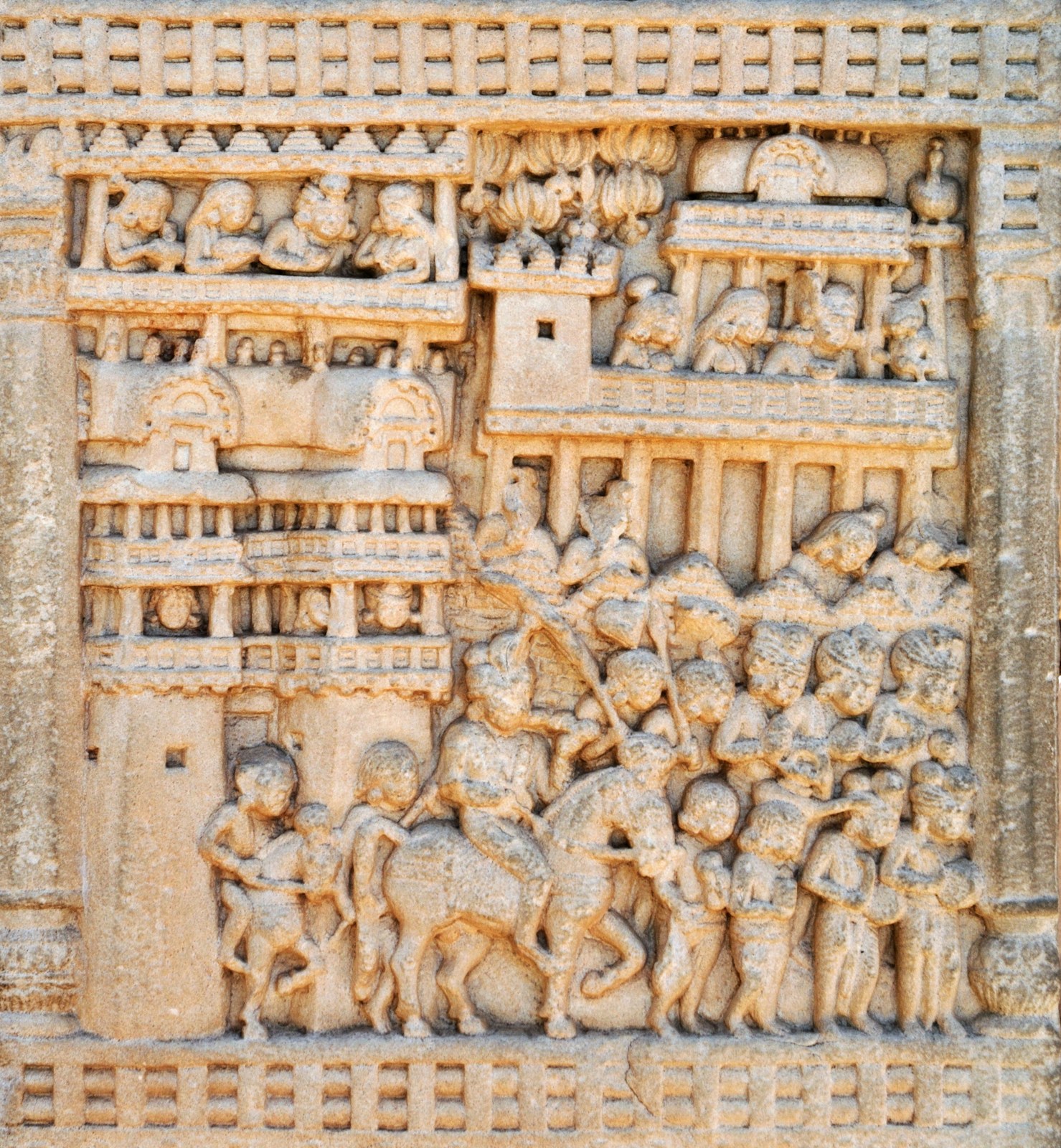
Image: Procession of King Pasenadi (Prasenajit) of Kosala leaving Sāvatthī to meet the Buddha, as the panel is usually identified; relief on the north gateway of Stupa 1, Sanchi, late 1st century BCE or early 1st century CE. Biswarup Ganguly, CC BY 3.0, via Wikimedia Commons. A later depiction.
The river came down from the hills
and ran beneath the palace wall;
an old king set his sword aside
and knocked, and spoke his name.
The Young Teacher
Of a king who doubted youth, and four things that should not be scorned.
In those days the realms of Kosala and Kāsi lay broad upon the northern plain, and their royal seat was Sāvatthī, by the river Aciravatī. There ruled Pasenadi. It is told that as a prince he had gone far to the north-west to study at Takkasilā, beside Mahāli of the Licchavis and Bandhula of the Mallas, and that when he came home his father was so pleased with his learning that he made him king.
Outside the city lay Jeta’s Grove, where the teacher whom men called the Buddha often stayed. Thither the king went one day, and when the greetings were done he sat to one side and asked him plainly, “Does the worthy Gotama claim to have awakened to the supreme perfect awakening?”
“If anyone should rightly be said to have awakened to the supreme perfect awakening, it’s me.”
The king was not easily won. Pūraṇa Kassapa and Gosāla and the other famous founders of his day had made no such claim. “So why do you, given that you’re so young in age and newly gone forth?”
“Great king, these four things should not be looked down upon or disparaged because they are young,” said the Buddha, and his word for the king was mahārāja, “Great King”. He named them: a prince of noble birth, a serpent, a fire and a monk. A small fire, once it has fuel, may become a great burning.
Pasenadi heard him out, and then he gave his answer. “From this day forth, may the Buddha remember me as a lay follower who has gone for refuge for life.”
A Bucket of Rice
Of a king who ate too much, and a verse spoken at every meal.
In the years that followed he came often to the Buddha, and he called him bhante, “sir”, as a layman speaks to a monk. For a time he ate boiled rice by the bucketful, and once he came to the Buddha huffing and puffing after his meal. The Buddha spoke a verse to him: “When a man is always mindful, knowing moderation in eating, his discomfort fades, and he ages slowly, taking care of his life.”
Behind the king stood a young brahmin named Sudassana. “Please, dear Sudassana, memorize this verse in the Buddha’s presence and recite it to me whenever I am served a meal,” said Pasenadi, calling him tāta, “dear”, and he promised him a hundred kahāpaṇa coins every day. So at every meal the verse was spoken, and little by little the king came down to a cup of rice. His body slimmed, and stroking his limbs he said, “In both ways the Buddha has sympathy for me: in the good of this life and the good of lives to come.”
Mallikā in the Upper Chamber
Of a queen who would not flatter, and a daughter born.
His chief queen was Mallikā. One day the two of them sat together upstairs in the royal longhouse, and the king asked her, “Mallikā, is there anyone more dear to you than yourself?”
“No, Great King, there isn’t. But is there anyone more dear to you than yourself?”
“For me also, Mallikā, there’s no one.”
Down the stairs he went, and out to the Buddha, and told him all. And the Buddha answered with a verse: “Having explored every quarter with the mind, one finds no one dearer than oneself.” Since every other person holds themselves just as dear, he said, one who holds himself dear should harm no other.
Another day, as he sat with the Buddha, a man came and whispered in his ear, calling him deva, “Your Majesty”: “Your Majesty, Queen Mallikā has given birth to a daughter.” The king’s face fell. And the Buddha said to him, “Well, some women are better than men, O ruler of the people.” That daughter was the princess Vajirī.
I am Pasenadi, king of Kosala, and I will tell you of my queen. We sat upstairs in the longhouse, and I asked Mallikā whether anyone was dearer to her than herself. She said there was no one, and asked me the same, and I had to give her the same answer. I went down and told the Blessed One, and he answered with a verse: that one who searches every quarter with the mind finds no one dearer than oneself, and so one who holds himself dear should harm no other.
The Mountain from the Four Quarters
Of a nephew taken in battle, a grandmother of a hundred and twenty, and a mountain that reached the clouds.
War came to him from Magadha. His nephew Ajātasattu marched into Kāsi, and in one battle Pasenadi was beaten and fell back to Sāvatthī. In another he broke his nephew’s army and took him alive. “Even though I’ve never betrayed this King Ajātasattu, he betrayed me. Still, he is my nephew,” he thought, and he let him go with his life.
Griefs came too. “Sir, my grandmother has passed away,” he said one noon. She was a hundred and twenty years old, and if giving away his elephant or his horse or the whole country could have bought her back, he would have given it. In time a man whispered to him that Queen Mallikā was dead, and he sat with his shoulders drooping and had nothing to say.
Once, when again he came at noon from the business of kings, the Buddha bade him suppose that trusted men came from the east and the west, the north and the south, each telling of “a big mountain that reached the clouds”, coming this way and crushing all creatures. He asked the king what he would do.
“Sir, what could I do but practice the teachings, practice morality, doing skillful and good actions?”
“I tell you, Great King, I announce to you: old age and death are advancing upon you.”
Foreign Cloth by the Aciravatī
Of an elephant called Single Lotus, an elder on the riverbank, and a gift that overflowed.
When no Buddha was near, he sought out a disciple. One noon he rode out on his elephant named Single Lotus and met Ānanda, and on the bank of the Aciravatī, pleased with the elder’s answers, he offered him a foreign cloth sent by Ajātasattu, sixteen measures by eight. Ānanda said his three robes were complete. “Sir, we have both seen this Aciravatī River when it has rained heavily in the mountains, and the river overflows both its banks,” said the king. So the elder might make new robes and give his old ones to his brothers, and the gift would overflow. Then Ānanda took it. “Well, now, sir, I must go. I have many duties, and much to do,” said the king, as he so often said. Once, too, at the village of Toraṇavatthu, he sat before the nun Khemā, whose own tale is still to come.
Shrines to the Teaching
Of roots of trees, a closed door, and a king of eighty.
The years went by. He came on some business to a town called Nagaraka, and drove out to a park with his general, Dīgha Kārāyana. Walking there, he saw the roots of great trees, quiet and still, far from the crowd, and they reminded him at once of the places where he used to pay homage to the Buddha. “My good Kārāyana, where is that Buddha at present?”
“Great king, there is a Sakyan town named Medaḷumpa.” It was three leagues off, and they might reach it while it was still light.
So the chariots rolled out across the evening country, and they came to the monastery before the light was gone. The monks showed him a dwelling with its door shut: “Approach it quietly, without hurrying; go onto the porch, clear your throat, and knock on the door-panel.” There the king gave his sword and his turban, uṇhīsa, to Dīgha Kārāyana and went on alone. He knocked, and the Buddha opened the door.
Pasenadi went in and bowed his head to the Buddha’s feet, covering them with kisses and stroking them with his hands, and he cried out his name: “Sir, I am Pasenadi, king of Kosala! I am Pasenadi, king of Kosala!”
“But, Great King, for what reason do you demonstrate such utmost deference for this body, conveying your manifest love?”
Then the old king gave his reasons, one after another. Elsewhere kings fought kings and brothers fought brothers, but here the monks lived “blending like milk and water, and regarding each other with kindly eyes.” In his own court men interrupted him, though he could put them to death, while here many hundreds sat so still that none so much as cleared his throat. And last of all he said, “The Buddha is an aristocrat, and so am I. The Buddha is Kosalan, and so am I. The Buddha is eighty years old, and so am I.”
Then he rose, and bowed, and went out. When he had gone, the Buddha said to the monks, “Mendicants, before he got up and left, King Pasenadi spoke shrines to the teaching.” And he bade them learn those words by heart.
I am Pasenadi, and I was eighty years old when I knocked at that door. I gave my sword and my turban to Kārāyana on the porch, and went in, and bowed to the feet of the Blessed One and told him my name twice over. He asked me why I showed such love to his body. I told him what I had seen in my long life, and that he and I were of one age.
The Shut Gate
Of one horse, one serving woman, and a night outside Rājagaha.
What waited outside that door is told only by later tellers. While the king was within, they say, Dīgha Kārāyana took the five marks of royalty, made Viḍūḍabha, the king’s son, king in his place, and went back to Sāvatthī. He left behind one horse and one serving woman.
When the old king came out and heard from her what had been done, he set out for Rājagaha, meaning to bring his nephew Ajātasattu against the usurper. It was late in the day when he came there, and the gates were shut. Worn out by wind and sun, he lay down in a rest-house outside the walls, and in the night he died. At first light men heard the woman weeping: “King of Kosala, you have lost your protector!” Then Ajātasattu gave his uncle a funeral of great pomp.
The truth behind the tale
The scenes above come from the Kosala Saṃyutta (SN 3.1, 3.8, 3.13, 3.14, 3.15, 3.16, 3.22 and 3.25), AN 5.49 (Mallikā’s death), MN 88 (the Bāhitika Sutta, on the foreign cloth), MN 89 (the Dhammacetiya Sutta, “Shrines to the Teaching”) and SN 44.1 (the night with Khemā). MN 87 names Vajirī as the daughter of Pasenadi and Mallikā. Spoken lines are quoted from the translations below, some shortened; the four young things, the mountain and the king’s reasons are summarised.
His schooling at Takkasilā, the coup by Dīgha Kārāyana, the single horse and serving woman, the death outside Rājagaha and the funeral come from the commentaries, chiefly the Dhammapada commentary’s story of Viḍūḍabha, compiled around the 5th century CE. MN 89 itself ends with the king leaving the Buddha’s dwelling. Later tradition, as Malalasekera summarises it, makes Sudassana the king’s nephew; SN 3.13 calls him only a young brahmin (māṇava). T. W. Rhys Davids suggested that “Pasenadi” may have been a title; Malalasekera judged the evidence insufficient.
The discourses were handed down orally and written down centuries later. His dates follow the disputed dates of the Buddha, with whom MN 89 makes him exactly of an age: about 480 to 400 BCE on the chronology many scholars now favour, or some eighty years earlier on the older reckoning. Nothing from his lifetime names him. About the 2nd century BCE a relief at the Bharhut stupa was labelled “Rājā Pasenaji Kosalo”, King Pasenadi of Kosala, and a panel at Sanchi is usually read as his procession setting out to meet the Buddha.
Imagined voice: the italic passages in which Pasenadi speaks in the first person are imagined. They are built only from the texts and studies named here, add no events, and are not quotations.
Sources
- Bhikkhu Sujato (trans.), Saṃyutta Nikāya 3.1, 3.8, 3.13, 3.14, 3.15, 3.16, 3.22 and 3.25, the Kosala Saṃyutta, SuttaCentral. Quotations in the first four scenes.
- Bhikkhu Sujato (trans.), Aṅguttara Nikāya 5.49, The King of Kosala, SuttaCentral. Mallikā’s death.
- Bhikkhu Sujato (trans.), Majjhima Nikāya 87, Born From the Beloved, SuttaCentral. Vajirī as the daughter of Pasenadi and Mallikā.
- Bhikkhu Sujato (trans.), Majjhima Nikāya 88, The Foreign Cloth (Bāhitika Sutta), SuttaCentral. Quotations by the Aciravatī.
- Bhikkhu Sujato (trans.), Majjhima Nikāya 89, Shrines to the Teaching (Dhammacetiya Sutta), SuttaCentral. Quotations at Nagaraka and Medaḷumpa.
- Bhikkhu Sujato (trans.), Saṃyutta Nikāya 44.1, With Khemā, SuttaCentral.
- Pāli texts, SuttaCentral (Mahāsaṅgīti edition): mahārāja (SN 3.1, 3.25, MN 89), bhante (SN 3.22, MN 89), deva (SN 3.16), tāta and kahāpaṇa (SN 3.13), uṇhīsa (MN 89.8), ekapuṇḍarīka, “Single Lotus” (MN 88.3).
- E. W. Burlingame (trans.), rev. Ānandajoti Bhikkhu, Dhammapada Commentary 4.3, The Story about Viḍūḍabha, Ancient Buddhist Texts. Takkasilā, the coup and the death at Rājagaha; quotation of the serving woman.
- G. P. Malalasekera, Dictionary of Pāli Proper Names, “Pasenadi”, summarising the commentaries, Sudassana, and Rhys Davids’s suggestion on the name.
- A. F. Rudolf Hoernle, “Readings from the Bharhut Stūpa”, Indian Antiquary 10 (1881), discussing Alexander Cunningham’s reading of the label “Rājā Pasenaji Kosalo” on the South Gate pillar.