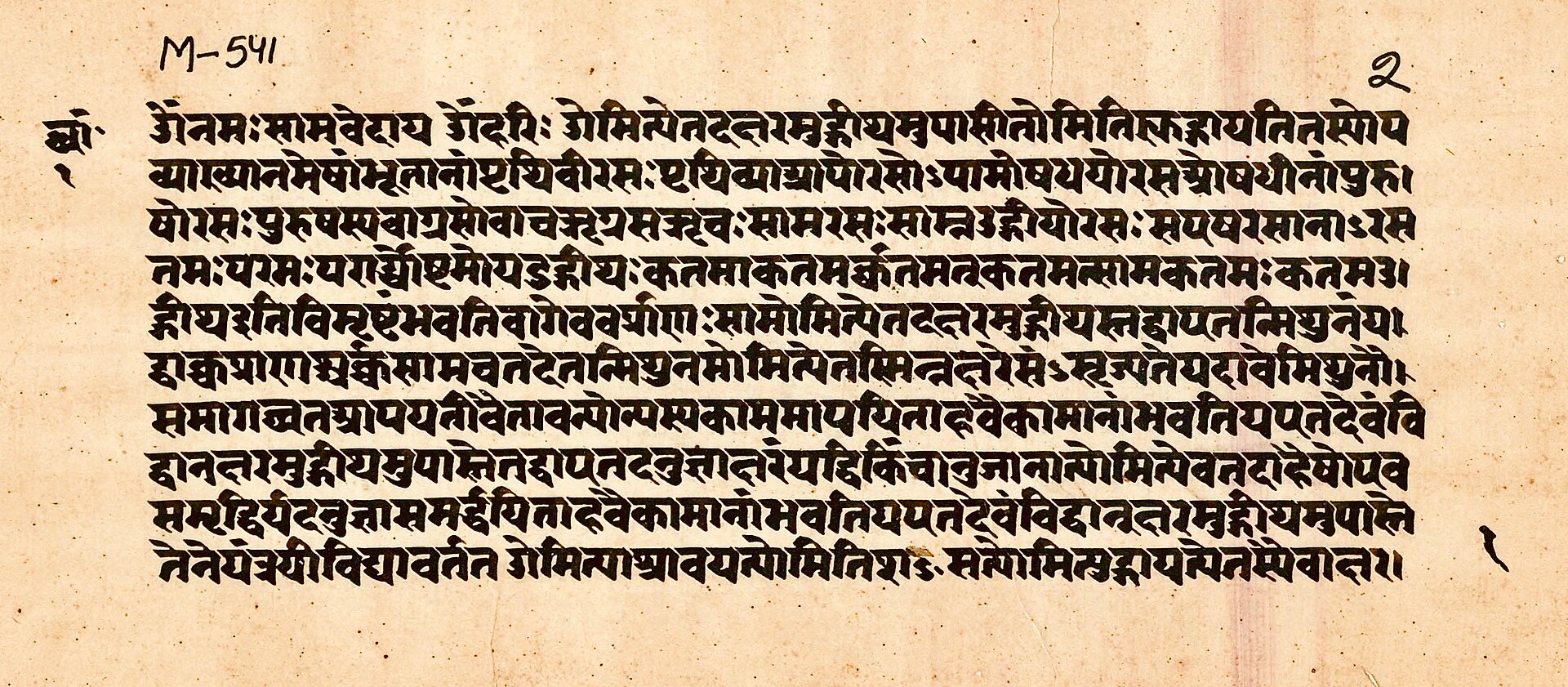
Image: Chāndogya Upaniṣad, opening verses, in an 1849 Devanagari manuscript. Ms Sarah Welch, CC BY-SA 4.0, via Wikimedia Commons.
No father’s name had the boy to give,
only the truth he was told;
four hundred lean cows he drove away,
and a thousand came home to the fold.
A Question for His Mother
Of a boy who wished to study, and a mother who would not pretend.
In those days the teachers of the Veda kept their sacred fires in households at the edge of the clearings, and boys came to live with them as brahmacārins, students bound to a teacher’s house. A boy who wished to be taken in had to give his gotra, the line of his fathers. One boy, Satyakāma, came to his mother with that question. His name means “one who loves the truth”.
“Mother,” he said, “I want to become a vedic student. So tell me what my lineage is.”
His mother’s name was Jabālā, and she did not invent a line for him. “Son, I don’t know what your lineage is,” she said. She had been young when she bore him, and in those years she had worked as a maid in other people’s houses and had been with many men. She could not say who his father’s people were. “But my name is Jabālā, and your name is Satyakāma. So you should simply say that you are Satyakāma Jābāla.”
He took the name she gave him, the son of Jabālā, and went to look for a teacher.
At Gautama’s Door
Of a lineage confessed, and firewood fetched for a teacher’s fire.
The teacher he chose was Hāridrumata Gautama. Satyakāma came to him with the old words of asking. “I want to live under you as a vedic student,” he said. “I come to you, sir, as your student.”
Gautama put the question every teacher put: kiṃgotro nu somyāsi, “Son, what is your lineage?”
Satyakāma could have named any house he liked, and no one on that road would have known. He told the teacher, word for word, what his mother had said: that she had been a maid, that she had been with many men in her youth, that she did not know his line. “So I am Satyakāma Jābāla, sir.”
Gautama heard him out. “Who but a Brahmin could speak like that!” he said. “Fetch some firewood, son. I will perform your initiation. You have not strayed from the truth.”
So the boy brought samidh, sticks for the teacher’s fire, and Gautama initiated him.
I am Satyakāma, son of Jabālā. My mother told me plainly what she knew and what she did not, and I carried her words to my teacher’s door as she had given them to me. He asked my line, and I gave him her name and mine. He sent me for firewood. I have never been asked for a father since.
Four Hundred Lean Cows
Of a thin herd driven out, and a vow made over it.
The first lesson came without words. Gautama went among his cattle and picked out four hundred of the thinnest and weakest, and he told the new student to look after them.
Satyakāma turned the herd out towards the wild country. As he drove them off he called back over his shoulder: “I will not return without a thousand!”
He lived away for a number of years, through rains and dry seasons and the slow growth of a herd, until the four hundred had become a thousand head.
The Bull Speaks
Of a bull that called a herdsman by name.
Then the bull of the herd called out to him. “Satyakāma!”
“Bhagavaḥ,” he answered. “Sir?” It was the word a pupil gives his teacher.
“Son, we have reached a thousand,” said the bull. “Take us back to the teacher’s house, and I will tell you one quarter of brahman.”
The word for quarter, pāda, also means a foot, as a beast has four feet to stand on. Brahman was the hidden power behind the sacred word and behind all things.
“Please tell me, sir.”
The east was one sixteenth of it, said the bull, and the west another, the south another and the north another. Those four sixteenths made one quarter of brahman, and its name was prakāśavān, the Far-flung, the Shining. A man who knew it so and venerated it would spread far in this world, his name carried wide. And the bull said that the fire would tell him the next quarter.
Fire, Goose and Waterbird
Of three evenings, three fires, and three teachers who were not men.
The next morning Satyakāma drove the cows on towards home. Wherever they happened to be at sunset, he built a fire, penned the cattle, fed the fire with wood and sat down behind it, facing the east.
The fire called out to him. “Satyakāma!”
“Sir?”
The earth was one sixteenth, said the fire, the middle air another, the sky another and the ocean another. That quarter was named anantavān, the Limitless, and the man who knew it would find no limits in this world. A wild goose, the fire said, would tell him the next.
On the next evening, by the next fire, a goose, a haṃsa, flew down and called his name. It told him the third quarter: fire, sun, moon and lightning, and its name was jyotiṣmān, the Radiant. A waterbird would tell him the last.
On the third evening a waterbird, a madgu, came down beside the flames. Breath, it said, and sight, hearing and mind; this quarter was named āyatanavān, the one that has an abode. The man who knew it would have a resting place in this world.
Four evenings, four fires, and every one of them began the same way: my name called out of the dark, and my answer. A bull, a fire, a goose and a diving bird taught me what my teacher had not yet spoken. I listened to each as a pupil listens. Then I drove the herd home.
The Glow on His Face
Of a teacher who saw a change, and a pupil who asked to be taught regardless.
At last Satyakāma drove a thousand cattle into his teacher’s yard. Gautama called out to him: “Satyakāma!”
“Sir?”
“Son, you have the glow of a man who knows brahman! Tell me, who taught you?”
“Other than human beings,” Satyakāma said. Yet he asked his teacher to teach him all the same, for he had heard from people of Gautama’s standing that knowledge reaches its goal most surely when it is learnt from a teacher. So Gautama explained it to him, and he did so without leaving anything out.
The Student Who Stopped Eating
Of a pupil kept back, and fires that took pity on him.
The herdsman became a teacher, with fires of his own and students to tend them. One of these was Upakosala Kāmalāyana, who tended Satyakāma’s fires for twelve years. Other students finished their time and were sent home to marry and keep households. Upakosala he kept, and did not dismiss.
Satyakāma’s wife spoke up for the young man. “The student has performed his austerities and faithfully tended the fires,” she said. “Teach him before the fires beat you to it.” But Satyakāma went off on a journey without teaching him.
Upakosala fell sick at heart and stopped eating. When the teacher’s wife pressed him to eat, he said that the desires lurking within him were many and that he was overwhelmed.
Then the fires spoke among themselves. The student had served them faithfully, they said; let them teach him. “Brahman is breath,” they told him. “Brahman is joy. Brahman is space.” He could grasp that brahman was breath, he said, but not joy or space, and the fires told him that joy and space were the same. Then each of the three fires taught him in turn, and at the end they told him that his teacher would show him the goal.
Water on a Lotus Leaf
Of a teacher come home, and a pupil who pointed at the fires.
When Satyakāma came back, he called out, “Upakosala!”
“Sir?”
“Son, your face glows like that of a man who knows brahman. Tell me, who taught you?”
“Who could possibly have taught me, sir?” said Upakosala, half denying it, and he looked towards the fires. They looked one way now, he said, but they had been different.
Satyakāma asked what the fires had told him, and heard it. The fires had taught him about the worlds, he said, but he would teach him the thing about which it is said that bad actions do not stick to the one who knows it, “just as water does not stick to a lotus leaf”.
“Sir, please teach me that,” said Upakosala, and his teacher did.
A Name Passed Down
Of a saying carried to a king’s court, and a rite handed from pupil to pupil.
At the court of Janaka of Videha the sage Yājñavalkya asked the king what his other teachers had told him. “Brahman is the mind,” said Janaka. “That’s what Satyakāma Jābāla told me.” Yājñavalkya allowed that it was true as far as it went, and asked whether Satyakāma had said what its abode and foundation were. He had not. Then it was a one-legged brahman, said Yājñavalkya, a thing that stands on a single foot.
In a list of teachers handing down a rite of mixed herbs and butter, Satyakāma appears as one link in the chain. He received it from his own teacher, Jānaki Āyasthūṇa, and passed it on to his pupils with the same promise: pour this mixture on a withered stump, and it would sprout new branches and grow new leaves.
The truth behind the tale
Satyakāma Jābāla appears in the Chāndogya Upaniṣad (4.4–4.15) and in the Bṛhadāraṇyaka Upaniṣad (4.1.6 and the teacher lineage of 6.3). Both texts are usually placed before the Buddha, roughly in the 7th to 6th centuries BCE, though no date is firm. The talks with his mother and with Gautama, the herd, the teachings of the bull, the fire, the goose and the waterbird, the return, and the story of Upakosala all follow the Chāndogya. Nothing is recorded of his years with the herd, and this chapter adds no events to them. The talking bull, fires and birds are the Upaniṣad’s own way of teaching and are not history.
Jabālā’s words, bahv ahaṃ carantī paricāriṇī yauvane tvām alabhe, are read by most modern translators as saying that she had been a maid with many partners. The medieval commentator Śaṅkara read them more gently: that she was so busy serving guests in her husband’s house that she never thought to ask his lineage, and that his father died about the time of the boy’s birth. The name of the eastern quarter, prakāśavān, can mean “far-flung” or “shining”, and both senses may be intended. Gautama’s judgement that the boy’s honesty showed him a Brahmin is often quoted in later debates about birth and worth; an older verse in the Yajurveda already asks why one should inquire about a Brahmin’s father and mother when learning can be found in him. Whether Satyakāma was one real teacher or a name that gathered stories cannot be known.
On the translations. Quotations in English follow Patrick Olivelle’s translation. The Sanskrit words, including Gautama’s question kiṃgotro nu somyāsi and the reply bhagavaḥ, follow the GRETIL text.
Imagined voice: the italic passages in which Satyakāma speaks in the first person are imagined. They are built only from the texts and studies named here, add no events, and are not quotations.
Sources
- Patrick Olivelle (trans.), The Early Upaniṣads: Annotated Text and Translation (Oxford University Press, 1998): Chāndogya 4.4–4.15; Bṛhadāraṇyaka 4.1.6 and 6.3.7–12; notes on 4.4.2, 4.4.5 and 4.5.2.
- Chāndogya Upaniṣad with Śaṅkara’s commentary, Sanskrit text, GRETIL: 4.4.1–4.5.1.
- Heinrich Lüders, “Zu den Upaniṣads: II. Die Ṣoḍaśakalavidyā”, in Philologica Indica (1940): the episode and the name prakāśavān.