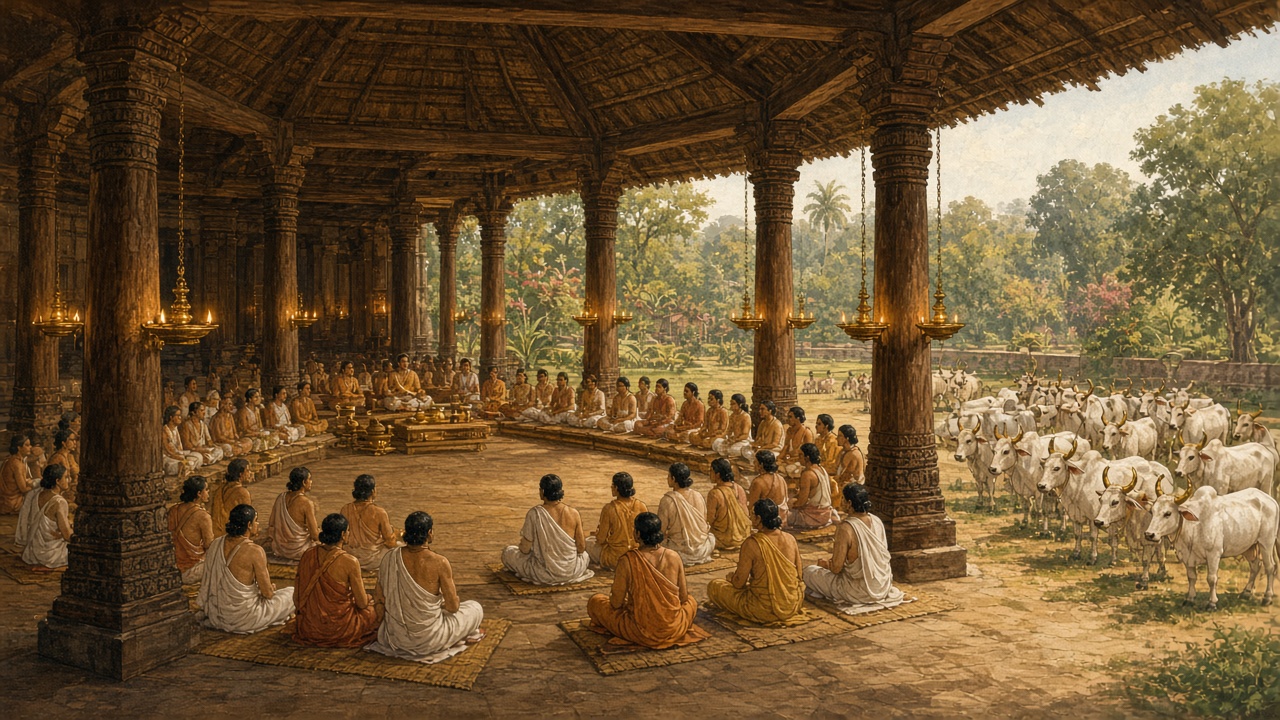
AI illustration: a scholars' assembly in Janaka's hall at Mithilā, with the prize cows (an imaginative reconstruction).
Gold on the horns in the eastern court,
a thousand cows, a challenge laid;
sun and moon and fire gone out,
and still the king asked for light.
Gold upon the Horns
Of a thousand cows and a challenge laid before the wise.
In those days, when the smoke of a great sacrifice hung over the eastern kingdom of Videha, a thousand cows stood penned in the king’s courtyard. On every pair of horns, the old book says, gold was fastened: ten pādas of it, five upon each horn, and it glinted as the beasts tossed their heads. The rite was a bahudakṣiṇa sacrifice, one of abundant gifts, and Brahmins had come to it from the Kuru and Pañcāla lands far to the west.
The king was Janaka, called samrāṭ, sovereign. He spoke to the assembly as brāhmaṇā bhagavantaḥ, “honoured Brahmins”: let the wisest among you drive these cows away.
No one dared. Then the sage Yājñavalkya, whose own tale is still to come in these Chronicles, turned to his pupil Sāmaśravas, a brahmacārin, and said, “Drive them away, my dear.” The word is somya, as a teacher speaks to a pupil. And the young man drove them off.
I am Janaka, king of Videha, and I will tell you why I set gold upon the horns of my cows. I wished to know who among the learned was wisest. Not one of them would claim it. Then one man did, and his pupil drove the herd away before my eyes.
The Brahmins were angry. Janaka’s own priest, Aśvala the hotṛ, asked Yājñavalkya whether he truly thought himself the wisest of them all. “I bow before the wisest,” the sage replied, “but I wish indeed to have these cows.”
So began a long brahmodya, a contest of questions. One by one the learned rose against him, and one by one they fell silent. Among them was Gārgī, who alone stood twice, and whom these Chronicles have met already. Tonight our tale is of the king who set the gold upon the horns, and watched.
The Fire That Walked East
Of a fire carried east, and the one river it spared.
It is told in an older book how Videha was first settled. Long ago, a chief named Videgha Māthava carried the sacred fire, Agni Vaiśvānara, in his mouth, and when it burst forth, it went burning eastward from the river Sarasvatī, drying up the rivers. The chief and his priest Gotama Rāhūgaṇa followed behind it.
But one river it did not burn: the Sadānīrā, whose name means always full of water, flowing cold from the northern mountains. For a long time Brahmins would not cross it, for the land beyond lay “very marshy”, untouched by the fire. Then the fire told the chief to make his home east of that river. So Videha began, a land of wide rivers and wet fields beneath the Himalaya; and even now, the tellers say, that river marks the boundary of the Kosalas and the Videhas.
Janaka ruled that frontier country, yet his court drew the wise from the old heartlands. Even in the old dialogues his name is a byword: a king of Kāśī complains that everyone runs off to Janaka, calling him their patron.
The King Who Drove Away
Of a king who outtalked the Brahmins, and drove off in his chariot.
Once, it is said, Janaka met three travelling Brahmins, Yājñavalkya among them, and asked how each performed the daily offering to the fire, the agnihotra. To Yājñavalkya, whose answer was best, the king gave a hundred cows. Then he told them that not even he truly understood the offering, mounted his chariot, and drove away.
The Brahmins muttered that this warrior “has outtalked us”, and wished to challenge him. But Yājñavalkya warned them: if they won, they had only beaten a warrior; if they lost, men would laugh that a warrior had beaten Brahmins. Then he climbed into his own chariot and went after the king, who taught him the hidden meaning of the offering. In return Yājñavalkya granted him a boon, and Janaka chose the right to ask him any question he liked. From that day, the book says, Janaka was counted a Brahman.
What Is the Light of Man?
Of a question asked in a hall, and the light that remains.
Yājñavalkya came to the king’s hall more than once. One day Janaka offered him, again and again, “a thousand cows with a bull as big as an elephant”, but the sage would not take them. His father, he said, had taught him never to accept a reward before the pupil was fully taught. At last the king came down from his throne, bowed, and asked to be taught. When the lesson ended, “You have indeed reached fearlessness,” Yājñavalkya told him, and Janaka answered with his whole realm: “Here are the Videhas, and here am I.”
Another day the sage came meaning to say nothing at all. But the king used his boon, and spoke first.
“Yājñavalkya,” he said, “what is the light of man?”
“The sun, O King,” the sage answered, calling him samrāṭ, sovereign. By the sun a man sits, moves about, does his work, and returns.
And when the sun has set? The moon. And when the moon has set as well? Fire. And when the fire has gone out? Sound, said Yājñavalkya: for when one cannot see even one’s own hand, still one walks towards a voice.
“When the sun has set, O Yājñavalkya, and the moon has set, and the fire is gone out, and the sound hushed, what is then the light of man?”
“The Self indeed is his light.”
I asked of the sun, and of the moon, and of fire, and of the voice in the dark. Each answer was true, and each was not enough. Then he spoke of the Self, and I offered him the Videhas and myself with them.
Then the sage spoke long of dream and deep sleep, and of a falcon that folds its wings and goes home to its nest. Again and again the king offered a thousand cows and begged him to speak on, until, the text admits, Yājñavalkya grew afraid that this clever king would drive him from every position he held. When the teaching was done, Janaka gave everything once more: “I give you the Videhas, and also myself, to be together your slaves.”
Smoke over Mithilā
Of a name that outgrew a man, and a city that might burn.
The name of Janaka outgrew any one man. Later tellers made it the name of a whole line of kings in Mithilā. In the later epic tale, a Janaka ploughing a field for a sacrifice finds a baby girl in the furrow and names her Sītā, “furrow”; later tellings call him Sīradhvaja, “plough-bannered”. Whether that Janaka and the questioner of Yājñavalkya were ever one man, no one can say.
An epic verse is sung by a Janaka who wanted nothing: if all Mithilā were burnt to ashes, “nothing of mine will be burnt”. Buddhist tellers gave a like saying to their own King Mahājanaka as he left his palace for the homeless life.
The truth behind the tale
The cows with gold on their horns and the “light of man” dialogue come from the Bṛhadāraṇyaka Upaniṣad (3.1 and 4.1–4.4). The chariot story comes from the Śatapatha Brāhmaṇa (11.6.2); its tale of the fire’s march east (1.4.1) is legend, though it may remember the eastward spread of Vedic ways. Both texts took shape roughly in the 8th to 6th centuries BCE and were edited over a long time. Janaka is a figure of literature: no inscription, coin or ruin names him, though Videha lay in what is now north Bihar and the Nepal Terai. Even these early texts treat him as a model king, so they may already be idealising a real ruler. The Rāmāyaṇa’s Sītā tale, the Mahābhārata verse and the Mahājanaka Jātaka are later legend, written down centuries afterwards. Whether “Janaka” was a personal name or a family title, and how many Janakas there were, we do not know.
Where the story’s details come from. The golden-horned cows, the brahmodya, Aśvala the hotṛ, and the light-of-man dialogue follow the Bṛhadāraṇyaka Upaniṣad 3.1 and 4.1–4.4, in Patrick Olivelle’s translation and the GRETIL Sanskrit; the ten pādas of gold and the addresses somya, samrāṭ and brāhmaṇā bhagavantaḥ are from that text. The fire’s march east (Agni Vaiśvānara, Gotama Rāhūgaṇa, the Sadānīrā as Kosala–Videha boundary) and the chariot agnihotra story follow the Śatapatha Brāhmaṇa 1.4.1 and 11.6.2, in Julius Eggeling’s translation. The king of Kāśī’s complaint is in the Bṛhadāraṇyaka Upaniṣad; Sītā found in the furrow and the name Sīradhvaja are from the Rāmāyaṇa; the verse “nothing of mine will be burnt” is from the Mahābhārata.
Imagined voice: the italic passages in which Janaka speaks in the first person are imagined. They are built only from the texts and studies named here, add no events, and are not quotations.
Sources
- F. Max Müller, The Upanishads II (SBE 15, 1884), Bṛhadāraṇyaka Upaniṣad 2.1, 3.1, 4.1–4.4; cf. P. Olivelle, The Early Upaniṣads (1998).
- J. Eggeling, The Śatapatha Brāhmaṇa I and V (SBE 12, 1882; SBE 44, 1900), 1.4.1 and 11.6.2.
- K. M. Ganguli, The Mahabharata, Śānti Parva, sections XVII and CCXVIII–CCXIX.
- R. T. H. Griffith, The Rámáyan of Válmíki, Book I, cantos LXVI and LXXI; H. H. Wilson, Vishnu Purana IV.5.
- E. B. Cowell (ed.), The Jātaka VI (1907), No. 539, Mahājanaka-Jātaka.
- M. Witzel, “Moving Targets? Texts, Language, Archaeology and History in the Late Vedic and Early Buddhist Periods” (2009).
- Bṛhadāraṇyaka Upaniṣad, Sanskrit text with Śaṅkara’s commentary, GRETIL, and P. Olivelle, The Early Upaniṣads (1998), 3.1 and 4.1–4.4: somya, samrāṭ, brāhmaṇā bhagavantaḥ, the ten pādas of gold, the bahudakṣiṇa sacrifice, Aśvala the hotṛ, and the brahmodya.
- J. Eggeling, The Śatapatha Brāhmaṇa I and V (SBE 12, 1882; SBE 44, 1900), 1.4.1 and 11.6.2: Agni Vaiśvānara, Gotama Rāhūgaṇa, the Sadānīrā as Kosala–Videha boundary, and the agnihotra chariot dialogue.