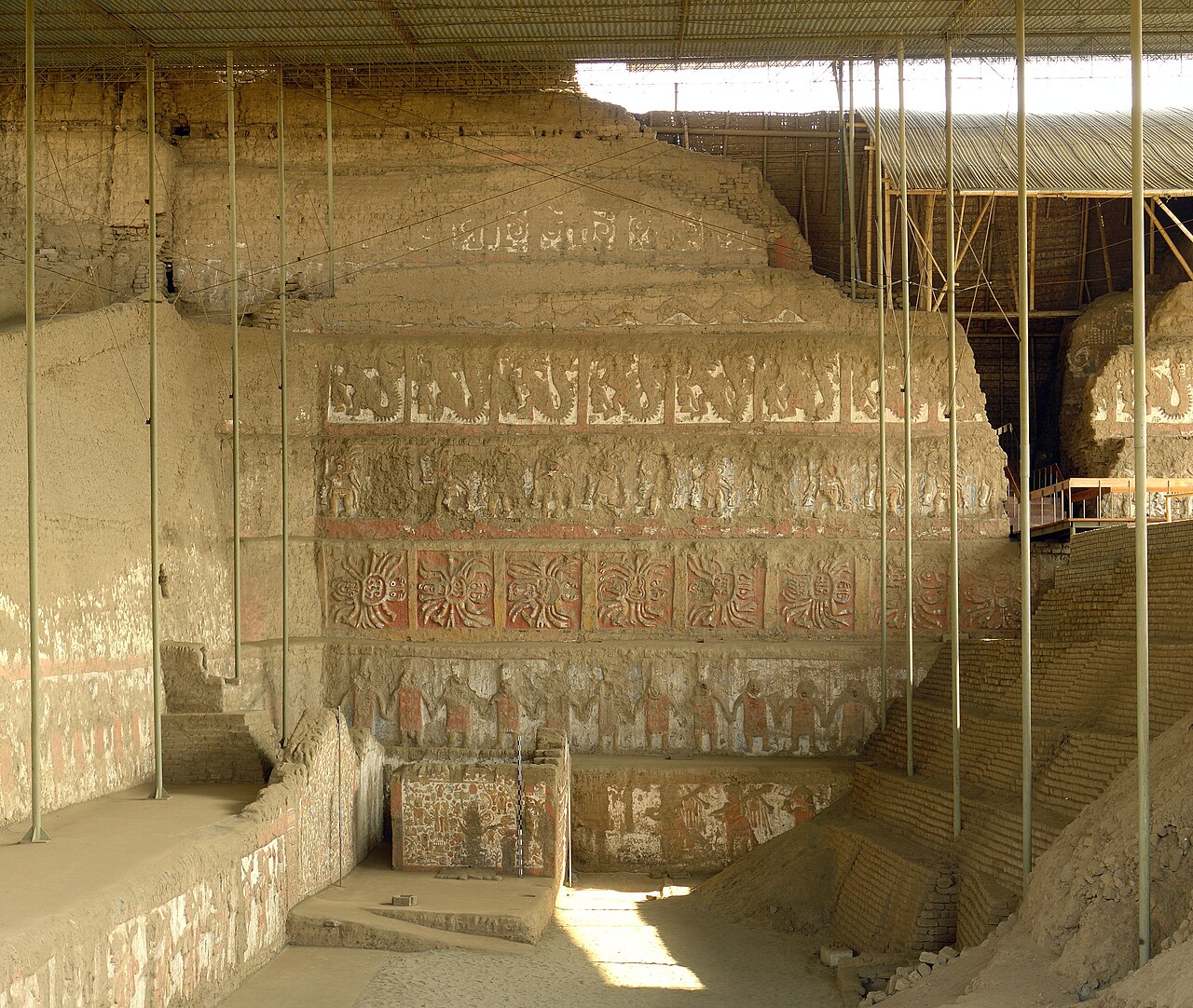
Featured image: the painted façade of the Huaca de la Luna at Huacas de Moche, near Trujillo in northern Peru, where this week’s child burial was found at the foot of the temple. Photo: Martin St-Amant, Wikimedia Commons, CC BY 3.0.
This roundup is published late. It was due on Saturday 24 October.
This week’s roundup covers 17 to 24 October 2026: two hero stones from Dharmapuri, a Late Bronze Age tower on the wall of Palaepaphos, a temple workshop in Kushite Nubia, more than a hundred Latin vows in a Spanish cave, the first Neanderthal found in Navarre, a Norse church in Greenland and an infant’s tomb below a Moche temple. Each item links to its source.
India and South Asia
Two hero stones in Dharmapuri
Researchers from the Coimbatore-based Yaakkai Trust, Kumaravel Ramasamy, Sudhakar Nalliyappan and Bala N., have documented two hero stones in Tamil Nadu’s Dharmapuri district. The older, at Malluthu village in Harur taluk, is a 6th-century memorial in Vatteluttu script that names the Pallava king Simhavishnu. It records the death of Keeranthai Maayan in a cattle-raid fight at Uthappi, and shows a warrior with long earlobes holding a short kukri-type dagger and a shield. The epigraphist Y. Subbarayalu confirmed the reading. The second, at Sottandahalli in Palacode taluk, dates to 1299 CE in the Hoysala period and commemorates Umaidevan, who died protecting the settlement from wild boars. Hunting dogs and a boar are carved beside him. Source: The Hindu, 23 October.
Grooves and rock paintings at Mrugavani
The historian Satyanarayana Dyavanapalli has reported four deep grooves near the Banda Juvvi watchtower in Mrugavani National Park at Chilkur, on the edge of Hyderabad, which he suggests may be linked to Neolithic activity of around the fifth millennium BCE. About a kilometre away, near the Forest Trek Park, ochre paintings of animals, hunting scenes and geometric designs have also been found. Their age, and any link with the grooves, is not yet known, and he has asked Telangana’s Department of Archaeology and Museums to survey both sites. Source: The Hindu, 21 October.
Fresh copies of the Big Temple inscriptions
The Archaeological Survey of India began the final phase of recopying the inscriptions of the Brihadeeswarar Temple in Thanjavur on 22 October. The Chola temple holds more than 500 inscriptions in Tamil and Marathi, last copied in 1886, and many of the old estampages, the paper impressions taken from the stone, have deteriorated. A team of more than 15 will work for over two weeks, and the new copies will be digitised under the BharatSHRI inscription repository, which already holds about 15,000 digitised Tamil estampages. Source: The New Indian Express, 22 October.
The Mediterranean and Africa
A Late Bronze Age tower at Palaepaphos
A University of Athens team led by Professor Konstantinos Kopanias has excavated the foundations of a tower on the Late Bronze Age city wall at Marchello in Kouklia, the village over ancient Palaepaphos, a little under a kilometre north-east of the sanctuary of Aphrodite. It began as a rectangular bastion in Late Cypriot IIIA and was later enlarged into a building of about 7.4 by 7.3 metres with heavy walls round a central room of some 9 square metres. Cyprus’s Department of Antiquities says the results are the first evidence of a monumental fortified enclosure at Palaepaphos in the Late Bronze Age. Only the foundations survive, so the tower’s height is unknown. Source: Ancient Cyprus, 21 October.
A faience workshop inside a Kushite temple
At Sanam, a temple complex at Napata built by the Kushite king Taharqo (690 to 664 BCE), Rennan Lemos of Durham University, Kathryn Howley of New York University and colleagues have identified a faience workshop. In Egypt such workshops usually stood on the edges of settlements because of their smoke and fumes, but this one lay within the temple complex and made objects tied to royal power, among them shabtis for the royal cemetery at Nuri. A green faience shabti from the workshop matches a mould found in the temple. The study, in Antiquity, also finds that Kushite craftspeople used local materials. Source: Archaeology, 20 October.
Europe
More than a hundred Latin vows in Cova Dones
In Cova Dones, in eastern Spain, the DONARQ project led by Aitor Ruiz-Redondo and Virginia Barciela has recorded at least 120 Latin inscriptions in a chamber more than 200 metres underground, the largest set of cave inscriptions known from the Roman Empire. Only about 15 were known before, and most date to the 1st and 2nd centuries AD. Five votive texts are addressed to a goddess called Domina, “the Lady”, and some appear to have been written by women themselves. Offerings left in the natural pools on the floor include two rings, a bracelet and many spindle whorls. The previous record holder, La Griega, has 107 inscriptions, only one of which names a woman. Source: University of Southampton via Phys.org, 20 October.
The first Neanderthal from Navarre
Six bone fragments found in earlier seasons in the Abauntz cave have been identified as the first Neanderthal remains from Navarre. They include three metacarpals and a middle finger bone from the right hand of an adult man, and radiocarbon dating puts him at about 46,000 years ago. Some bones carry carnivore bite marks. The team, co-directed by Andion Arteaga and Mikel Arlegi and working with the University of Vienna and the Max Planck Institute for Evolutionary Anthropology, combined protein analysis, ancient DNA and direct dating. The find was presented on 19 October, and genetic work continues. Source: Euronews, 20 October.
A Norse church confirmed in Greenland
Near Narsarsuaq in southern Greenland, about three miles from Erik the Red’s estate at Brattahlíð, a team co-led by Christian Edelfelt Koch Madsen of the National Museum of Denmark has found a burial that confirms a long-suspected building as a church. The skeleton lay with its arms at its sides and its head to the east, in the Christian manner. “This is ‘the smoking gun.’ Now there is no doubt that this is a church,” Madsen said. It is the first Norse church found in Greenland in more than 60 years, and its size and hewn stone suggest a date between 1100 and 1300. Source: Smithsonian, 20 October.
The Americas
An infant’s tomb below the Huaca de la Luna
The Huacas de Moche Archaeological Project has excavated the 1,400-year-old grave of an infant on the Uhle funerary platform at the foot of the Huaca de la Luna, near Trujillo. Other tombs on the platform held adults thought to be of high rank. The child was buried with more than 30 ceramic objects, painted with bird figures, prisoners, sacrifice, combat and deities. One bottle shows a body of water cut off from the sea by a strip of sand, with birds, fish and two frogs. The area round the skull was covered by a metal mask, possibly of copper, said Carlos Rengifo of the project. Source: Archaeology, 20 October.
The previous week’s news is in the roundup for 10 to 17 October. If we have missed a story, send it through the contact page and we will look at it for the next roundup.