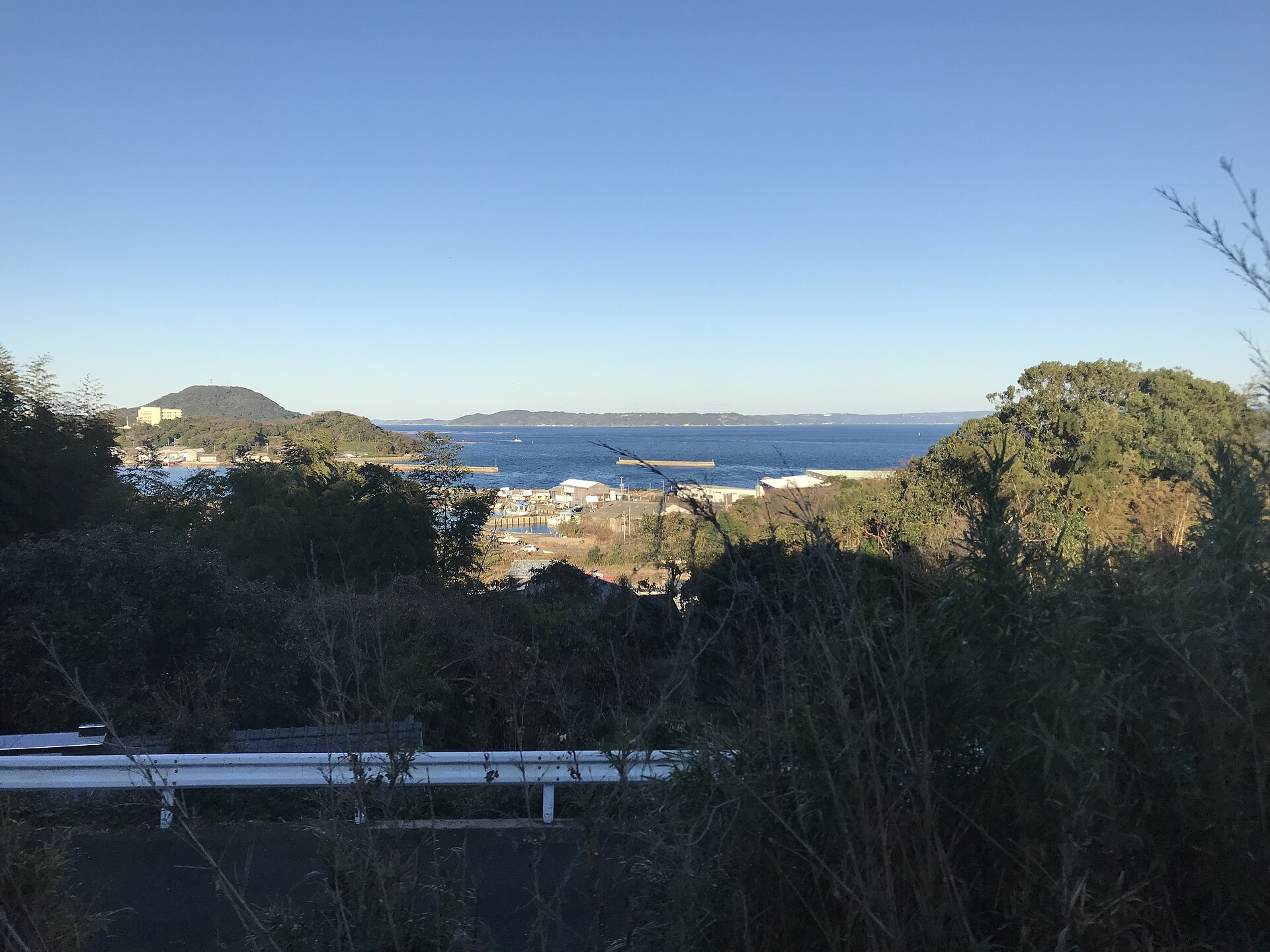
Featured image: Takashima Island and Matsuura Port, Nagasaki Prefecture, where a third ship from the Mongol fleet of 1281 has been investigated. Photo: そらみみ, Wikimedia Commons, CC BY-SA 4.0.
This week’s roundup covers 31 October to 7 November 2026: three Sanskrit manuscripts on a UNESCO register, 5,000-year-old rock art in Tamil Nadu, game pieces from a Mongol invasion ship, a haniwa shrine maiden, the oldest direct evidence of cannabis use, a case that the Atrebatic ruler Verica was a woman, a menhir cemetery near Paris, the drugs given to Inca sacrificial children, a Maya tooth shrine and new books. Each item links to its source.
India and South Asia
The Mahabharata, Arthashastra and Rajatarangini join a UNESCO register
Manuscripts of three Sanskrit works have been inscribed on UNESCO’s Memory of the World Regional Register for Asia and the Pacific, a decision taken at the 11th session of its regional committee in Jakarta and announced in India on 5 November. They are the birch-bark Mahabharata manuscript at the Bhandarkar Oriental Research Institute in Pune, acquired in Kashmir by Georg Bühler in 1875; a complete sixteenth-century palm-leaf manuscript of Kautilya’s Arthashastra in Grantha script at the Oriental Research Institute in Mysuru; and the manuscript of Kalhana’s twelfth-century chronicle of Kashmir, the Rajatarangini, at the Oriental Research Library in Srinagar. The Indira Gandhi National Centre for the Arts prepared the nominations, and India now has six inscriptions on the regional register. Source: The Hindu, 5 November; ThePrint, 6 November.
Rock art in Tamil Nadu
Cave paintings thought to be about 5,000 years old have been reported in Tamil Nadu. They are believed to date from the shift between late Mesolithic hunting and gathering and early Neolithic farming, and show human-like figures, wild animals, dancing and geometric designs. The Tamil Nadu State Department of Archaeology and the Archaeological Survey of India have been asked to protect the site. Source: Archaeology, 4 November.
East Asia and the Steppe
Dice and cards from a Mongol mother ship
A third thirteenth-century wreck has been investigated off Takashima Island in Nagasaki Prefecture, after others found in 2011 and 2015. All three are thought to have sunk in 1281, when the Yuan fleet of Khubilai Khan tried to invade Japan. The new ship was about 100 feet long and had living quarters, and may have been the fleet’s mother ship. Among the finds are five dice and 29 small cards for koppai, a game from China. “The koppai cards, which are considered precursors to mahjong tiles, were likely used for recreation,” said Yoshifumi Ikeda of Kokugakuin University, who led the work with Matsuura’s municipal government. Source: Archaeology, 6 November.
A haniwa shrine maiden in Gunma
The head and torso of a clay haniwa figure, about 16 inches long as it survives, has been found in the moat of a fifth-century burial mound at the Nishikaminomiya site in Gunma Prefecture. Its topknot, clay bracelets, red sash and the rod in one hand mark it as a miko, a female shaman. The excavators think it once stood near a boat-shaped coffin on the mound and slid down into the moat over time. It is now at the Gunma Prefectural Archaeological Research Center Museum. Source: Archaeology, 3 November.
Cannabis in a Scythian tomb, 2,800 years ago
A team led by Gino Caspari of the University of Bern and the Max Planck Institute of Geoanthropology reports in Science the oldest directly dated evidence of cannabis used as an intoxicant. The Tunnug 1 burial mound in Tuva, southern Siberia, built by high-ranking Scythians, held more than a thousand cannabis seeds, radiocarbon-dated to the early eighth century BC. Preserved human hair from the central chamber carried cannabinol, which forms when THC breaks down, with weaker signals consistent with THC itself. The researchers say the evidence cannot show how much was taken or whether it was smoked or swallowed. Source: Science, 5 November; Max Planck Institute of Geoanthropology.
A kidney stone from a steppe grave
A grape-sized stone from the grave of a man buried about 5,300 years ago in a kurgan cemetery near the Black Sea in south-western Russia proves to be made of whitlockite, a calcium salt found only in kidney, bladder and prostate stones and linked with infection. “His last years were probably marked by considerable and more or less constant pain,” said Natalia Berezina of Lomonosov Moscow State University. His bones also show worn joints and healed fractures of the shoulder, ribs and forearm. Source: Archaeology, 4 November.
Britain and Europe
Was Verica a queen?
Miles Russell of Bournemouth University argues that Verica, ruler of the Atrebates in the first century AD, was a woman. Verica was driven out around AD 40 and fled to Claudius, whose invasion of Britain followed in AD 43. Russell points out that the name ends in -a, like Boudicca and Cartimandua, that the title rex on the coins was used even by Cleopatra, and that Verica’s coins show a slender, bare-breasted rider. “We should take the archaeological evidence at face value and remember Verica as a female-king,” he said. Source: Archaeology, 6 November.
A menhir cemetery beside the Marne
INRAP archaeologists at Champigny-sur-Marne, near Paris, have excavated a cemetery about 6,500 years old with 11 graves, 30 megaliths and a human-shaped menhir that weighs more than 20,000 pounds and once stood over 10 feet tall. Its surface was pecked, then carved with a belt and an arc of cup marks, and white and black stains suggest it was painted. One grave held a seated adult in a narrow round pit, and the builders lined graves and stone pits with a mix of chalky sand, silt, gravel and water that set hard as it dried. Source: Archaeology, 5 November.
A painted tomb at Manduria
A rock-cut tomb about 2,200 years old in the Archaeological Park of the Messapian Walls at Manduria, in Puglia, may have belonged to a priestess of Demeter. Its walls are painted with a sanctuary key, geometric patterns, a border, an incense burner and an inscription in Messapic, the language of south-eastern Italy before the Roman conquest. A second inscription was found on a stone slab nearby. Source: Archaeology, 5 November.
A dog’s paw in a Bronze Age wall
Paw prints about 4,000 years old, said to be a dog’s, have been found in mud bricks from a wall that collapsed in a fire at Tavşanlı Höyük in Kütahya Province, western Anatolia, a mound settled for some 8,000 years. The excavation is led by Erkan Fidan of Bilecik Şeyh Edebali University. Source: Archaeology, 2 November.
The Americas and the Pacific
What the Inca gave children before the capacocha
Toxicology on hair and nails from eight children sacrificed at Andean mountain shrines in Peru and Argentina about 500 years ago found cocaine in every sample, which points to coca chewing. Some had been given alcohol, probably maize beer, and the girl known as the Ampato Maiden had taken harmine, a psychoactive compound from plants used in ayahuasca. “This suggests that the preparation of children was much more complex and varied than we previously thought,” said Dagmara Socha of the University of Warsaw. The study is in Antiquity. Source: Archaeology, 6 November.
A Maya tooth shrine in Belize
In Bats’ub Cave in southern Belize, a woman buried between about AD 250 and 400 had her head replaced by a bowl holding a jade bead. More than a century later people began leaving teeth at her grave, and went on doing so for over two hundred years. DNA from more than 200 teeth shows at least 30 individuals, more than 20 of them from elite family tombs at Muklebal Tsul, some 16 miles away. The team, led by Keith Prufer of the University of New Mexico with David Reich and Esther Brielle of Harvard, also found that women married into male family lines. Source: Archaeology, 3 November.
The first Hawaiians and Rapa Nui
A genetic study led by Alexander Ioannidis of Stanford, using more than 1,000 genomes from French Polynesia with others from Rapa Nui, Hawaii, Samoa, Tonga and Tahiti, finds that Polynesia was settled by small groups who passed through repeated population bottlenecks. Native Hawaiians are most closely related to the people of Rapa Nui, more than 4,000 miles away, and both link back to Mangareva, which may have been their launching point. Source: Archaeology, 2 November.
New books
Alexander: God, King, Man
Edmund Richardson’s life of Alexander the Great, and of the legend told about him by Romans, Jewish scholars, Icelandic bards and Persian courtiers, has won the £50,000 Baillie Gifford Prize for 2026. Source: The Guardian, 4 November.
Fatal Monsters
Jane Draycott’s Fatal Monsters (Atlantic Books) brings Cleopatra’s sisters Berenike and Arsinoe back into the story of the last Ptolemies, and looks at all three queens through Greek and Egyptian eyes as well as Roman ones. Source: Daily Mail review, 1 November.
Pericles: Statesman, Demagogue, Eccentric
Paul Cartledge’s short life of Pericles, in Reaktion’s Great Lives of the Ancient World series, covers his naval service, his leadership of Athens and his home life in under 200 pages. Source: Open Letters Review, 5 November.
Queen, Warrior, Captain
Violaine Sebillotte Cuchet’s study of Artemisia of Halicarnassus, who commanded ships for Xerxes at Salamis, is now out in English from Yale University Press, translated by Jody Gladding. Source: Asian Review of Books, 6 November.
The previous week’s news is in the roundup for 24 to 31 October. If we have missed a story, send it through the contact page and we will look at it for the next roundup.