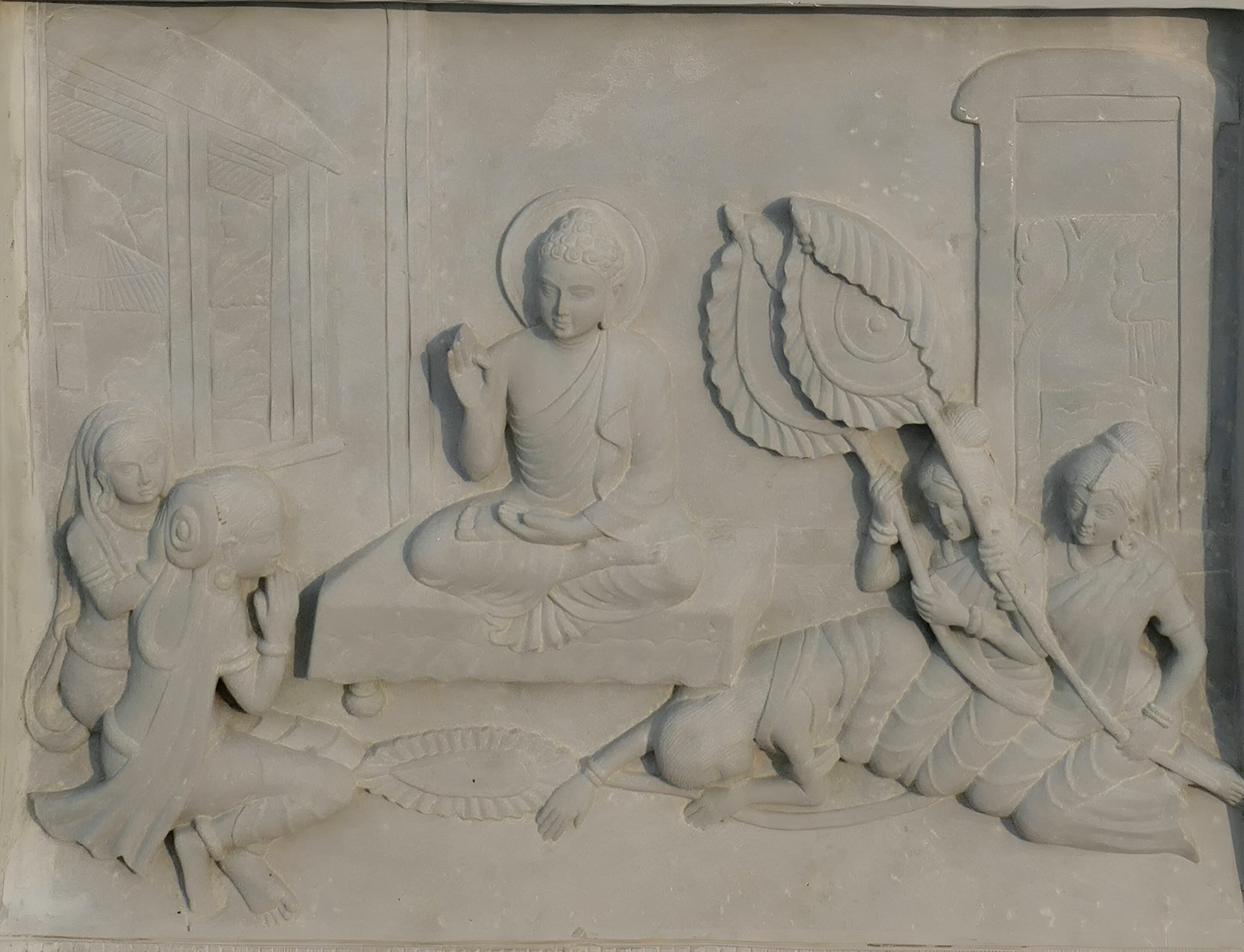
Image: Queen Khemā sees a woman age and die, modern drum relief at the Buddhavanam stupa, Telangana. Photograph by Ānandajoti Bhikkhu, CC BY-SA 4.0, via Wikimedia Commons. A modern depiction of the commentary legend.
She would not walk where the bamboo grew
for fear of what she might be told;
she saw the fairest face turn grey,
and spoke to a king of the sea.
Songs of the Bamboo Grove
Of a queen from Sāgala, and singers sent to praise a garden.
In those days, it is told, there was born at Sāgala in the Madda country, far to the north-west, a girl of a ruling house whose skin was the colour of gold, and her name was Khemā. She grew up to be the chief consort of Bimbisāra, whose tale readers of these chronicles already know. He was king of Magadha, and she dwelt with him in Rājagaha among its ring of hills.
Near the city lay the Bamboo Grove, Veḷuvana, which the king had given to the Buddha and his monks. Bimbisāra went there often. Khemā would not go. She had heard it said that the Teacher found fault with beauty of form, and she was drunk, the old tellers say, with the pride of her own.
So the king had songs made in praise of Veḷuvana and gave them to players to sing. And as Khemā listened, the grove seemed to her a place she had never seen nor heard of. “What grove are you singing about?” she asked them.
“Your majesty, we are singing about your own grove Veḷuvana.”
Then she longed to see it.
The Woman with the Palm Fan
Of a beauty that faded as Khemā watched, and a king’s leave.
The Buddha knew that she was coming, so the story runs. As he sat teaching in the midst of the assembly, he made to appear beside him a woman of surpassing beauty, fanning him with a palmyra fan. When Khemā came into the hall she saw that woman, and stood still.
“I have always been told that the Sambuddha finds fault with beauty of form. But here in his presence stands a woman fanning him,” she thought. “I do not come even within a sixteenth part of her beauty.” She did not hear even the sound of the Teacher’s voice, so fixed was her gaze.
Then before her eyes the woman changed. Her youth went from her as light goes from the hills at evening. She grew old and bent, and at the last she was no more than a bag of bones. And Khemā thought, “In but a moment a form even so beautiful as this has attained decay and death.”
The Buddha saw her thought and spoke. “Khemā, you falsely think: ‘There is an essence in beauty of form.’ Behold now the lack of essence!” And he gave her a verse: “Those who are impassioned follow the stream like a spider a web made by itself, having cut this away the wise proceed, seeking nothing, abandoning suffering.”
It is told that as she heard it she reached the end of the path, there in the hall. Then the Buddha turned to the king. “Great king, Khemā ought either to go forth or pass into Parinibbāna.”
“Venerable Sir, let her go forth; enough of Parinibbāna!” said Bimbisāra. So she went forth, and became a bhikkhunī, a nun.
The Tempter in the Grove
Of one who offered music, and a nun who knew him.
Her own verses are kept among the songs of the elder nuns, and they open with another voice. There came to her one who said that he was young as well. “You’re so young and beautiful! I too am young, just a youth. Come, Khemā, let us enjoy the music of a five-piece band.”
Khemā answered him. “This body is rotting, ailing and frail, I’m horrified and repelled by it, and I’ve eradicated sensual craving.” Sensual pleasures, she told him, “are like swords and spears”, and what he called delight was no delight for her now. “Relishing is banished in every respect, and the mass of darkness is shattered.” Then she named him for what he was. “So know this, Wicked One: you’re beaten, terminator!” Her words were pāpima, “Wicked One”, a name of Māra the tempter, and antaka, “ender”, a name for death.
Then she looked back along her own road, to the days when she had worshipped the stars and served the sacred flame in a grove. “But now I worship the Awakened One, supreme among men.”
I am Khemā, and I will tell you what I said to the one who came to tempt me. He told me that I was young and beautiful and that he was young too, and bade me come and take my pleasure in music. I told him that this body is rotting and frail, and that the pleasures of the senses are swords and spears to me. Once I worshipped the stars and tended the sacred flame in a grove, and thought that was purity. Now I bow to the Awakened One, and I am released from all suffering.
A Standard and a Measure
Of a nun foremost in great wisdom, and words a mother might say.
In time the Buddha named those among his followers who stood first in some gift. First among the nuns of long standing he named Mahāpajāpatī, who had raised him, and whose tale is told in these chronicles. And first among those of great wisdom, he said, “with great wisdom is Khemā.”
A faithful nun, he said, would rightly aspire, “May I be like the nuns Khemā and Uppalavaṇṇā!” They were a standard and a measure for all his nun disciples. And he told of a laywoman with an only daughter, dear and beloved, who might say to her child that if she went forth from the home life, “please be like the nuns Khemā and Uppalavaṇṇā.”
The Night at Toraṇavatthu
Of a king on the road, a nun in a village, and the sand of the Ganges.
It happened that Khemā was walking in the land of the Kosalans, between Sāvatthī and Sāketa, and she took up her dwelling at the village of Toraṇavatthu. On that same road came Pasenadi, travelling from Sāketa to Sāvatthī. He was king of Kosala, and readers of these chronicles know his tale. He halted at Toraṇavatthu for a single night.
The king wished to pay his respects to some holy person. “Please, my man, check if there’s a suitable (male) ascetic or brahmin in Toraṇavatthu to whom I can pay homage.” The man searched the whole village and found none, but he found the nun Khemā. He came back and told the king, calling him deva, “Your Majesty”, that she was spoken of as “astute, competent, intelligent, learned, a brilliant speaker, and eloquent.”
So the king went to her, and bowed, and sat to one side. “Ma’am, does a realized one still exist after death?” he asked, and the word he used for her was ayye, “lady”, and for the awakened one Tathāgata, “the Realized One”.
“Great king, this has not been declared by the Buddha,” she said, and she called him mahārāja, “Great King”.
He asked again whether a Realized One no longer exists after death, and whether he both exists and does not, and whether he neither exists nor does not. Four times he asked, and four times she gave him the same answer. “What’s the cause, what’s the reason why this has not been declared by the Buddha?”
“Well then, Great King, I’ll ask you about this in return, and you can answer as you like.” She asked whether he had any reckoner who could count the grains of sand in the Ganges, and he had none. Nor had he one who could count the measures of water in the ocean. “No, ma’am. Why is that? Because the ocean is deep, immeasurable, and hard to fathom.”
“In the same way, Great King,” she told him, any form by which a Realized One might be described has been cut off at the root, like a palm stump, and can never arise again. So with feeling, and perception, and choices, and consciousness. “A realized one is freed from reckoning in terms of form. They’re deep, immeasurable, and hard to fathom, like the ocean.” None of the four answers applied.
The king was glad of her words. He rose, and bowed, and walked around her keeping her on his right, and went on his way.
I am Khemā, and I will tell you of the night at Toraṇavatthu. The king of Kosala came to the village where I was staying and asked me four times whether a Realized One exists after death. Four times I told him that the Blessed One has not declared it. Then I asked him whether any reckoner of his could count the sand of the Ganges or the water of the ocean. He said that none could, for the ocean is deep and immeasurable. So is a Realized One, I told him.
The Same Words
Of the king before the Buddha, and how the answers agreed.
Some time after, Pasenadi came to the Buddha himself and put to him the same four questions. He called him bhante, “sir”, as a layman speaks to a monk. And the Buddha answered him with the sand of the Ganges and the water of the sea, as Khemā had done.
Then the king marvelled. “It’s incredible, sir, it’s amazing! How the meaning and the phrasing of the Teacher and the disciple fit together and agree without contradiction when it comes to the chief matter!” He told the Buddha that he had once asked the nun Khemā, and that she had explained it with the same words and phrases. “Well, now, sir, I must go. I have many duties, and much to do.”
So he went. Of the rest of Khemā’s days, and of her death, nothing is told.
The truth behind the tale
The main early Pāli texts on Khemā are these. Her verses stand at Therīgāthā 6.3, where a tempter offers her music and she answers him, naming him as the Wicked One. AN 1.236 ranks her first among the nuns for great wisdom. AN 4.176 and SN 17.24 make her and Uppalavaṇṇā the standard for nuns. SN 44.1 records her talk with Pasenadi at Toraṇavatthu and his later talk with the Buddha. Spoken lines there are quoted from Bhikkhu Sujato’s translations, some shortened.
Everything in the first two scenes is commentary. Her birth at Sāgala, her golden skin, her marriage to Bimbisāra, the songs about Veḷuvana, the vision of the fading woman, the setting of the verse of the spider and the king’s choice that she should go forth come from the Dhammapada commentary, compiled around the 5th century CE, and the Therīgāthā and Aṅguttara commentaries summarised by Malalasekera. The quotations there are from E. W. Burlingame’s translation of the Dhammapada commentary as revised by Ānandajoti Bhikkhu. Dhammapada 347 itself carries no setting. Tellings differ. Hellmuth Hecker’s modern retelling has her awakened by a talk on impermanence, with no vision. That the tempter was a youth comes only from his own words in the verse.
The early texts were handed down orally and written down centuries later. If Khemā lived, she was a contemporary of the Buddha, whose dates are disputed: about 480 to 400 BCE on the chronology many scholars now favour, or some eighty years earlier on the older reckoning. No inscription or find in the ground can be tied to her.
Imagined voice: the italic passages in which Khemā speaks in the first person are imagined. They are built only from the texts and studies named here, add no events, and are not quotations.
Sources
- Bhikkhu Sujato (trans.), Therīgāthā 6.3, Khemā, SuttaCentral. Quotations in the scene of the tempter.
- Bhikkhu Sujato (trans.), Aṅguttara Nikāya 1.235–247, SuttaCentral. Khemā foremost in great wisdom (AN 1.236).
- Bhikkhu Sujato (trans.), Aṅguttara Nikāya 4.176, Aspiration, and Saṃyutta Nikāya 17.24, An Only Daughter, SuttaCentral.
- Bhikkhu Sujato (trans.), Saṃyutta Nikāya 44.1, With Khemā, SuttaCentral. Quotations at Toraṇavatthu and before the Buddha.
- Pāli texts, SuttaCentral (Mahāsaṅgīti edition): bhikkhunī, ayye, mahārāja, deva, Tathāgata and bhante (SN 44.1); pāpima and antaka (Thig 6.3).
- E. W. Burlingame (trans.), rev. Ānandajoti Bhikkhu, Dhammapada Commentary 24.5, The Story about the Elder Khemā, Ancient Buddhist Texts. The songs, the vision, the verses and the king’s leave; all quotations in the first two scenes.
- G. P. Malalasekera, Dictionary of Pāli Proper Names, “Khemā”, summarising the commentaries (Sāgala, the Madda country, her golden skin).
- Hellmuth Hecker, trans. Sister Khema, Buddhist Women at the Time of the Buddha, Wheel 292/293 (Buddhist Publication Society, 1982), Access to Insight. The variant telling of her awakening.