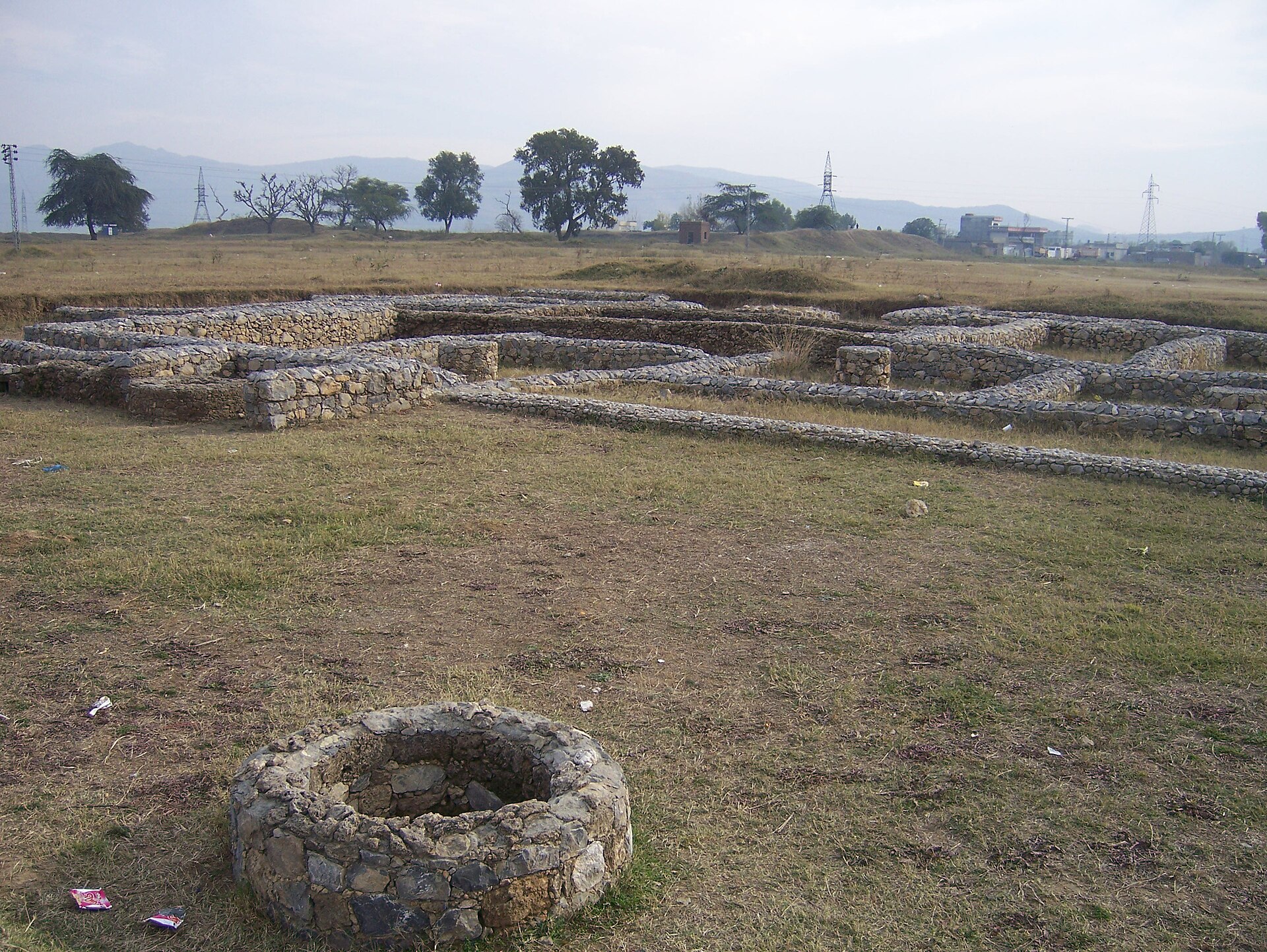
Image: Ruins at Bhir Mound, ancient Taxila, a city named in Pāṇini's own rules (4.3.93). Dawoodmajoka, Public domain, via Wikimedia Commons.
Where the cold river meets the broad,
fourteen lines of sound were set;
four thousand threads in eight books bound,
and a name the brown hills keep yet.
Where the Two Rivers Meet
Of a town in Gandhāra, and a man whose age is lost.
Far to the northwest of the kingdoms of the Ganges, the land of Gandhāra climbs toward the mountains. There the Kabul River, cold with the snows of the western heights, comes down to join the broad Indus. Brown hills stand behind the meeting of the waters, and in those days a town called Śalātura stood near that joining. Beyond the Indus to the southeast lay Takṣaśilā, a city of teachers and traders; but our tale begins in the smaller place among the hills.
There, it is told, was born Pāṇini. His mother is remembered as Dākṣī. Of his life we know almost nothing more. Even his age is lost in mist. Some say he lived about five hundred years before the Common Era; others place him a century earlier, or a century later. Yet he left behind one thing that has outlasted every wall of his town: a grammar, a full account of how the words of a language are made.
The Sounds Set in Order
Of fourteen lines, and the markers set at their ends.
The language was Sanskrit, and Pāṇini wished to show how every word of it is built.
He began with the sounds themselves. He laid them out in fourteen short lines, and at the end of each line he set a marker: a letter outside the sounds themselves, used only as a signpost. With these markers he could name a whole group of sounds in a single breath. Just as we might say “from A to F” rather than naming six letters one by one, so one short word, made of a first sound and a marker, could stand for all the vowels, or for every consonant. Such a compact name is called a pratyāhāra, a drawing-together. Later ages named these fourteen lines after the god Śiva, as though they had come from him, and they are called the Śiva Sūtras still.
I am Pāṇini, son of Dākṣī, of Śalātura. Of my days I will tell you nothing, for I left you nothing of them. But hear the sounds: I set them in fourteen rows, and at each end I placed a mark, so that a whole company of sounds could be called by a single name.
Eight Chapters, Learned by Heart
Of rules as short as threads, and a cloak returned at the door.
Then he wove his rules. There are nearly four thousand of them, set in eight chapters, and so the work is called the Aṣṭādhyāyī, “the Eight Chapters”. Each rule is a sūtra, a “thread”, and many are only two or three words long. Some are easy to grasp: when two like vowels meet, they melt into one long vowel. Others work only together, like the wheels of a mill. One rule builds the body of a word, another gives it an ending, and a third smooths the sound where two words touch. A word said once in a rule is carried forward into the rules that follow, so it need not be said again.
So short were his threads that grammarians of later times had a saying: that saving half a short vowel (ardhamātrā) gave them as much joy as the birth of a son.
The grammar was learned by heart. Pupils sat before their teacher and repeated each line until it was their own, and so it passed from mouth to ear down the long years. Whether Pāṇini himself ever wrote it down, no one can say.
At its very end stands one of the shortest rules of all, two sounds only: a a. All through the work the short vowel a has been treated as open and full (vivṛta), for the sake of the rules. This last line quietly gives back its true sound in speech, closed (saṃvṛta), as a guest returns a borrowed cloak at the door.
Through all my rules I let the short a stand open and full, because the rules needed it so. At the last I gave it back its true sound. A borrowed thing should be returned.
The Names of the Northwest
Of wells by the Vipāś, and the man of Śalātura.
His grammar speaks for the whole Sanskrit world, yet it keeps turning towards home. One rule tells how to name a man whose forebears came from the Sindhu country or from Takṣaśilā. The very next tells how to name a man of Śalātura, and long afterwards that same name, Śālāturīya, “the man of Śalātura”, was given to Pāṇini himself. His rules name the Gāndhāris, the people of that northwest land, and the Yavanas, strangers from the far west. He even noticed that wells on the northern side of the river Vipāś were named in a slightly different way from others, as only a man who knew that country well might do. Later commentators marvelled at the subtle eye of the sūtra-maker who paused for so small a thing.
What Later Tellers Said
Of a dull pupil, a god’s thunder, and a lion.
Where history falls silent, later tellers speak. Some fifteen hundred years afterwards, a tale told in Kashmir made him a “rather stupid pupil” in the house of the teacher Varṣa at Pāṭaliputra, far away in the east. Sent away by his teacher’s wife, he went up into the Himalaya and did hard penance, until Śiva granted him “a new grammar, the source of all learning”. Then he came down and challenged the learned Vararuci, also called Kātyāyana. For seven days they argued. On the eighth Vararuci was winning, when a terrible sound came from Śiva in the sky, and Pāṇini prevailed.
A book of animal fables remembered a darker end in a single verse: “A lion took the life of Panini, / Grammar’s most famous name”. What lies behind it, no one knows.
In the seventh century of the Common Era, a Buddhist pilgrim from China came to Śalātura. He wrote that “this is the place where the Rishi Pāṇini” was born. In a tale he heard there, a Brahmin of the town says that its children honour the sage, and that “a statue erected to his memory still exists”.
The Long Road of the Rules
Of the teachers after him, and two thousand years of Sanskrit.
The grammar did not stay in the northwest. Some generations later, a scholar named Kātyāyana wrote short notes on its rules, testing them and adding what the language had gained. After him, perhaps in the second century before the Common Era, Patañjali wrote the Great Commentary, the Mahābhāṣya, and in it Pāṇini is called Dākṣīputra, “son of Dākṣī”.
Through such teachers his rules became the measure of good Sanskrit. Poets and philosophers, priests and kings wrote by them for more than two thousand years, and the language we call Classical Sanskrit is in great part the language he described. In our own age, those who study how all human languages work still marvel at how much he caught in so few words.
The houses of Śalātura in his day are long gone.
The truth behind the tale
The Aṣṭādhyāyī itself is real and survives: about 3,960–4,000 short rules (the count varies slightly by tradition) in eight chapters, opened by the fourteen sound lists called the Śiva Sūtras. Pāṇini’s own rules name Takṣaśilā (4.3.93), Śalātura (4.3.94), the Gāndhāris (4.1.169) and wells north of the Vipāś (4.2.74), which is why most scholars place him in the far northwest; Śalātura is usually identified with Lahor, Swabi district, Pakistan. The name “son of Dākṣī” comes from Patañjali’s Mahābhāṣya (c. 2nd century BCE), and the name Śālāturīya is found only in much later sources, including an 8th-century CE inscription. His date is uncertain: most put him around the 5th century BCE, but estimates run from the 6th to the 4th. The story of the dull pupil and Śiva’s gift is from Somadeva’s Kathāsaritsāgara (11th century CE), the lion verse from a medieval Pañcatantra, and the statue from a legend recorded by Xuanzang (7th century CE); none is historical evidence. We do not know how he lived, whom he taught, whether he used writing, or how he died.
Imagined voice: the italic passages in which Pāṇini speaks in the first person are imagined. They are built only from the texts and studies named here, add no events, and are not quotations.
Sources
- Aṣṭādhyāyī sūtrapāṭha (sanskritdocuments.org), esp. 4.1.49, 4.1.169, 4.2.74, 4.3.93–94, 6.1.101, 8.4.68.
- C. H. Tawney (trans.), The Kathá Sarit Ságara, vol. I (1880), ch. 4.
- A. W. Ryder (trans.), The Panchatantra (1925), Book II.
- S. Beal (trans.), Si-yu-ki: Buddhist Records of the Western World, vol. I (1884), Book II, Gandhāra.
- H. Scharfe, Grammatical Literature (1977), p. 88; G. Cardona, Pāṇini: A Survey of Research (1976/1997).
- Aṣṭādhyāyī: the Śiva Sūtras (akṣarasamāmnāya) and pratyāhāra designations; 8.4.68 a a, restoring short a from open (vivṛta) to closed (saṃvṛta) (Mahābhāṣya on 8.4.68).
- Kāśikāvṛtti on 4.2.74 (udak ca vipāśaḥ): wells north of the Vipāś; mahatī sūkṣmekṣikā vartate sūtrakārasya.
- Nāgeśa Bhaṭṭa, Paribhāṣenduśekhara: ardhamātrā-lāghavena putrotsavaṃ manyante vaiyākaraṇāḥ (saving half a short vowel equals joy at a son’s birth).
- G. Cardona, Pāṇini: A Survey of Research (1976/1997); H. Scharfe, Grammatical Literature (1977): northwest placement, oral transmission, dating.