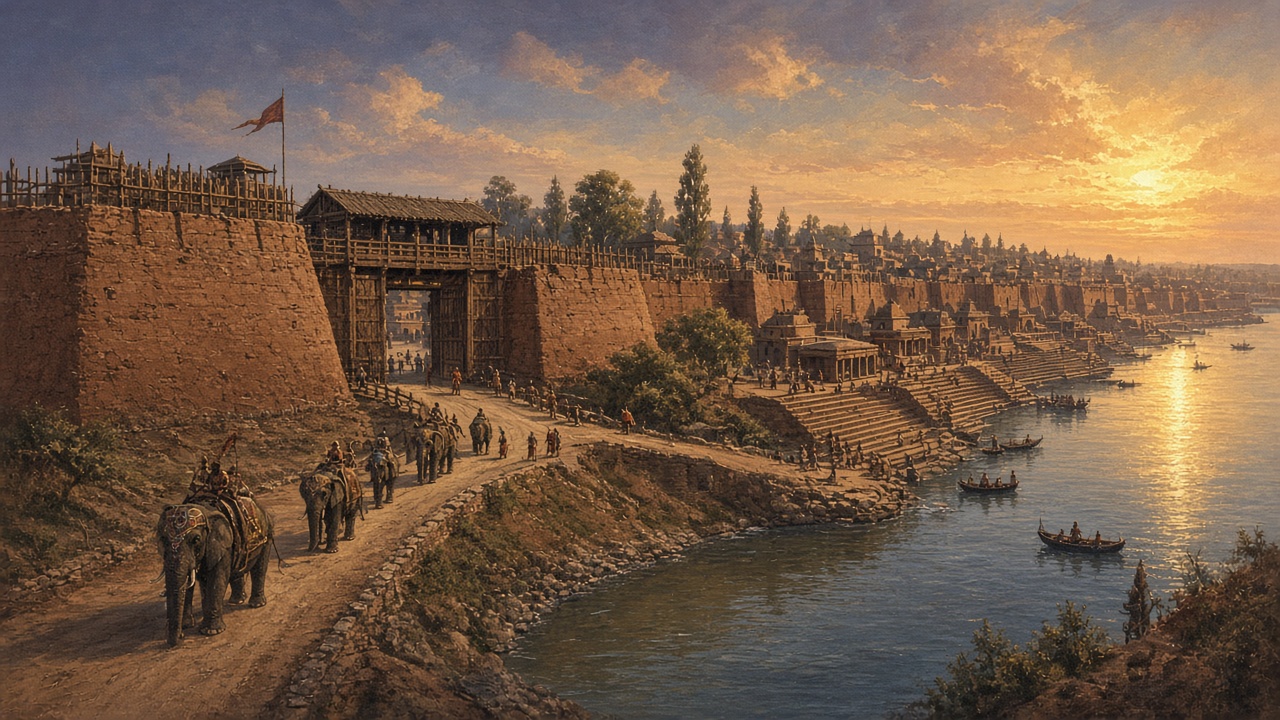
AI illustration: the ramparts of Ujjayinī on the Śiprā at sunset (an imaginative reconstruction).
West of the forests a fierce king reigned,
and a cup of ghee was his shame;
a she-elephant fled through the night,
and a cloth bore the Buddha’s name.
The City Beyond the Forests
Of Avanti on the Śiprā, and a king called the Fierce.
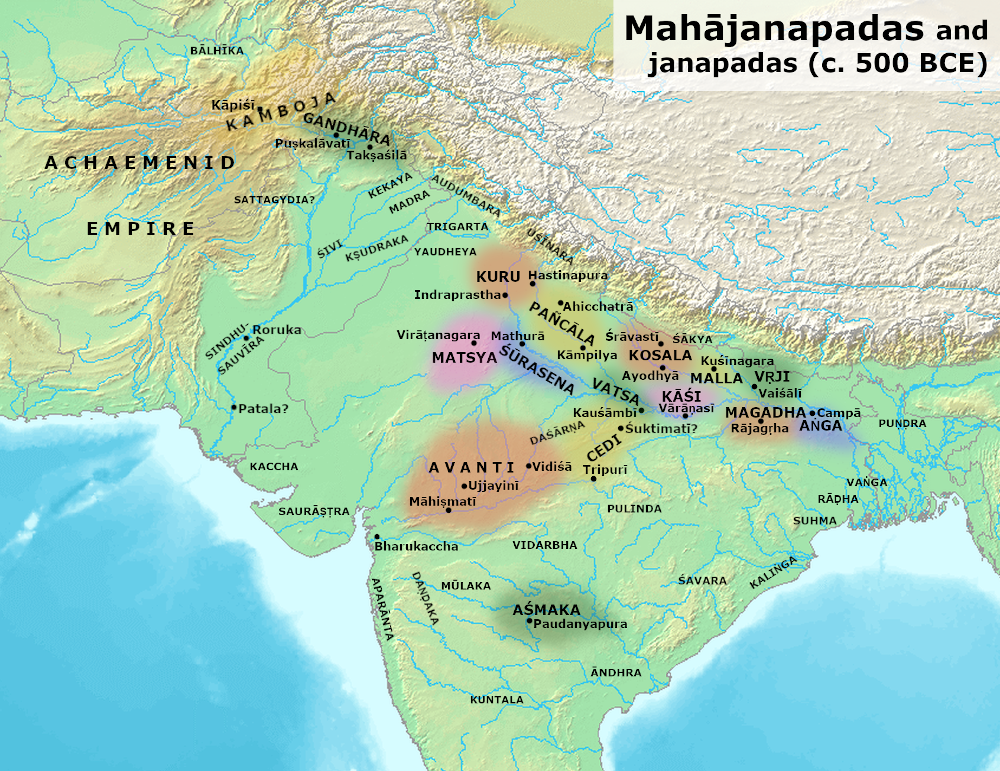
Four and twenty centuries ago, when the Buddha still walked the roads of the Ganges country, there was a kingdom far to the south and west, beyond the long forests. It was called Avanti, and its chief city was Ujjayinī (Ujjenī in the eastern tongue), on a wide plain beside the river Śiprā. Caravans passed through its gates, and it owed nothing to the kings of the east.
There ruled Pradyota, whose name means “radiance”; the monks of the east called him Pajjota. Yet men seldom spoke that name alone. They called him Caṇḍa, the Fierce, for his temper was swift and his anger feared. Tibetan tellers later said the world was lit as by a lamp at his birth, on the day the Buddha was born. But that is a later song.
The Yellow Sickness
Of a proud king yellow with jaundice, and a doctor sent from the east.
It is told in the old book of monastic rules that Pradyota fell sick with jaundice (paṇḍuroga). Famous physicians came, took their gold, and went away; none could heal him. So the proud king sent east to Bimbisāra of Magadha, whom these Chronicles have met already, asking for Jīvaka, the vejja, the doctor of that age, whose own tale is still to come in these Chronicles.
Bimbisāra spoke as kings spoke to those beneath them, saying bhaṇe, “I say”: go to Ujjenī and treat King Pajjota. Jīvaka answered Evaṃ, deva, “As you say, Your Majesty,” and went west.
He looked upon the king and saw what was needed: medicine boiled in ghee. He addressed him as deva, as attendants addressed a sovereign. But the king would have none of it. “I have an aversion and a distaste for ghee,” he said. Heal me some other way.
I am Pradyota of Ujjayinī, and men call me the Fierce. I will tell you of my sickness. The great physicians came, took their gold and failed me. Then the young doctor from the east spoke of ghee, and I would not drink what I loathe.
The Cup and the She-Elephant
Of an astringent decoction, leave to pass any gate, and flight upon Bhaddavatikā.
Jīvaka knew there was no other way. So he boiled the ghee with many drugs until it had the colour, smell and taste of “an astringent decoction” (kasāva: an astringent draught). When the king digested it, he would vomit and know he had been tricked. And this king was cruel, and might have him killed.
So Jīvaka asked a favour. We vejjā, he said, must dig roots and gather herbs at odd hours: let him take any beast, pass any gate, and come and go at any hour. The king granted it.
Then Jīvaka gave him the cup, saying Kasāvaṃ devo pivatū, “May Your Majesty drink the astringent.” While the king drank, the doctor went to the stalls. There stood Bhaddavatikā, the king’s she-elephant, who could travel fifty leagues in a day. Upon her back Jīvaka passed out of the city and was gone.
Soon the ghee did its work, and the king rose in fury. He sent after the doctor a slave named Kāka, said to be born of a spirit, who could travel sixty leagues in a day. He spoke to him as to a servant, saying bhaṇe: “Those physicians,” the king warned him, “are cunning people.” Take nothing from his hand.
The Myrobalan on the Road
Of Kāka overtaken at breakfast, half a fruit, and a cloth finer than thousands.
Kāka overtook the doctor at breakfast in Kosambī, and called him ācariya, teacher: the king orders you turned back. Jīvaka would share his meal; Kāka refused. But Jīvaka had secretly worked a drug into a myrobalan fruit with his fingernail. He ate of it himself and offered the rest, and Kāka, thinking no harm could lie in the doctor’s own food, ate half a fruit and fell sick on the spot. Be not afraid, said Jīvaka; you will be well, and so will your king. But I will not return to a king who might kill me. He gave the she-elephant back into Kāka’s keeping and went on to Rājagaha, and Bimbisāra said he had done rightly.
When Pradyota was healed, his wrath cooled into gratitude. He offered a boon; Jīvaka asked only to have his service remembered. So the king sent him a suit of Siveyyaka cloth, the finest among many thousands. Jīvaka judged that none but the Buddha or Bimbisāra was worthy of it, and gave it to the Buddha. Soon after, the Buddha first allowed his monks to accept robes from householders.
Yes, he tricked me, and I raged. But I was well again. So I sent him the finest cloth of all my thousands. What he did with it I learned afterwards.
The Elephant That Was Not an Elephant
Of a wooden beast, a captive king, and a lesson behind a curtain.
Tellers of a later age remembered Pradyota in a wilder tale. Looking once upon his own splendour, he asked whether any king could match it. His courtiers named Udayana of Kosambī, who could charm wild elephants with a spell and a lute. So Pradyota had an elephant made of wood, wrapped in cloth and painted, with sixty men hidden in its belly, and set it loose near his rival’s land. Udayana rode after it, playing his lute, but the wooden beast only ran faster. He left his army far behind, and Pradyota’s men seized him.
When the king demanded the elephant charm, Udayana would teach it only if the king paid him homage. The king threatened death. “Do so,” Udayana answered; “you are lord of my body, not of my mind.”
So Pradyota plotted. His daughter would learn the charm, and he would learn it from her. But fearing they might fall in love, he told Udayana that his pupil was a hunchback, and told the princess that her teacher was a leper. She sat behind a curtain while he taught from outside. One day, when she stumbled over the words, Udayana cried, “Dunce of a hunchback!” She answered in anger, and he lifted the curtain. There sat Vāsuladattā, the king’s daughter, whom later poets call Vāsavadattā. From that day there were no more lessons.
When the king went out to his garden, Udayana loaded sacks of gold and silver onto the she-elephant Bhaddavatī, lifted the princess up, and fled. When soldiers pursued, he scattered the coins, and while they stooped to gather them, he escaped home to Kosambī and made her his chief queen. Later poets told the tale again in plays and in the great Ocean of Story, where the fierce king is often called Mahāsena, “he of the great army”.
Walls in the East
Of a chaplain who became a monk, and walls raised against the west.
The commentators also tell that Pradyota’s chaplain, Kaccāna, went east at his bidding to invite the Buddha, and there became a monk. The Buddha sent him home in his stead; and it is said the king, frightened by a dream, learned gentler ways from him. Among the verses kept under that monk’s name is a line a fierce king might heed: “mortals have deeds as their kin.”
Yet the oldest discourses keep a harder memory. Not long after the Buddha passed away, Bimbisāra’s son Ajātasattu was strengthening the walls of Rājagaha, suspicious of King Pajjota. So the Fierce outlived the Master.
The truth behind the tale
The ghee story comes from the Pali Vinaya (Mahāvagga VIII), though the fifty-league elephant and spirit-born slave are storytelling. The plainest early evidence for Pradyota as a real, feared power is one line in the Majjhima Nikāya (MN 108). The wooden elephant and the flight with the princess come from the Dhammapada commentary, written down in Sri Lanka around the 5th century CE; Bhāsa’s plays and the 11th-century Kathāsaritsāgara tell later versions. Kaccāna’s mission and the dream are commentarial; the Tibetan birth story is later still. The Purāṇas list five “Pradyota” kings ruling 138 years, founded when a minister killed his master and crowned his son; they place them in Magadha, but many historians think this remembers Avanti. Excavations at old Ujjain found a great clay rampart and moat, though its date is debated. Pradyota lived in the Buddha’s time, usually placed in the 5th century BCE (some say the 6th), so all dates are approximate.
Imagined voice: the italic passages in which Pradyota speaks in the first person are imagined. They are built only from the texts and studies named here, add no events, and are not quotations.
Sources
- T. W. Rhys Davids and H. Oldenberg, Vinaya Texts II (SBE 17, 1882), Mahāvagga VIII.1.23–29; also Bhikkhu Brahmali, Vinaya Khandhaka 8 (SuttaCentral).
- E. W. Burlingame, Buddhist Legends I (Harvard Oriental Series 28, 1921), Book 2, Story 1, Part 4.
- Bhikkhu Sujato, Majjhima Nikāya 108 and Theragāthā 8.1 (SuttaCentral).
- G. P. Malalasekera, Dictionary of Pali Proper Names, “Caṇḍappajjota”.
- H. H. Wilson, Vishnu Purana IV.24; C. H. Tawney, Kathāsaritsāgara, chapters XI–XIV.
- “The Ganga-Yamuna Basin”, Expedition (Penn Museum).
- Vinaya, Mahāvagga VIII.1 (Khandhaka 8), Pāli text and trans. Bhikkhu Brahmali, SuttaCentral: vejja (doctor); Jīvaka’s address deva to King Pajjota; the king’s bhaṇe to Kāka; the astringent (kasāva); Kāka’s address ācariya; Bhaddavatikā and the Siveyyaka cloth.