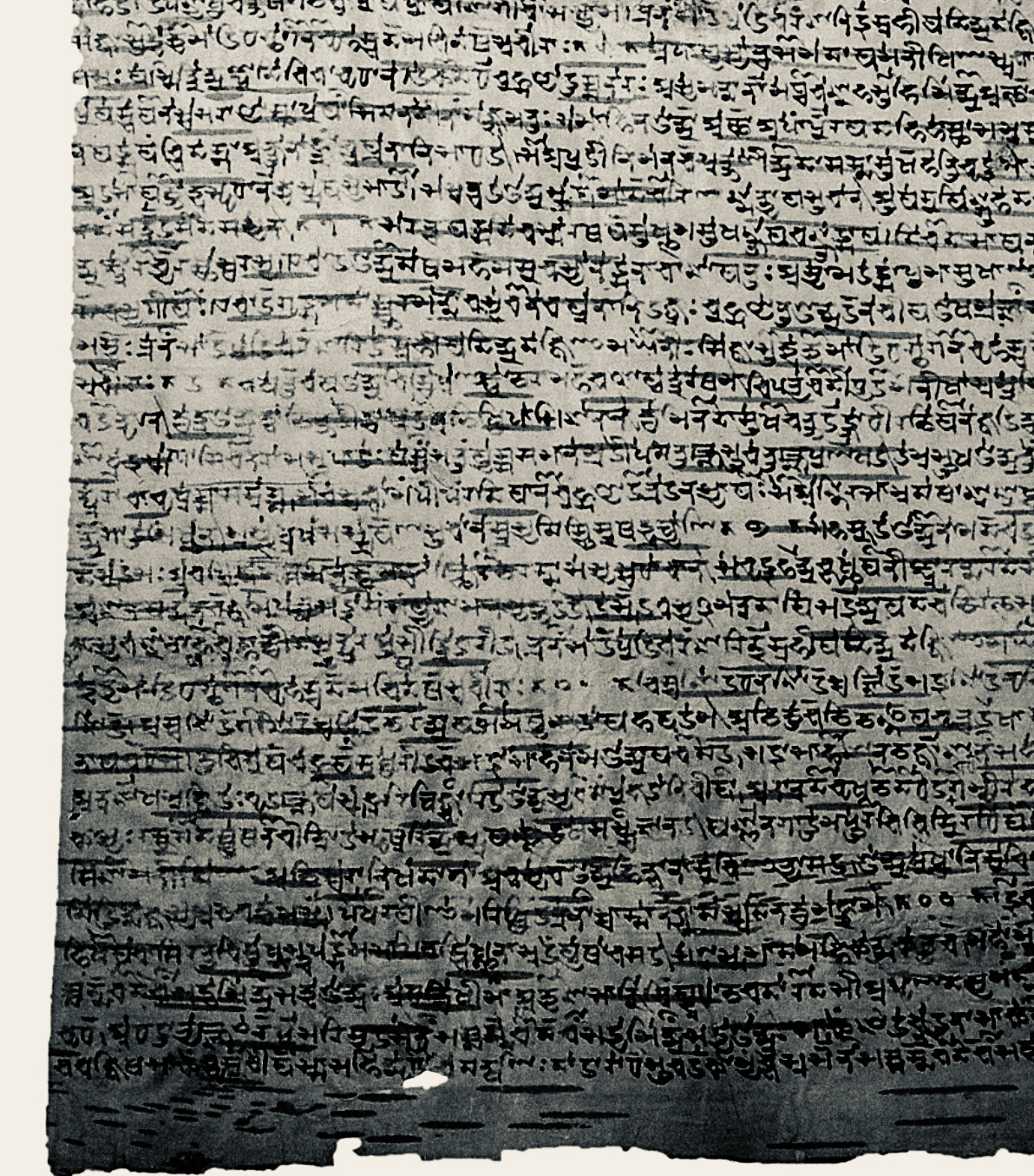
Image: Ṛgveda on palm leaf in Śāradā script, Kashmir; Bhandarkar Oriental Research Institute, Pune. Ms Sarah Welch, CC0, via Wikimedia Commons.
Riders of morning, swift as thought,
you have healed the old and the lame;
come to the house where a daughter waits,
and stay when the dawn has come.
The House of the Singer
Of a poet’s house, and a daughter who stayed.
In those days, when the Ṛgveda was still being sung into being, there lived a poet named Kakṣīvant. He came of an old line of singers: he was called the son of Uśij, and the house of the seer Dīrghatamas was counted among his forebears. Of all the gods, he loved best the Aśvins, the twin horsemen of the morning. In one of his songs he praised them for pouring from the hoof of their horse a hundred jars of honey for the people.
It is told that Kakṣīvant had a daughter, and her name was Ghoṣā. In the old tongue the word means a sound or a cry, a fitting name for one remembered for her voice.
The seasons went over the house of her father. Rains came and went, the herds were driven out at dawn and home at dusk, and other girls left with husbands. Ghoṣā stayed. One of her father’s own hymns remembers it in a single line: “Even to Ghoṣā, living at home with her father, you gave a husband, though she was growing old.” The rest must be heard in the hymns that bear her name.
I am Ghoṣā, daughter of Kakṣīvant, and I will tell you how the seasons passed over my father’s house. The rains came and went. Other girls went away with husbands. I stayed, and I grew older, and each morning I heard the singers call upon the riders of the dawn.
The Riders Before the Sun
Of the twin horsemen of morning, and the deeds sung of them.
Each morning, before the sun was up, the singers turned their faces east. That was the hour of the Aśvins. Their chariot was swifter than thought, made for them by craftsmen of the gods, and when it was yoked, so the song says, Dawn, the Daughter of Heaven, was born.
The first of the hymns given to Ghoṣā calls them by their old fame as healers. They are “good fortune even for the woman growing old at home”, it says, and help for the slow, the hungry, the blind and the broken.
Then the song tells their great deeds, one after another, like beads on a thread. They “fashioned old Cyavāna, like a chariot, into a youth again”. They made the poet Kali young again. They pulled the son of Tugra out of the waters. They dug Vandana out of a snare and raised up Rebha, hidden and already given up for dead. For Atri they made a pit of heat a place of comfort. In an instant they made Viśpalā go again; Ghoṣā’s father sang that they gave her a leg of metal. They brought a bride to Vimada and freed a quail “even from within the mouth of the wolf”.
And in the middle of all this praise, a woman’s voice breaks in. She begs the twins to care for her as parents care for a child, for she is “without friends, without kin”, and she asks to be saved from her shame. Many have heard Ghoṣā herself in that cry. Yet the song does not name her, and some who know it well think it is another woman’s voice, set there beside hers.
Where Do You Rest at Night?
Of questions light as a child’s, and a name spoken once.
The second hymn opens with questions, light as a child’s. Where are the Aśvins in the evening, and where at dawn? Where did they sleep? Who draws them home, as a maiden draws a dashing youth to a meeting? They come to the soma rites, the singer says, “like kings’ sons”, as young princes ride to a feast.
Then a name rings out, the only time it is spoken in her hymns. “Ghoṣā, the daughter of a king”, circling about the twins, speaks to them boldly: “Will you be there for me for the day and be there for the night?” She names the ones they have aided before, Bhujyu among them, and the widow, and she says that she takes delight in their kindness.
So I spoke to them myself. Where do you rest at night, you two? Will you be there for me by day and by night? You helped Bhujyu and the widow. I take delight in your kindness.
Here there is a riddle. In her father’s song she is growing old in his house; in her own she is a princess. Perhaps the princess is her proud name and the lonely house her sorrow. Perhaps they are two women. The old songs do not say.
The Wedding Song
Of sprouts and rivers, and a marriage at last.
After her words, the hymn turns to a wedding, and the images come like spring after a long dry season. The maiden is born. The sprouts spring up by the wonder of the Aśvins. The rivers run down as if into a valley. And then, plain and glad: “this is marriage!”
The kin weep at the rite. The fathers have long planned the match, and it is precious to them that the couple is brought together; to the husbands it is a joy to hold their wives. At the last the singer begs the twins to clear every stump from the path, and asks once more where they have gone.
What Later Tellers Said
Of sixty years in a father’s house, and a story grown like ivy.
Long after the hymns were fixed, other tellers filled the silence with a story. An old book of the gods and their legends says that Ghoṣā was “disfigured by an evil disease”, and that she stayed in her father’s house for sixty years. At last she thought that her father had won youth and health by praising the Aśvins, and that she might win beauty in the same way. Then she “saw” the two hymns, as seers were said to see their songs. The twins were pleased. They made her “ageless, free from disease, and beautiful”, and gave her a husband and a son, the sage Suhastya. A teacher of a much later age named her sickness: it was leprosy, he said, and that was why no man would wed her.
To Suhastya the tradition gives a short hymn of his own, set just after his mother’s. It too begins with the chariot of the Aśvins at break of dawn.
So the story grew around the songs, as ivy grows around a doorway. Whether a woman truly made these hymns, or whether her name was later drawn from the woman who speaks in them, no one can now say.
The truth behind the tale
The hymns are real: Ṛgveda 10.39 and 10.40, fourteen verses each, from Book 10, a late layer of a collection usually placed around 1500–1000 BCE. Ghoṣā is named in 10.40.5 as a king’s daughter, and her father’s hymn 1.117.7 says the Aśvins gave her a husband when she was growing old in his house; the long list of rescues comes from 10.39, except Viśpalā’s metal leg (1.116.15). Older readings that find her in 1.120.5 and 1.122.5, with a husband named Arjuna, are doubtful, since ghoṣā there may simply mean “cry”. The ancient index (Anukramaṇī) names her as poet, but it often took poets’ names from people in a hymn, and some modern translators see no firm evidence that a woman composed these songs, or that the friendless woman of 10.39.6 is Ghoṣā. The disease, the sixty years and the son Suhastya come from the Bṛhaddevatā (7.42–48), a later work of disputed date, and the passage is missing from some manuscripts; the word “leprosy” comes from the commentator Sāyaṇa (14th century CE). We do not know where or exactly when she lived, or whether she lived at all.
Imagined voice: the italic passages in which Ghoṣā speaks in the first person are imagined. They are built only from the texts and studies named here, add no events, and are not quotations.
Sources
- S. W. Jamison and J. P. Brereton (trans.), The Rigveda (2014): introduction; RV 1.116–122; 10.39–41.
- R. T. H. Griffith (trans.), The Hymns of the Rigveda (1896), sacred-texts.com: RV 1.117, 10.39, 10.40.
- A. A. Macdonell (trans.), The Bṛhad-devatā (1904), vol. II, 7.42–48.
- H. H. Wilson (trans.), Rig-Veda Sanhitá with Sāyaṇa’s commentary, note on RV 1.117.7 (wisdomlib.org).