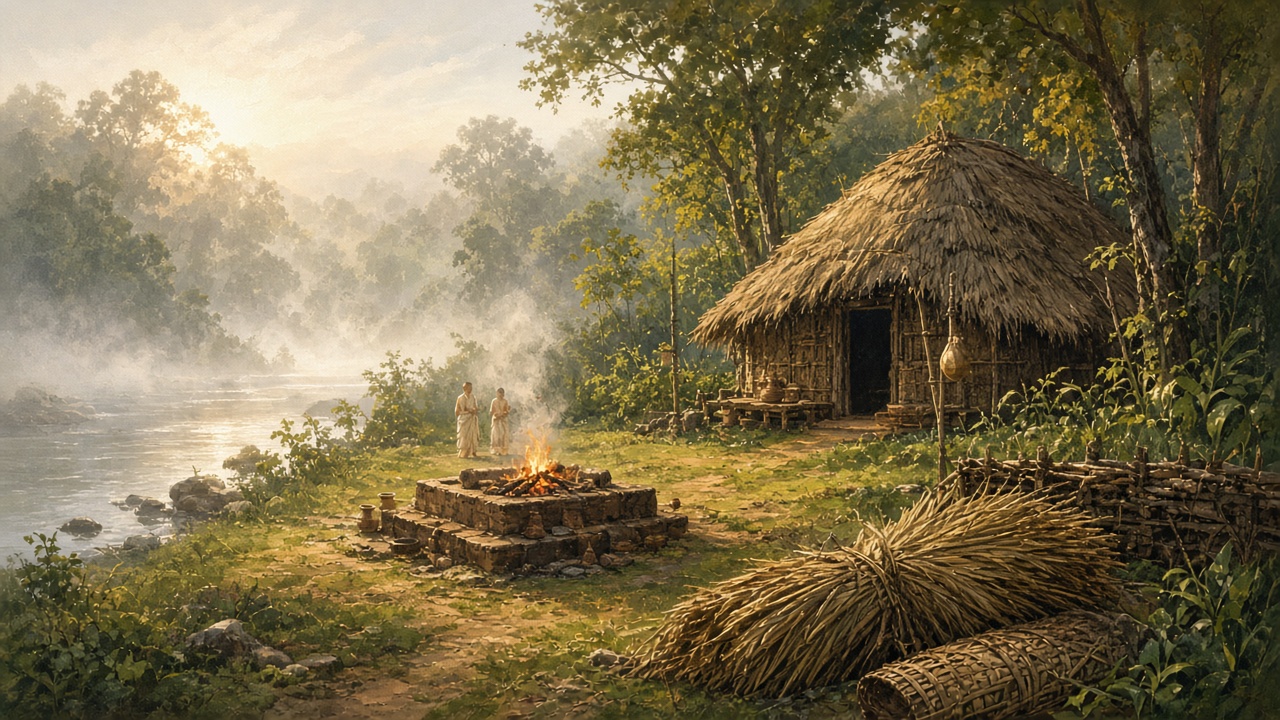
AI illustration: a Vedic forest hermitage by a river at dawn (an imaginative reconstruction).
Evening and morning the fire was fed,
through autumns many and long;
the sage spoke of labour, the wife of love,
and the student kept the song.
The Fire at Evening
Of a wife who had waited many autumns, and a sage who gave way.
The fire was lit again, as it was every evening and every morning, in the days when the hymns were young. A woman watched her husband bending over the rite, and she had had enough. “For many autumns have I been laboring,” she says, “evening and morning, through the aging dawns. / Old age diminishes the beauty of bodies.” Then, with no softening at all: “Bullish (men) should now come to their wives.”
Like one pleading at law, she cites precedent: even the ancients “who served truth and at one with the gods spoke truths” still “got out of harness, for they did not reach the end.” No one ever reached the end of the work, she says; and so they may rest awhile.
I am Lopāmudrā, and I will tell you of the many autumns. Evening and morning I tended that fire beside him, while the dawns grew old and we grew old with them. The ancients themselves laid down the work unfinished. So I said to him: lay it down awhile, and come to me.
Her husband, the sage Agastya, answered like a man long wedded to the altar. “Not in vain is the labor that the gods help,” he insists, and he turns their marriage into a campaign of war: “let us two win here the contest of a hundred stratagems, when as a united couple we will drive on.” It is a noble speech. It lasts one verse. In the next, desire “has come to me … from here, from there, from everywhere,” and the steadfast man yields to the woman he calls flighty. Then a third voice, by tradition a student, sighs over his soma: “for of many desires is mortal man.”
The Closing Cycle of Book One
Of Agastya the punning poet, and a hymn tucked somewhat oddly away.
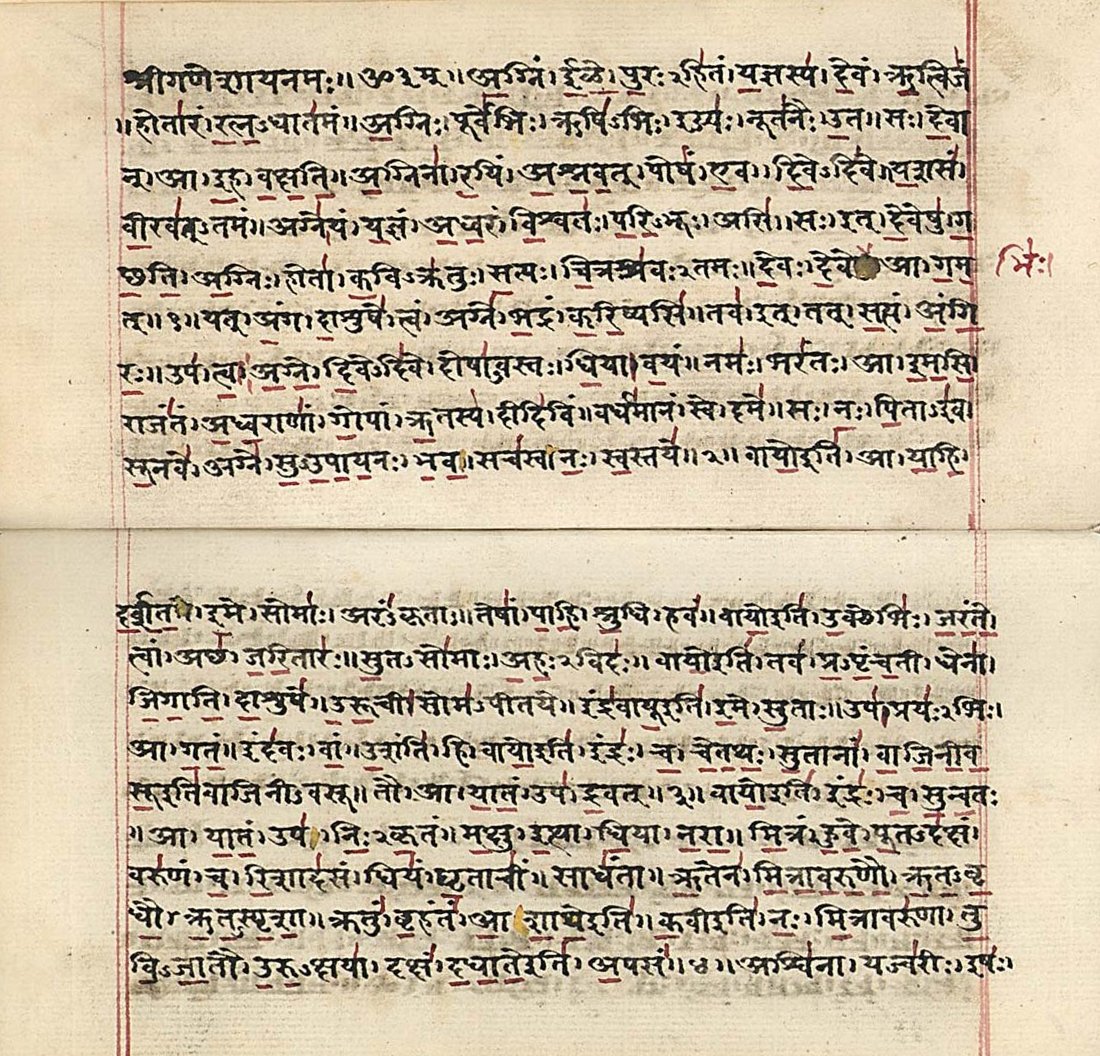
The Ṛgveda’s thousand-odd hymns were made and handed down by mouth long before anyone wrote them down. Every date is an estimate: they are commonly set around 1500–1000 BCE, and this chapter takes no side in debates about origins.
Readers of the Viśvāmitra chapter met the “family books”, 2 to 7. Agastya’s hymns stand elsewhere, as the closing cycle of Book 1 (1.165–191). He was one of the great masters of the hymn-makers’ craft, a poet of puns and riddles. He names himself Mānya, son of Māna. His best-known hymns (1.165, 170 and 171) tell how Indra and the Maruts, the storm gods, quarrelled over a sacrifice he offered, until they were reconciled. Nearly all his hymns end with the same signature line: “May we know refreshment and a community having lively waters.”
Tucked away between his hymns to Indra and his hymns to the Aśvins lies 1.179. It belongs to a small and vivid group of dialogue hymns, beside Yama and his twin Yamī, and the nymph Urvaśī and her mortal husband Purūravas. Tradition names the hymn’s deity as Rati, “Delight”. In one Indra hymn (1.170.4) Agastya says “we two shall extend” the sacrifice, and the second of the two may well be Lopāmudrā.
Ascetic and Householder
Of two goals that cannot both be served, and a wife beside the sacrificer.
In a few lines the hymn holds, in embryo, a theme that runs through all Indian religious literature: the pull between two goals of holy men, ascetic practice and the getting of sons. It brings in also the figure who reconciles them: the eager wife who seduces the ascetic, so that he gains sons without wholly forsaking his austerities.
Agastya’s call to fight “as a united couple” may also touch a question of the late hymns: whether the sacrificer’s wife (patnī) should stand beside him as a partner in the rite.
The women in the dialogue hymns speak out boldly, often about sex, and the men beside them tend to look weak and helpless. Tradition went further, and named other women as Ṛgvedic poets: Ghoṣā (whose own chapter follows soon), Apālā and Viśvavārā. Centuries later, Gārgī would rise at a king’s court to cross-examine Yājñavalkya.
He spoke of a hundred stratagems, and of labour the gods would bless. It was a fine speech. But one verse later he was mine, and a student by the fire was sighing over his soma. Of many desires is mortal man, he said. He was not wrong.
A Proverb in a Common Accent
Of a shrug in verse five, and a sage digging with spades.
The most human line is the smallest. Verse 5 ends with a shrug: “for of many desires is mortal man.” It has the ring of a popular saying. The word for “many” is spoken with an l (pulu-) in place of the standard r (puru-). That homely form comes again only once in all the hymns, in the racy Vṛṣākapi hymn. It is as if a proverb, in an everyday accent, had slipped into sacred verse.
The last verse sets all in order. Agastya, “digging with spades, seeking offspring, descendants, power”, throve in both “colours”, sons and ascetic power, and “arrived at his hopes.” A fourteenth-century commentator, more decorously, took the digging to mean “obtaining the desired result by means of lauds and sacrifices.”
What we actually know, and what we don’t
Text. For the hymn’s six verses, the Anukramaṇī gives verses 1–2 to Lopāmudrā, 3–4 to Agastya and 5–6 to a student. Verse 4 is disputed. Many modern translators, among them Geldner, Renou and Wendy Doniger, give it to Lopāmudrā, making her the one seized by desire. Jamison sides with the Anukramaṇī and Sāyaṇa and gives it to Agastya, which she says “makes for a more psychologically complex portrait.” Verse 5 is often read as the expiation of someone, perhaps a Vedic student, who has broken a vow, quite possibly of chastity. Thieme saw the dialogue as a mythical precedent recited to make the penance work. Griffith (1896) printed verses 3–4 only in Latin, and recorded Abel Bergaigne’s mystical reading, in which Agastya is the heavenly Soma, drawn down by Lopāmudrā as “fervent Prayer.”
Later tradition, clearly labelled. The Mahābhārata (Vana Parva, Tīrthayātrā section; Ganguli’s sections 96–99) is many centuries later, and very different. Agastya sees his ancestors hanging head-down in a pit, needing a descendant. So he shapes a woman from the most beautiful parts of different creatures and gives her to the childless king of Vidarbha, who raises her as a princess called Lopāmudrā. When she marries the sage, she swaps her silks for bark and deerskin. But when he summons her, she asks for a bed “like to that which I had in the palace of my father”, and for ornaments. Agastya must find wealth without spending ascetic merit. Three kings, Śrutarvan, Bradhnāśva and Trasadasyu, show him that their income exactly matches their expenditure, so he takes nothing from them: a sage who respects a balanced budget. The demon Ilvala is another matter. He kills brahmins by serving them his brother Vātāpi as mutton and then calling him back out. Agastya eats the lot; when Ilvala calls, the sage laughs: “How can he come out? I have already digested that great Asura.” Offered a thousand sons or one, Lopāmudrā answers: “One good and learned son is preferable to many evil ones.” Their son Dṛḍhasyu is born after seven years and nicknamed Idhmavāha, “carrier of sacrificial wood”. Later still, Britannica notes that Agastya is revered as the brahmin who brought Sanskrit-speaking civilisation to the south, and Tamil tradition honours him as Akattiyar. Śrīvidyā tantric lineages attribute one form of their fifteen-syllable Pañcadaśī mantra (the hādi form) to Lopāmudrā. In Kodagu legend, the river Kāverī is Lopāmudrā herself.
What’s missing. We have no date, place or biography. In the Ṛgveda her name appears only in this hymn. Jamison and Brereton warn that the index’s attributions to women (Ghoṣā, Apālā and Viśvavārā among them) are often drawn from names in the hymns themselves. They conclude that “there is no real evidence for female poets.” So we cannot know whether a woman composed verses 1–2. What survives, beyond doubt, is a woman’s voice.
Where the story’s details come from. Hymn 1.179 is quoted in Stephanie Jamison and Joel Brereton’s translation (2014). They call Agastya “one of the great masters of the Rgvedic tradition”, find the hymn placed “somewhat oddly”, suggest that the second of “we two” in 1.170.4 is Lopāmudrā, and say it “contains in embryo” the “competing and incompatible goals” of ascetic practice and sons. Building on her Sacrificed Wife/Sacrificer’s Wife (1996), Jamison and Brereton read the late Ṛgveda as debating the wife’s place in the rite, and conclude that the hymn “cannot be seen as a ringing endorsement” of it. They note that women in the dialogue hymns “are quite outspoken, usually about sex, and their male conversation partners tend to look weak and helpless in comparison.” Following Paul Thieme, Jamison says verse 5’s last line “bears the mark of a popular saying.” The deity Rati is named in the Anukramaṇī, and the decorous reading of the digging is Sāyaṇa’s, as reported by Griffith.
Imagined voice: the italic passages in which Lopāmudrā speaks in the first person are imagined. They are built only from the texts and studies named here, add no events, and are not quotations.
Sources (lightly noted)
- Stephanie W. Jamison and Joel P. Brereton, The Rigveda: The Earliest Religious Poetry of India (Oxford University Press, 2014): introduction, Agastya cycle (I.165–191) and I.179.
- Stephanie W. Jamison, Rigveda Translation: Commentary, I.100–191 (UCLA, online, 2026 revision); Sacrificed Wife/Sacrificer’s Wife (Oxford University Press, 1996).
- Ralph T. H. Griffith, The Hymns of the Rigveda (1896), I.179 with notes, Internet Sacred Text Archive.
- Mahābhārata, Vana Parva, sections 96–99, trans. K. M. Ganguli, Internet Sacred Text Archive.
- Encyclopaedia Britannica, “Hinduism: narratives of culture heroes” (Agastya); Douglas R. Brooks, Auspicious Wisdom (SUNY Press, 1992), on Śrīvidyā.
Myth and text flagged throughout: the cold open follows RV 1.179 in Jamison and Brereton’s translation; verse assignments follow the Anukramaṇī, with the dispute over verse 4 noted; the Vidarbha princess, Vātāpi and the seven-year pregnancy are Mahābhārata legend; Śrīvidyā, Tamil and Kāverī traditions are later still; all dates are approximate.