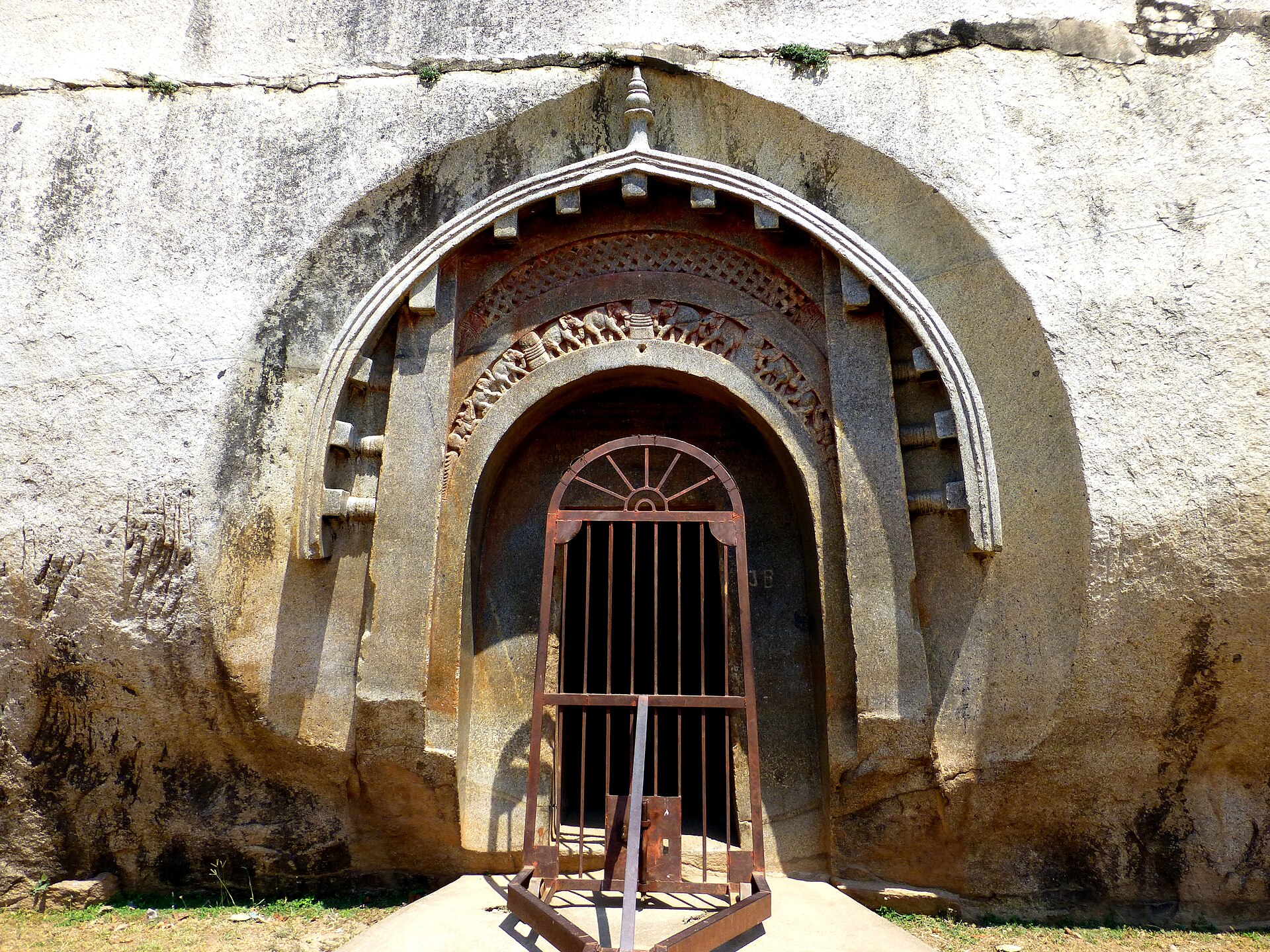
Image: Lomas Rishi cave in the Barabar Hills, Bihar, where Aśoka dedicated caves to the Ājīvikas. Photo Dharma (Anandajoti Bhikkhu), CC BY 2.0, via Wikimedia Commons.
Throw down the ball and let it run,
unwinding down the dusty track;
the fool, the wise, go on as one,
and none can wind the thread-ball back.
A Tale Told by Rivals
Of a teacher whose own words are lost, and the enemies who kept his name.
In those days many teachers walked the roads of Magadha and Kosala. One of them taught that there was no road to choose. All beings, he said, run their course as a thread runs off a ball, and when the thread is spent they come to the end of sorrow, the fool and the wise alike. That teacher was Makkhali Gosāla, and the naked ascetics who followed him were called the Ājīvikas.
Of his own words nothing has come down. All that is told of him was told by two rival houses, the followers of Mahāvīra and the followers of the Buddha, and neither loved him. This is the tale of a man as his enemies remembered him.
I am Makkhali Gosāla, and nothing I said has reached you in my own voice. Every word you will hear of me was carried by those who stood against me. Listen to them, then, and remember who is speaking.
The Cowshed at Saravaṇa
Of a showman’s son, born where the cattle sheltered from the rain.
The Jains tell it so. Long afterwards, in Sāvatthī, Indabhūti Goyama, the eldest of Mahāvīra’s disciples, asked his master, bhante, “sir”, whence this Gosāla had come. And Mahāvīra told him.
There was a man named Mankhali, a mankha, a wandering showman who earned his bread by showing a picture he carried in his hand. His wife was Bhaddā. As the rains set in he came to the settlement of Saravaṇa and found no shelter but the cowshed of a wealthy Brahmin. There Bhaddā bore a son, and because he was born in a cowshed, a gosālā, they named him Gosāla.
Among the Buddhists, long after, another tale was told. Makkhali was a servant carrying a pot of oil across muddy ground, and his master called after him, “My dear man, take care lest you stumble!” He stumbled all the same and fled, and when the master caught the edge of his garment he let the cloth go and ran on naked.
Both tales make him low-born, and both were told by his rivals.
The Sesame Plant
Of a plant torn up by its roots, and seeds that formed regardless.
Gosāla met Mahāvīra, whose own tale is still to come, in a weaver’s shed at Nālandā outside Rājagaha. Three times Gosāla asked to be his disciple and three times he was refused. At last he gave away his clothes and his pictures, shaved his head, and was accepted, and for six years the two lived together, practising austerities.
Once, on the road to Kummagāma, they passed a great sesame plant in flower. Gosāla asked whether it would perish. Mahāvīra answered that it would, and that its seeds would form in the pods of that same plant. To prove him false, Gosāla went quietly back and tore the plant up by its roots. Just then a shower of rain fell, and the plant took root again and stood. When they passed that way again, the seeds were in the pods.
From that day, it is told, he held that all living beings, like the sesame, may die and be quickened again. Soon after, he went his own way. By hard discipline he won a burning power of his own, named himself a Jina, a conqueror, and became head of the Ājīvikas.
Fire at Sāvatthī
Of a burning power hurled at a master, and turned back as from a rock.
His chief seat was Sāvatthī, where a potter woman named Hālāhalā, a lay follower of the Ājīvikas, gave them lodging in her workshop. When Mahāvīra came to that city and said that Gosāla was no Jina, the word ran through the streets, and Gosāla came out in anger with his Ājīvikas to face him.
“You have called me your pupil; but that pupil of yours, Gosāla Mankhaliputta, is long since dead and reborn in the world of the devas,” he said. Another soul, he claimed, now dwelt in the dead man’s body.
Mahāvīra answered that he was like a thief who hides under one disguise after another and fancies that no one knows him. Gosāla abused him grossly. Two of Mahāvīra’s disciples rebuked him, and he struck each of them down with his burning power, the tejolesā. Then he drew back a few paces and hurled the fire at his old master. It rebounded as from a rock, and turned back and burned Gosāla himself.
“You will die of fever within six months,” said Gosāla.
“I shall live sixteen years yet,” said Mahāvīra. “It is you who will die of fever, within seven days.”
Seven Days in the Potter’s House
Of a mango held in a fevered hand, and a burial with two faces.
Many of the Ājīvikas left him then and went over to Mahāvīra. A few stayed. Gosāla fled back to the potter woman’s house, and there, in the fever, he held a mango in his hand, and drank and sang and danced, and sprinkled himself with the cool, muddy water in the potter’s vessels.
A lay follower named Ayampula came to ask him what a certain insect was like, and the elders signed to Gosāla to throw the mango away. Gosāla answered, “it is like the root of the bamboo; play the lute, brother, play the lute!”
Knowing he would die, Gosāla told his elders to bury him with every honour and to proclaim that with him the last Tīrthaṅkara had passed. At the end his certainty gave way. He declared that Mahāvīra alone was the true Jina, that he himself was only Gosāla, the son of Mankhali, a wicked man, and that they should bury him in dishonour. Then he died.
The elders shut the doors of the workshop and within its walls made a show of the shameful rite. Then they opened the doors and buried him in public with every honour, as he had first commanded.
The Ball of String
Of a king’s question, and an answer like a ball of string unwinding.
The Buddhists remembered his teaching more than his life. On a full-moon night, it is told, King Ajātasattu of Magadha, the son of Bimbisāra, asked his ministers which ascetic he might visit to bring peace to his mind. One of them, addressing him as deva, “Your Majesty”, said, “Your Majesty, this bamboo-staffed ascetic Gosāla leads an order and a community, and tutors a community.”
The king had gone to him once already. He had greeted him as bho Gosāla, “good sir”, and asked what fruit the ascetic life could show in this very life. Gosāla answered, “Sentient beings are purified without cause or reason,” and, “There is no power, no energy, no human strength or vigor.” All living things are shaped by niyati, destiny, by circumstance and by their own nature, and through eight million four hundred thousand great aeons the fool and the wise wander from birth to birth. No vow or penance can ripen a deed before its time.
“It’s like how, when you toss a ball of string, it rolls away unraveling. In the same way, after transmigrating the foolish and the astute will make an end of suffering.”
Fool and wise man, you are a ball of string thrown down upon the road. You will roll until the string runs out, and there you will stop, every one of you, at the end of sorrow. No vow can make the string run faster. My followers went naked and fasted all the same, and why they did so went into the dark with their books.
Ajātasattu was displeased, but he would not rebuke an ascetic living in his realm. He rose from his seat and left. It was, he later told the Buddha, like someone who, “when asked about a mango, answered with a breadfruit.”
The Buddha spoke harder words to his mendicants. A hair blanket, he said, is the worst of woven cloths, “cold in the cold, hot in the heat, ugly, smelly, and unpleasant to touch”, and Makkhali’s teaching was the worst of all, for it denied the power of deeds and effort. He called him moghapurisa, a futile man, a trap set at a river’s mouth to the harm of many fish.
Caves in the Granite Hills
Of polished caves given to an order that outlived its founder.
Gosāla died, and the Ājīvikas lived on. Some two hundred years later King Aśoka had caves cut into the granite of the Barabar hills, their walls ground smooth as glass, and gave them to the Ājīvikas. His grandson Daśaratha gave more in the Nāgārjunī hills nearby, to be theirs for as long as sun and moon endure. Later a hand chiselled at the name of the Ājīvikas on those stones, yet it can still be read.
The caves remain in the hills of Bihar, dark and cool.
The truth behind the tale
Makkhali Gosāla was a real teacher of the fifth century BCE, a rival of Mahāvīra and the Buddha. One modern estimate puts his death around 485 BCE, but the dates of this age are uncertain. No Ājīvika writing survives, so all we know comes from Jain and Buddhist sources hostile to him. What he truly taught, and how his followers squared fixed destiny with hard asceticism, we do not know.
Where the story’s details come from. The cowshed birth, the years with Mahāvīra, the sesame plant, the quarrel at Sāvatthī, the burning power, Ayampula’s visit, the confession and the double burial come from the Jain Bhagavatī Sūtra, book 15, set down in its present form centuries later. They are retold from A. F. R. Hoernle’s summary translation, and most of the dialogue is recast from his indirect speech; only Gosāla’s challenge and his answer to Ayampula are quoted. The magic and the deathbed recantation are best read as sectarian legend: the same chapter claims that Ājīvika doctrines grew out of Gosāla’s delirium. The oil-pot story is from Buddhaghosa’s commentary on the Sāmaññaphala Sutta (5th century CE). The king’s visit and Gosāla’s doctrine are from the Sāmaññaphala Sutta (DN 2), the hair blanket and the trap from AN 3.137,. “Bamboo-staffed ascetic” is Bhikkhu Sujato’s rendering of Makkhali, whose meaning is disputed.
The caves are firm history. Aśoka’s inscriptions at Barabar and Daśaratha’s at Nāgārjunī (3rd century BCE) name the Ājīvikas, and in several the word was later chiselled away.
Imagined voice: the italic passages in which Gosāla speaks in the first person are imagined. They are built only from the texts and studies named here, add no events, and are not quotations.
Sources
- Bhikkhu Sujato (trans.), Sāmaññaphala Sutta (DN 2), SuttaCentral: the quotations of the minister, of Gosāla and of the king; Pāli deva, bho.
- Bhikkhu Sujato (trans.), Kesakambala Sutta (AN 3.137), SuttaCentral: the hair blanket; Pāli moghapurisa.
- A. F. R. Hoernle (trans.), The Uvāsagadasāo, vol. II (1888), Appendices I and II, Internet Archive: summary of Bhagavatī 15 and Buddhaghosa on DN 2, and the quotations “You have called me your pupil…”, “it is like the root of the bamboo…” and “My dear man, take care lest you stumble!”
- Bhagavatī Sūtra 15, Ardhamāgadhī text as quoted in studies of the Gosāla chapter (Journal of Indian and Buddhist Studies, J-STAGE): Goyama’s address bhante; the term tejolesā.
- A. L. Basham, History and Doctrines of the Ājīvikas (1951).
- E. Hultzsch, Inscriptions of Asoka, Corpus Inscriptionum Indicarum I (1925); Harry Falk, “Barabar Reconsidered” (2007): the cave dedications.