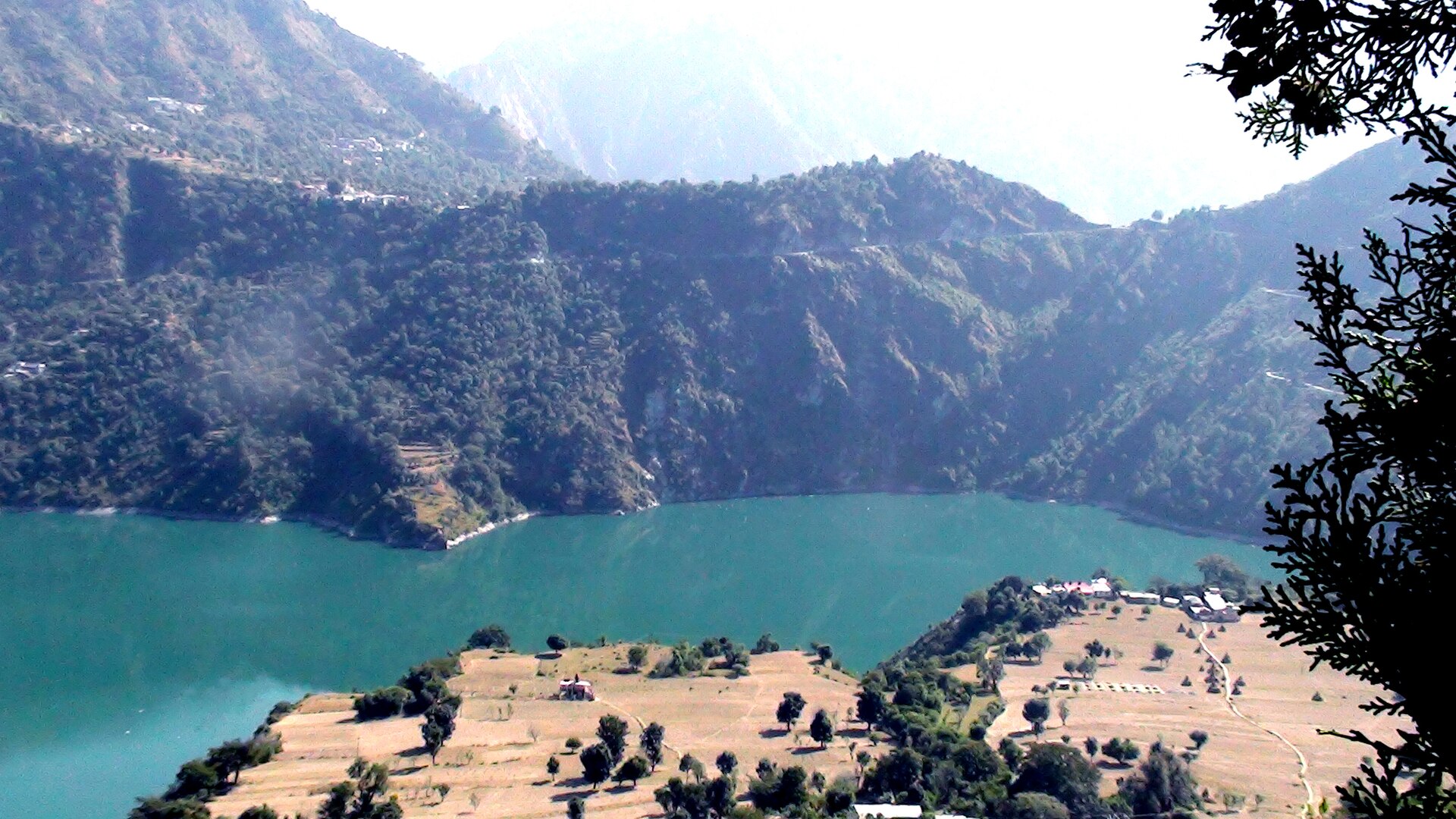
Image: The Ravi in Chamba district, traditionally identified with the Paruṣṇī. Sridhar Rao, CC BY-SA 4.0, via Wikimedia Commons.
The dust rose up at the ends of the earth,
and the few stood ringed by the many;
the river ran on, the fords lay clear,
and the good giver gave as any.
The Good Giver
Of a king of the five rivers, known only from his poets’ songs.
In those days the land of the five rivers lay open under a wide sky, and the peoples who sang to Indra moved across it with their herds, seeking grass and water. Among them were the Bharatas, and with them a clan called the Tṛtsus. Their king was Sudās, and his name means “good giver”. The singers called him Paijavana, the son or the descendant of one Pijavana, and they named the great chief Divodāsa as “the father of Sudās”. How these men truly stood to one another the songs leave unclear.
No chronicle of Sudās was ever made. What remains are hymns sung beside the sacred fire by the poets he rewarded, and they praise the king and their own craft in the same breath.
Two Singers
Of two houses of poets, and one who stood beside the king.
It is told that the Bharatas once had another singer, Viśvāmitra, son of Kuśika, whose tale came earlier in these Chronicles. By the power of his words he begged two swollen rivers to stand still so that the Bharata host might cross, and the songs of his house remember that he brought Sudās over the waters. In the songs of the great battle, though, another poet stands at the king’s side.
He was Vasiṣṭha, and his house was proud. The Vasiṣṭhas wore their hair braided on the right, and they said their forefather was born of a flash of lightning seen by the gods Mitra and Varuṇa. They held that a well-made hymn, a bráhman, a sacred formulation, could draw a god down from heaven to the place where they sat.
The Ten Kings Gather
Of old comrades turned to foes, and dust at the ends of the earth.
Then ten kings joined against Sudās, though the peoples named are more than ten. There were the Pūrus, once the Bharatas’ kin; the Anus and the Druhyus; Turvaśa and the Matsyas, whose name means “fish”; the Bhṛgus; and the Pakthas, the Bhalānas, the Alinas, the Viṣāṇins and the Śivas, though some read these last as nicknames for raiders. Former comrade, sang the poet, now crossed former comrade.
The Bharatas were few and their foes were many. A singer cried out in the hour of danger, “The ends of the earth have appeared covered in dust!” The tumult climbed to heaven, and the enmities of the tribes closed in on every side. In that hour, another sang, they were cut short like goads for driving cattle, “the puny Bharatas”.
I am Sudās, son of Pijavana, king of the Bharatas, and I will tell you of that day. Dust rose at the ends of the earth, and men I had called kin came against me. We were few. My singers say that we looked to Indra as the thirsty look to the sky for rain, and of that hour they told the truth.
The Prayer at the Fire
Of a god who left another man’s soma for a better song.
The Vasiṣṭhas kept faith. It is sung that Indra was far off, drinking the soma pressed for him by one Pāśadyumna, when the Vasiṣṭhas called to him. He rose from that man’s ritual grass and came to them instead, for he preferred them above the other.
“Like thirsty ones looking toward heaven” for rain, the hemmed-in Bharatas looked to Indra. Indra heard Vasiṣṭha as he praised, and he made broad room for the Tṛtsus. So the Vasiṣṭhas told it, and in their telling it was their sacred formulation that won the day for Sudās.
The River That Turned
Of the Paruṣṇī, a broken flood, and a lioness slain by a wether.
The battle was fought by the Paruṣṇī, the river most often held to be the one now called the Rāvī. Here the hymn grows dark and broken, full of jests and turns of speech whose meaning is half lost.
The allies, it seems, sought to turn the river from its course. “They parted inexhaustible Paruṣṇī,” sang the poet. The waters would not serve them. Indra had already made the spreading floods into fords easy to cross for Sudās, and the enemy came to the river as to a goal and found their ruin there. “Not even the swift one made it home for supper.” Kavaṣa, old and famous, was wrenched down into the waters, and with him the Anu and the Druhyu.
Then the singer counted the dead. The Anu and Druhyu people fell down to sleep, “sixty hundred, six thousand” of them. The words that follow are uncertain. Some read sixty-six heroes more among the fallen. Others read the sixty-six as the small band who fought on Sudās’s side. Either way, the few had overthrown the many. With a feeble thing, the poet sang, Indra “smote even the lioness with a wether”, and he broke seven strongholds and gave the wealth of Anu’s line to the Tṛtsus.
The song moves east, to the Yamunā. There a chief called Bheda was stripped of all he had, for the Yamunā helped Indra, and so did the Tṛtsus, and three peoples, the Ajas, the Śigrus and the Yakṣus, brought horses’ heads as tribute. Whether this was the same war or another, the verses do not say.
In yet another hymn the victory belongs to Indra and Varuṇa together, the one who smashes obstacles in battle and the one who guards his commands. The ten kings had gathered without zeal for the sacrifice, it says, and they could not stand against Sudās.
Gifts in the Evening
Of cows and chariots, and horses hung with pearls.
When the dust settled, the king gave as his name promised. Vasiṣṭha sang of two hundred cows from the line of Devavant, and two chariots from Sudās, “carrying brides” or “with mares to draw them”, for the old word can be read both ways. There were four horses besides, covered with pearls, to carry the poet and his son. Then the singer asked the storm gods to stand by Sudās as they had stood by Divodāsa before him.
They call me the good giver. When the river had done its work I gave as a king should give: cows to my singer, chariots, and horses hung with pearls. A king whose name is sung beside the fire must open his hand.
Echoes in Later Ages
Of a later king of a like name, and the Bharatas moving east.
Long afterwards, the great epic told of a king named Kalmāṣapāda, son of Sudāsa of the line of Ikṣvāku, who was cursed by a son of Vasiṣṭha, became an eater of men, and devoured Vasiṣṭha’s sons while Viśvāmitra urged him on. The names and the old rivalry of priests echo there. The king himself belongs to another royal house and a later legend.
The Bharatas did not fade. In time, it is thought, they moved east and became part of the Kuru realm, and the name of the Bharatas lived on.
The truth behind the tale
Sudās is known only from the Ṛgveda, chiefly hymns 7.18, 7.33 and 7.83, with a mention in 3.53. These were composed somewhere around 1400 to 1000 BCE, though no date is fixed, and no archaeological find has identified the battle or anyone in it. The alliance, the fight at the Paruṣṇī, the drowning of Kavaṣa, Bheda’s defeat by the Yamunā and the gifts to Vasiṣṭha are in the text. That the enemies tried to breach or divert the river, and that the Bheda fight was a second campaign, are modern readings. Hymn 7.18 is full of puns and obscure words; translators differ on many verses, including the list of peoples, the sixty-six and the “brides”. The identification of the Paruṣṇī with the Rāvī is traditional but not certain.
Many scholars think the victory let the Bharatas settle further east, where they later merged into the Kuru realm, and some trace the name “Bhārata” for India to this tribe; later tradition credits it instead to a legendary king Bharata. A feud between Viśvāmitra and Vasiṣṭha belongs to later tradition more than to the hymns. The Mahābhārata‘s Kalmāṣapāda, son of Sudāsa, is a later legend of an Ikṣvāku king.
On the translations. “They parted inexhaustible Paruṣṇī” (7.18.8) and “with mares to draw them” (7.18.22) follow Ralph Griffith’s translation. Every other quotation follows Jamison and Brereton: “the father of Sudās” (7.18.25), “The ends of the earth have appeared covered in dust!” (7.83.3), “the puny Bharatas” (7.33.6), “Like thirsty ones looking toward heaven” (7.33.5), “Not even the swift one made it home for supper” (7.18.9), “sixty hundred, six thousand” (7.18.14), “smote even the lioness with a wether” (7.18.17) and “carrying brides” (7.18.22). Where Jamison and Brereton have the river “diverted”, Griffith has it “parted”.
Imagined voice: the italic passages in which Sudās speaks in the first person are imagined. They are built only from the texts and studies named here, add no events, and are not quotations.
Sources
- Stephanie W. Jamison and Joel P. Brereton (trans.), The Rigveda: The Earliest Religious Poetry of India (Oxford University Press, 2014): RV 3.53, 7.18, 7.33 and 7.83 and their introductions; the term bráhman, “sacred formulation”.
- Ralph T. H. Griffith (trans.), The Hymns of the Rigveda (1896), Book 7, hymns 18, 33 and 83.
- Michael Witzel, “Early Sanskritization: Origins and Development of the Kuru State” (1995/1997): Sudās’s victory and the Bharata settlement in Kurukṣetra.
- Kisari Mohan Ganguli (trans.), The Mahabharata, Ādi Parva (Chaitraratha Parva), sections 177 to 179: Kalmāṣapāda, son of Sudāsa.