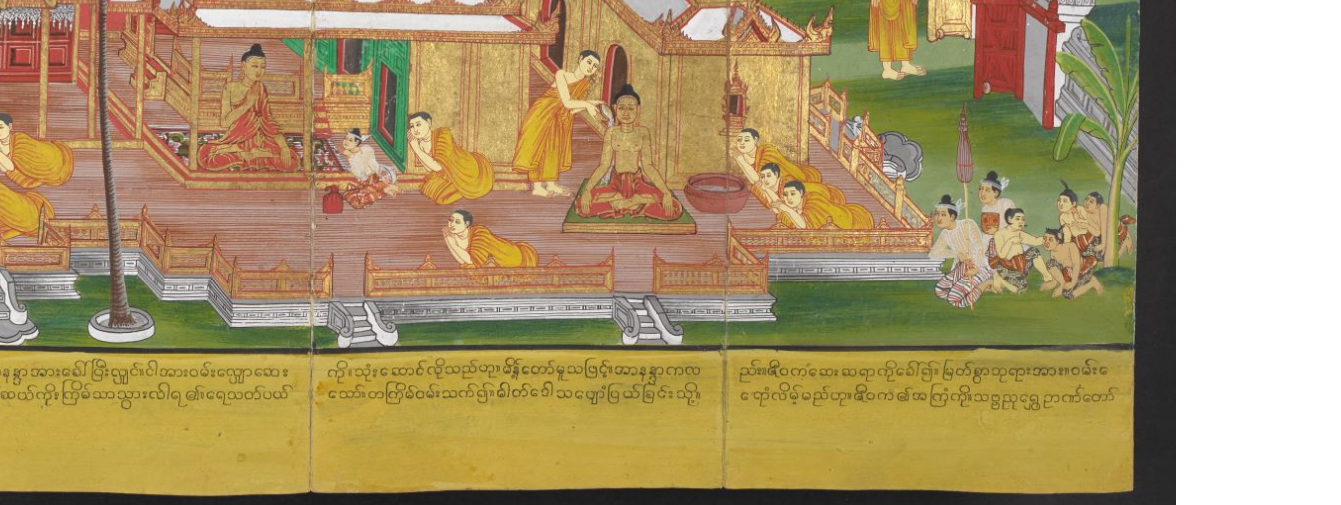
Image: Jīvaka tending the Buddha, from a Burmese Mālālaṅkāra Vatthu manuscript, 1875 (British Library, Or 14405). Unknown Burmese artist; British Library, CC0, via Wikimedia Commons. A later depiction.
Laid in a basket where the crows were loud,
a child the city meant to lose;
he sought one useless herb and found it not,
and by torchlight led a king.
The Basket on the Heap
Of a courtesan’s secret, and a prince who asked what the crows were circling.
In those days the merchants of Rājagaha came home from Vesālī full of the fame of Ambapālī, whose tale readers of these chronicles already know. “Sir, please appoint a courtesan,” they said to King Seniya Bimbisāra of Magadha. So they chose a girl called Sālavatī, fair and gracious, and soon she asked a hundred coins for a night.
Soon, too, she was with child. “Men don’t like pregnant women,” she thought. “If anyone finds out about this, it will ruin my career.” She gave out that she was sick, and when her son was born she said to her slave-woman, “Listen, take this boy away in a winnowing basket and throw him on the trash heap.”
On that same morning Prince Abhaya, walking to wait upon the king, saw a thing on the heap with crows all about it. “What’s that surrounded by crows?” “It’s a boy, sir,” said those with him. “Is he alive?” “Yes, he’s alive.” “Well then, take him to our compound and give him to the wet-nurses to feed.”
When they knew that he would live, they named him Jīvaka, “Survivor”, and because a prince had him reared, Komārabhacca, “Prince-reared”. When the boy came to the age of discernment he asked, “Who, sir, are my mother and father?” And Abhaya answered, “I don’t know who your mother is, but I’m your father, because I brought you up.”
I am Jīvaka, and I was named for this: that I lived. I was carried out in a winnowing basket and laid on the heap among the crows, and a prince on his way to the king stopped and asked what lay there. When I was old enough I asked him who my parents were, and he told me he was my father, because he had brought me up.
The Spade at Takkasilā
Of a long road, seven years, and a search that came back empty.
In time Jīvaka thought, “It’s not easy to make a living in a royal family without a profession.” Far off at Takkasilā lived the foremost physician in the world, and without asking leave of Abhaya the young man took the road there. “Teacher, I wish to learn the profession,” he said, calling him ācariya, as a pupil speaks to his master.
He learned much and learned quickly; he remembered well and did not forget. Yet after seven years he saw no end to it, and asked, “When will I complete the training for this profession?” Then the old physician gave him a spade and a strange errand: to walk a yojana all around Takkasilā, some thirteen kilometres, and bring back any plant that was no medicine.
Jīvaka searched far with his spade, and came back empty-handed. “You’re well-trained, Jīvaka,” said his teacher. “It’s enough for you to live on.” And he gave him a little food for the road.
A Handful of Ghee
Of a dry road, a seven years’ headache, and a thrifty wife.
By Sāketa his food was spent. There a merchant’s wife had suffered a headache for seven years, and the most famous physicians had failed her. “Forget it. I don’t need a young doctor,” she said, until Jīvaka sent word that she need pay nothing in advance.
“Ma’am, I need a handful of ghee,” he said, calling her ayye, “lady”. He cooked it with medicines and gave it to her through the nose, and she spat it into a vessel. “Listen, save this ghee in a cotton wad,” she told a slave. Jīvaka’s heart sank, for so close-fisted a woman might give him nothing. She read it in his face. “We householders know the benefit of such frugality,” she said; the ghee would do for the lamps. “Don’t be concerned, doctor, your fee will be abundant.”
With that one treatment the headache was gone. She and her son, her daughter-in-law and her husband gave four thousand coins each, with two slaves and a carriage and horses besides. Jīvaka laid it all before Abhaya, who would take none of it.
Physician to the King
Of a king laughed at by his women, and ornaments heaped high.
Now King Bimbisāra suffered from piles, and his garments were stained with blood, and the women of his household laughed at him. Jīvaka took a little medicine on his fingernail and went in to him. “Sir, let me see your affliction.” With one anointing the king was cured.
Then Bimbisāra offered him a heap of ornaments stripped from five hundred women. “There’s no need. Please just remember my act of service.” So the king bade him tend himself, the women’s quarters, and the Saṅgha of monks with the Buddha at its head. Harder cures are told of him after: a skull opened in Rājagaha, the tale says, to lift out two living creatures, and a gut twisted by somersaults set straight in Benares.
The Ghee at Ujjenī
Of a temperamental king, a swift she-elephant, and half a fruit.
Far to the west, at Ujjenī, King Pajjota lay sick with jaundice; readers met him in an earlier chapter as Pradyota. “I hate ghee; it’s disgusting,” he told Jīvaka. So Jīvaka cooked the ghee with medicines until it had the colour, smell and taste of a bitter drug. Foreseeing that the king would vomit and might have him put to death, he first won leave to ride any beast and pass any gate, as doctors must gather roots at short notice.
The king had a she-elephant named Bhaddavatikā that could go fifty yojanas in a day. Jīvaka saw the king drink and rode out of the city on her. Presently the king vomited. “That scoundrel Jīvaka made me drink ghee,” he cried, and sent after him Kāka, a slave whose mother, it was said, was a spirit, and who could go sixty yojanas in a day. “But Kāka, these doctors are full of tricks. Don’t receive anything from him.”
Kāka found him at breakfast by the road at Kosambī. Jīvaka, working a little medicine with his fingernail, ate an āmalaka, the emblic fruit, and offered the same. Kāka ate half a fruit and vomited where he sat. “Will I survive?” “Don’t be afraid, Kāka. Both you and the king will be well.” When Pajjota was cured he sent Jīvaka two valuable cloths, one in a million, and Jīvaka judged none worthy of them but the Buddha or King Bimbisāra.
Blue Water-Lilies
Of thirty purgings, and a favour that was blameless.
Once the Buddha’s body was full of impurities, and he asked for a purgative. Jīvaka, deeming a strong purge unfitting for him, steeped three handfuls of blue water-lilies, uppala, with medicines. “Sir, please smell the first handful. This will purge you ten times,” he said, calling him bhante, “venerable sir”, as a layman speaks to a monk. Outside the gatehouse he reckoned that a bath would be needed to make the thirtieth, and the Buddha, knowing his thought, had Ānanda heat water.
When the Buddha was well, Jīvaka brought him the cloths from Ujjenī. “Sir, I wish to ask for a favor.” “Buddhas don’t grant favors, Jīvaka,” came the answer, and for “Buddhas” he said Tathāgatā, the Thus-gone. “It’s allowable and blameless.” Then Jīvaka said that the Buddha and his monks wore paṁsukūla, robes of cast-off rags, and asked him to take the cloths “and please allow the Sangha of monks to use robe-cloth given by householders.”
So it was granted, though whoever wished might still wear rags. And the people of Rājagaha rejoiced: “Now we’ll give gifts and make merit.”
I gave the Blessed One blue water-lilies, for a strong purge was not fitting for him, and he knew my reckoning before I came back to tell it. When he was well I asked a favour, and he told me that the Thus-gone are beyond favours. I said mine was allowable and blameless, and he heard me.
Lamps in the Mango Grove
Of a moonlit roof, a frightened king, and a host of monks who made no sound.
Jīvaka had a mango grove near Rājagaha, and there he once asked whether creatures were slaughtered for the Buddha’s food, and heard that a monk may not eat meat he has seen, heard or suspected to be killed for him. “It is the Buddha who truly abides in love,” he said, and went for refuge for life.
After Bimbisāra’s days, King Ajātasattu, who ruled in his place, sat on the upper floor of his palace on the uposatha, the holy day, at the full moon of Komudī. “Oh, sirs, this moonlit night is so very delightful,” he said, and asked what holy man might bring his mind peace. Six ministers named six teachers, calling him deva, “Your Majesty”, and to each the king kept silent. Jīvaka sat silent too. “But my dear Jīvaka, why are you silent?” said the king, and his word was samma, “my dear”. Then Jīvaka told him of the Buddha in his mango grove with twelve hundred and fifty monks.
By torchlight the king rode out on his bull elephant, with five hundred she-elephants each bearing a woman. Near the grove he grew afraid, and his hair stood on end, for in so great a host there was no cough nor any sound. “My dear Jīvaka, I hope you’re not deceiving me!” “Do not fear, Great King, do not fear!” said Jīvaka, calling him mahārāja. “Go forward, Great King, go forward! Those are lamps shining in the pavilion.”
There sat the Buddha against the central pillar, facing east, and the monks about him sat silent as a still, clear lake. Before that night was out the king confessed that he had taken the life of his father, “a just and principled king, for the sake of authority”.
How Jīvaka’s own days ended, these old books do not tell.
The truth behind the tale
Jīvaka’s life is told at length in the Vinaya, the Pāli book of monastic discipline, in its chapter on robes (Mahāvagga VIII, Khandhaka 8). There the story serves a rule: it ends with the Buddha allowing monks robe-cloth from householders. DN 2 and MN 55 set the Buddha in “the Mango Grove of Jīvaka Komārabhacca”, and AN 1.256 names him foremost among lay followers in confidence in an individual. Spoken lines are quoted from the translations below, some shortened; the meat question and the queens’ jibe are paraphrased. The translator reckons a yojana at about 13 km. How Jīvaka used his fingernail on Kāka’s fruit is obscure in the Pāli and is told loosely here.
The Pāli is one telling among several. Kenneth Zysk, as summarised by C. Pierce Salguero, finds the biography in the robes or clothing chapter of the Mahīśāsaka, Dharmaguptaka, Sarvāstivāda, Mūlasarvāstivāda and Theravāda Vinayas, and in Sanskrit, Tibetan and Chinese versions that reflect “regional peculiarities, indigenous influences, and doctrinal oddities”. None of them can be shown to be the original. The Pāli leaves Jīvaka’s teacher unnamed, while the Sanskrit-Tibetan and Chinese versions name him as Ātreya. A Chinese version makes him the son of Āmrapālī (the Pāli Ambapālī), born from a mango tree. This chapter follows the Pāli alone.
A real royal physician at Rājagaha may stand behind the tales, but they were written down long afterwards and shaped by monks. The opened skull and bowel, the elephant’s fifty yojanas and the spirit-born runner are legend. Salguero, writing of the Chinese retellings, puts the general point plainly: “Medical legends simply cannot be considered evidence of medical practice.” Zysk argues more broadly that the medicine of the early Buddhist monasteries helped to form Āyurveda. DN 2 has Ajātasattu confess that he killed his father; Buddhist tradition names that father as Bimbisāra. Bimbisāra and Ajātasattu ruled Magadha in the 5th century BCE, or earlier on the older dating of the Buddha. No find in the ground can be tied to Jīvaka.
Imagined voice: the italic passages in which Jīvaka speaks in the first person are imagined. They are built only from the texts and studies named here, add no events, and are not quotations.
Sources
- Bhikkhu Brahmali (trans.), Vinaya Mahāvagga / Khandhaka 8, “The chapter on robes” (Kd 8), sections 1–2, SuttaCentral. All quotations from the Jīvaka story.
- Bhikkhu Sujato (trans.), DN 2, “The Fruits of the Ascetic Life”, SuttaCentral. Quotations from the night visit to the mango grove.
- Bhikkhu Sujato (trans.), MN 55, “With Jīvaka”, SuttaCentral.
- Bhikkhu Sujato (trans.), AN 1.248–257 (AN 1.256), SuttaCentral.
- Pāli texts, SuttaCentral (Mahāsaṅgīti edition). Vinaya Khandhaka 8.1: the addresses deva, ācariya, ayye and bhante, the Buddha’s word Tathāgatā, and the terms paṁsukūla, yojana, āmalaka and uppala. DN 2: the addresses deva, samma and mahārāja, and the uposatha at the Komudī full moon.
- C. Pierce Salguero, “The Buddhist Medicine King in Literary Context: Reconsidering an Early Medieval Example of Indian Influence on Chinese Medicine and Surgery”, History of Religions 48, no. 3 (2009): 183–210, doi:10.1086/598230. The versions of the biography, the teacher Ātreya, the Chinese Jīvaka Sutra, and the quotation on medical legends.
- Kenneth G. Zysk, Asceticism and Healing in Ancient India: Medicine in the Buddhist Monastery (1991; repr. New Delhi: Motilal Banarsidass, 1998), pp. 52–61 and 151 n. 9, as summarised and quoted by Salguero (2009); the book’s thesis on Buddhist monastic medicine and Āyurveda as given in its abstract (University of Copenhagen Research Portal).