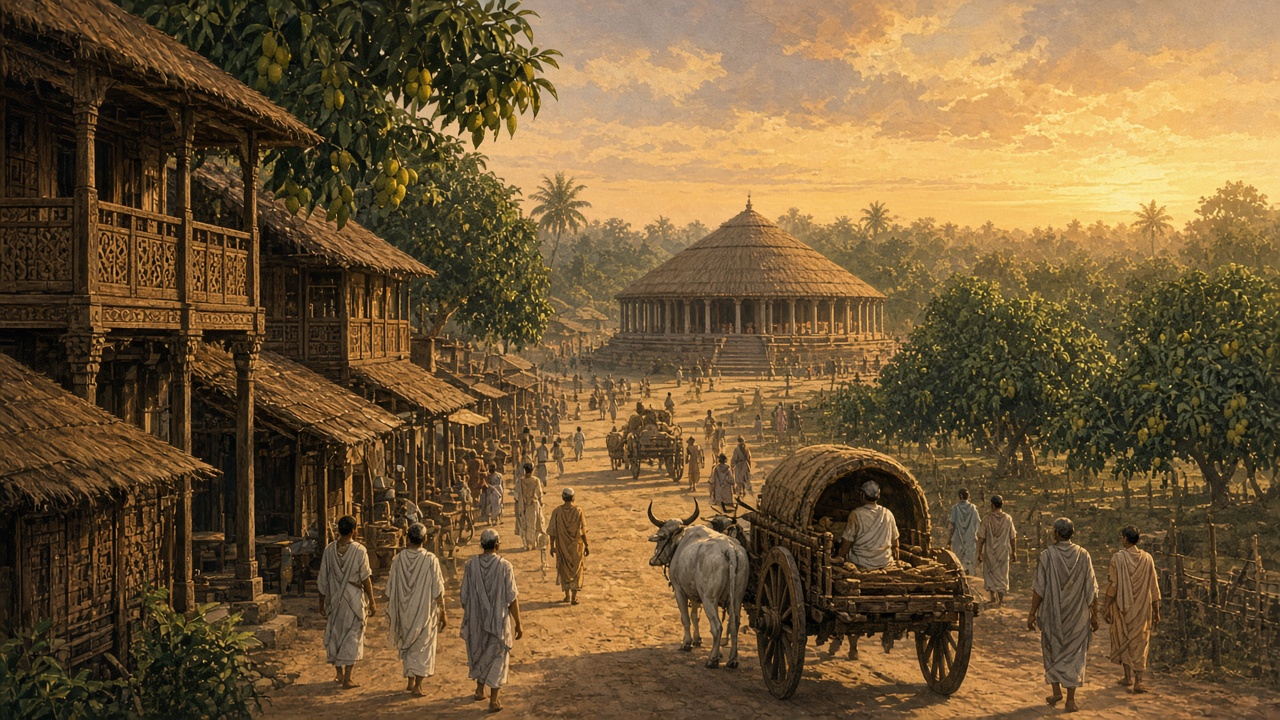
AI illustration: Vaishali in the 5th century BCE (an imaginative reconstruction).
Wheel against wheel on the Vesālī road,
and a meal that no gold could buy;
a grove given, a song grown old,
and a name that a tree kept by.
The Carriages of Vesālī
Of a meal that no gold could buy, and princes beaten on the road.
Four and twenty centuries ago, north of the Ganges, where the great river runs broad and slow across the plain, there stood Vesālī, a city of many lords. And in Vesālī dwelt Ambapālī. In later days the tellers said that she was found as a child at the foot of a mango tree, and that thence came her name; but that is their tale, and the oldest books do not tell it.
Now there came a day when word ran through Vesālī that the Buddha had come. And Ambapālī called for her carriages. In the finest of them she went forth from the city, and she rode on as far as the ground would bear a carriage; and there she got down, and went the rest of the way on foot. She bowed, sat, and heard him. Then she spoke, calling him bhante, as lay people addressed a monk: “Sir, would the Buddha, together with the mendicant Saṅgha, please accept tomorrow’s meal from me?” And he consented in silence.
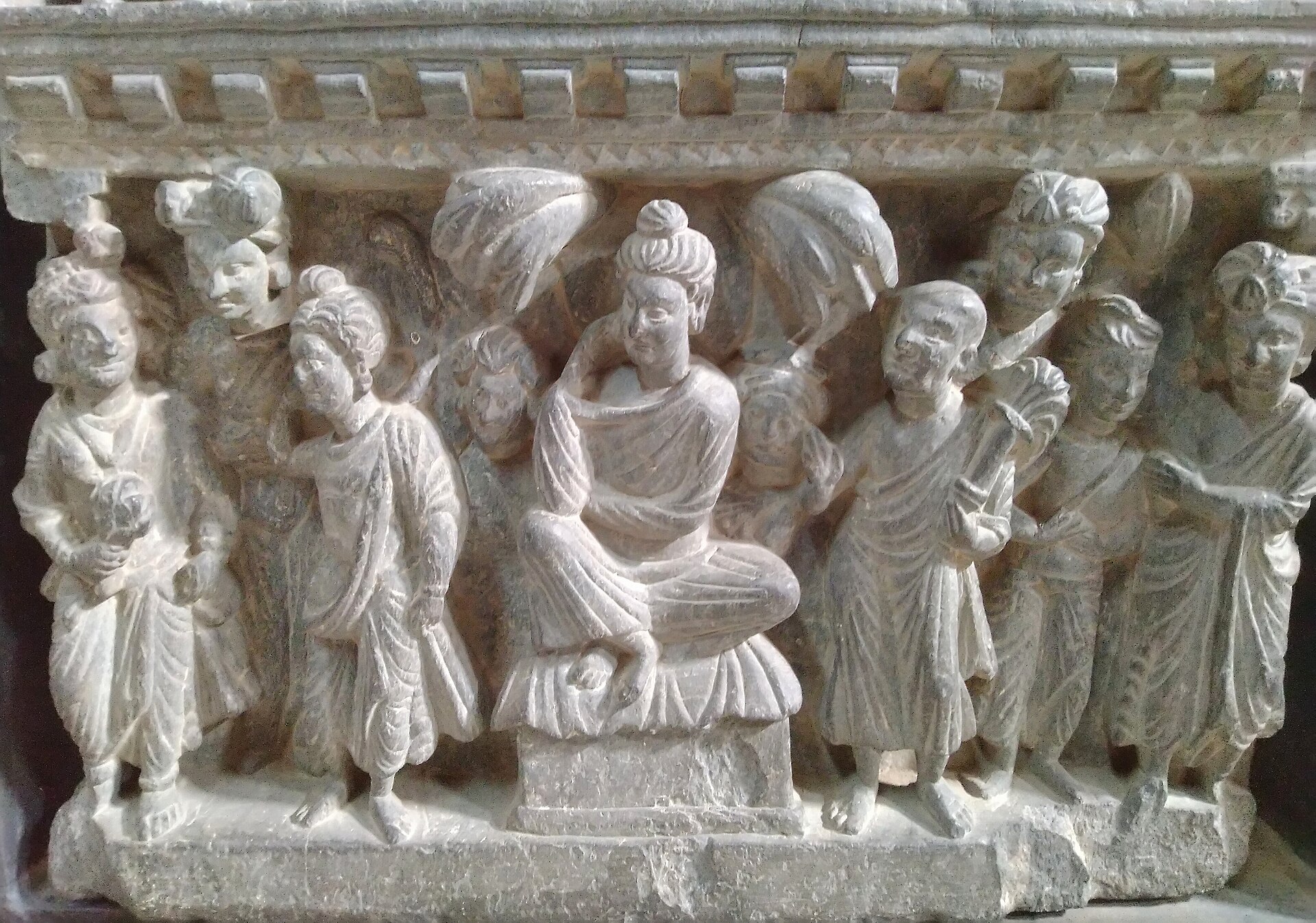
I am Ambapālī of Vesālī, and I will tell you of the day on the road. They wore blue and yellow, red and white, and they had the wealth of a city. I did not turn my horses aside.
On the road home she met the young lords of the Licchavis coming the other way. Some of them were blue from head to foot, blue of garment and blue of ornament, and others all in yellow, or all in red, or all in white. But Ambapālī did not draw aside. Straight at them she drove, “axle to axle, wheel to wheel, yoke to yoke”.
What did she mean by it, they demanded. She had bidden the Buddha to dine, she told them. “Give us that meal for a hundred thousand!” they cried. And she answered: “Masters, even if you were to give me Vesālī with her provinces, I still wouldn’t give that meal to you.”
Then the princes snapped their fingers. “We’ve been beaten by the aunty!” The Pali word is ambakā, a pun upon her name that can also be heard as “the mango woman”. And as they came into sight, the Buddha said to his monks that whoever had never seen the gods of the Thirty-Three should “just have a look at the assembly of Licchavis”. And when the princes asked him to dinner, he told them that he had already accepted.
A City of Many Councils
Of the Vajjis, who met often, and of the king beyond the river.
Vesālī lies now beneath a village called Besarh, in Bihar. In its day it was the capital of the Licchavi republic, and its name is woven into the first histories of both the Buddhists and the Jains. At its height the city was “prosperous and crowded with people”: thousands of houses raised upon stilts, and parks, and lotus pools.
No king sat in Vesālī. The Licchavis were the foremost clan of the Vajji confederacy, a gaṇa-saṅgha, where the heads of the noble houses governed together in assembly. The Buddha’s last journey began under a threat from the south. Ajātasattu, King of Magadha, son of Bimbisāra, has sworn to “wipe out these Vajjis”. And the Buddha, while the king’s minister stands listening, tells Ānanda that so long as the Vajjis “meet frequently and have many meetings”, and act in harmony, they may look for growth and not decline.
The Splendour of the City
Of fifty coins, and of a rival city’s envy.
A gaṇikā was a public courtesan: wealthy, accomplished and unwed. Ambapālī, it was told, was “skilled in dancing, singing, and instrumental music”, and her price was fifty coins a night. It was said too: “Because of her, Vesālī was even more splendid.”
Out of Rājagaha came merchants, and they saw her; and when they went home they spoke to Bimbisāra, whom these Chronicles have met already: “Sir, please appoint a courtesan.” So a girl named Sālavatī was chosen. In time she left her baby son upon a rubbish heap, and Prince Abhaya took him up; and that child was Jīvaka the physician, whose own tale is still to come in these Chronicles.
When all this befell hangs upon the Buddha’s own days. Tradition sets his passing around 483 BCE, and many scholars now prefer a date nearer 400 BCE. Yet either way, Ambapālī’s dinner fell upon his last journey, only months before the end.
The Gift of the Grove
Of a low seat, and a garden given away.
At dawn she sent word: “Sir, it’s time. The meal is ready.” He came with bowl and robe, and she served him and his monks fresh and cooked foods (khādanīya, bhojanīya) “with her own hands”. Then upon a low seat she sat, and spoke: “Sir, I present this park to the mendicant Saṅgha headed by the Buddha.” And he accepted. An ārāma was a pleasure garden; but so many such gardens were given to monks that in time the word came to mean “monastery”. In Ambapālī’s grove, it is told, teachings on mindfulness were given. Of how she came to hold that land, nothing is said.
The Song of the Elder
Of hair as black as bees, and what the years made of it.
Tradition says that she became a nun, and nineteen verses among the “Verses of the Elder Nuns” bear her name. Down through the body the poem goes, hair and brows, eyes and teeth, voice, hands and feet, setting each as it was in youth beside the same in age:
My hair was as black as bees,
graced with curly tips;
now old, it has become like hemp bark—
the word of the truthful one is confirmed.
Once I was the beauty of Vesālī, and now I am old. Hair, eyes, hands: I set each down as it was and as it is, and the teacher’s word holds true.
It ends with the whole body as “a house in decay with plaster crumbling”. The refrain can also be heard as “It’s just as the Buddha, speaker of truth, said, nothing different than that.”
On one level it is a song of impermanence. It also borrows the head-to-toe inventory of South Asian love poetry, in a metre later called rathoddhatā and linked with springtime and attraction, and then turns that form upon its head. A bolder reading hears her saying “I was beautiful when I was young, and I’m beautiful now.” Whoever made these verses, the collection is often called the world’s first anthology of women’s literature, and Ambapālī’s is among its most memorable voices.
The Son of the Tree
Of a riddle in four lines.
Tradition gives her a son who became a monk, Vimala Koṇḍañña. His whole poem is a riddle of four lines, and it begins: “I arose from the one named after a tree; / I was born of the one whose banner shines.” Whoever knows the later tale will hear the mango, amba, in “named after a tree”. Later tellers, writing centuries afterwards, named the boy’s father as Bimbisāra.
What we actually know, and what we don’t
Text. Two canonical versions tell of the meal and the grove: the Mahāparinibbāna Sutta (DN 16) and the Vinaya (Mahāvagga VI.30). They differ in the details. In the Vinaya she first meets the Buddha at Koṭigāma, while in the sutta he is already in her grove. The Vinaya’s Jīvaka story (Mahāvagga VIII.1) gives her fee and her fame. The Therīgāthā verses are attributed to her, and we cannot prove who composed them.
Commentarial and later tradition, clearly labelled. The following all come from commentaries written centuries later, as gathered in Malalasekera’s Dictionary of Pāli Proper Names. They say she appeared spontaneously and was found at the foot of a mango tree in the royal gardens, hence her name. They say princes fought over her until she was made a courtesan to end the quarrel. The popular version, in which the Licchavi assembly itself makes the decision, belongs to this late layer too, not to the canon. The commentaries also say that Bimbisāra was her patron and the father of Vimala Koṇḍañña, that she became a nun after hearing her son preach, and that a past-life insult to a nun explains why she was reborn a courtesan. Modern novels and films have embroidered the story further.
Archaeology. No inscription or excavation names her. The Archaeological Survey of India dates the innermost core of Vaiśālī’s relic stupa to about the fifth century BCE and links it with the Licchavis’ share of the Buddha’s ashes. At nearby Kolhua an Aśokan lion pillar of the third century BCE, later than her time, stands among monastery remains. Britannica notes Northern Black Polished Ware from early Buddhist times. The city is real, but nothing found in the ground has been tied to her or her grove.
Where the story’s details come from. The road scene, the dinner and the gift of the grove follow the Mahāparinibbāna Sutta (DN 16) in Bhikkhu Sujato’s translation; “the mango woman” is Ajahn Brahmali’s rendering of ambakā in the Vinaya, which also describes Vesālī and Ambapālī’s accomplishments. Vesālī as the Licchavi capital is as given by Encyclopaedia Britannica. Her poem is Therīgāthā 13.1, quoted in Bhikkhu Sujato’s translation; the refrain “It’s just as the Buddha, speaker of truth, said”, the love-poem reading and the rathoddhatā metre are from Charles Hallisey’s translation (Murty Classical Library, 2015), and Hallisey credits the bolder reading to the novelist Martin Wickramasinghe. Vimala Koṇḍañña’s riddle is Theragāthā 1.64; it is the commentary that names Bimbisāra as his father.
Imagined voice: the italic passages in which Ambapālī speaks in the first person are imagined. They are built only from the texts and studies named here, add no events, and are not quotations.
Sources (lightly noted)
- Mahāparinibbāna Sutta (DN 16), trans. Bhikkhu Sujato, SuttaCentral; Ānandajoti Bhikkhu’s annotated edition (ancient-buddhist-texts.net) for the ambakā pun.
- Vinaya, Mahāvagga VI.30 and VIII.1, trans. Bhikkhu Brahmali, SuttaCentral.
- Therīgāthā 13.1, trans. Sujato (SuttaCentral) and Thanissaro (Access to Insight); Theragāthā 1.64 (Sujato); Charles Hallisey, Therigatha (Murty Classical Library, 2015), quoted from his Harvard Divinity Bulletin interview.
- G. P. Malalasekera, Dictionary of Pāli Proper Names, “Ambapālī”: the commentarial stories.
- Encyclopaedia Britannica, “Vaishali”; Archaeological Survey of India, Patna Circle, notes on the Relic Stupa and Kolhua.
- Mahāparinibbāna Sutta (DN 16) 2.14–2.19, Pāli text (Mahāsaṅgīti edition), SuttaCentral: the forms of address bhante and ayyaputtā, the summons to the meal and the foods served.
Myth and text flagged throughout: the cold open follows DN 16 and the Vinaya; the mango-tree birth, the princes’ quarrel and Bimbisāra’s paternity are marked as commentarial or later tradition; the poem’s authorship is “attributed”; all dates are approximate.