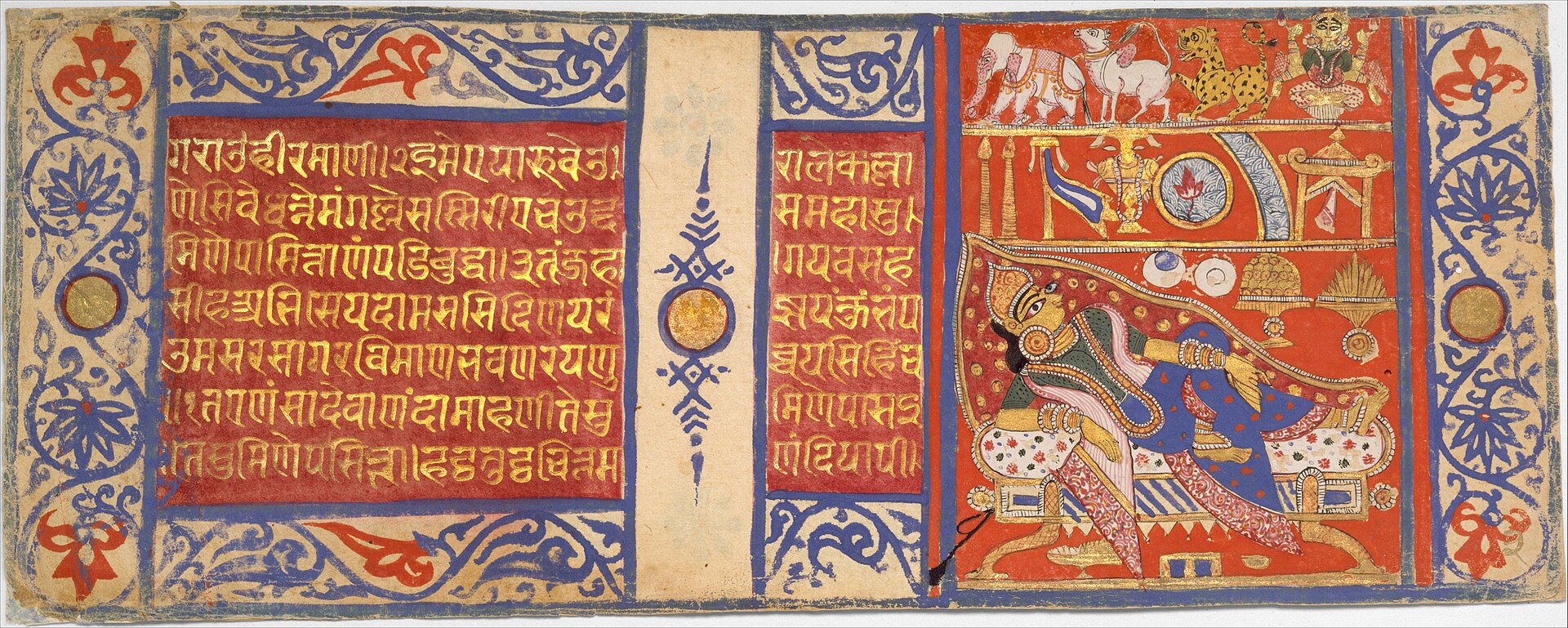
Image: Devānandā's fourteen auspicious dreams foretelling the birth of Mahāvīra, folio from a Kalpasūtra manuscript, Jaunpur, c. 1465. Master of the Jaunpur Kalpasutra; The Metropolitan Museum of Art (Open Access), CC0, via Wikimedia Commons. A later depiction from the Kalpasūtra tradition.
A lamp was lit when the light went out,
on Kārttika’s last dark night;
he watched the ground a man’s length ahead,
and harmed no thing in his sight.
A Child Who Kept Still
Of great dreams at Kuṇḍapura, and a child named Increasing.
In those days Vaiśālī, the city of the Licchavis, stood on the plain north of the Ganges, and near it lay Kuṇḍapura, home of a warrior clan called the Jñātṛs. Their chief was Siddhārtha, and his wife was Triśalā.
It is told that one night Triśalā, half sleeping and half waking, saw fourteen great dreams: an elephant, a bull, a lion, the goddess Śrī, a garland, the moon, the sun, a banner, a vase, a lotus lake, the ocean, a heavenly palace, a heap of jewels and a flame without smoke. Such dreams, the interpreters said, come to the mother of a world-ruler or of a Jina, a conqueror.
From the moment the child was conceived, the house grew richer. Its silver increased, and its gold, and its grain, and its good name. So his parents resolved to call him Vardhamāna, “the increasing one”.
Later in the pregnancy, the story goes, the unborn child lay still so as not to cause his mother pain. Triśalā took the stillness for death. “The fruit of my womb has been taken from me,” she grieved, and the music in Siddhārtha’s palace fell silent. Then the child quivered a little, and she rejoiced. While still in the womb, it is said, he resolved that he would not tear out his hair and leave the house while his parents lived.
Five Handfuls of Hair
Of a prince who waited for his parents’ deaths, and a tree in a clan park.
He grew up a prince of Videha and was called the moon of the clan of the Jñātṛs. Some say he married a lady named Yaśodā and had a daughter; others say he never married.
When he was thirty his parents died, and he kept his word. With the leave of his elder brother he gave away his wealth and was carried in a palanquin through the town to a park of his clan. Under an aśoka tree he stepped down, took off his ornaments and garlands with his own hands, and with his own hands plucked out his hair in five handfuls. Then, quite alone, he went from the house into houselessness. Later ages called him Mahāvīra, the Great Hero, and his followers name him samaṇe bhagavaṃ Mahāvīre, the Venerable Ascetic Mahāvīra.
Thirteen Long Years
Of one robe, then none, and a man’s length of ground ahead.
The oldest account of the years that followed has no gods in it and no wonders. “As I have heard it,” it begins, “I shall tell how the Venerable Ascetic, exerting himself and meditating” wandered about after he entered the order that winter.
“For a year and a month he did not leave off his robe.” After that he went naked. For more than four months small creatures gathered on his body, crawled about it and caused him pain, and he bore it. He walked with his eyes fixed on a space before him “of the length of a man”, so as to tread on nothing that lived. People gathered, shocked at the sight, and struck him and cried out. Asked a question, he often gave no answer.
He lodged in workshops and assembly places, in sheds of straw, in travellers’ halls, on burning grounds, in abandoned houses and at the foot of a tree. “In these places was the wise Śramaṇa for thirteen long years.” He slept little and meditated day and night. When wanderers at night asked who was within, he would sometimes say only, “It is I, a mendicant.”
Earth and water, fire and wind, lichens, seeds and sprouts, he had found, are all “imbued with life”, and he avoided injuring them.
I am Vardhamāna of the Jñātṛs. My eyes were on the ground a man’s length ahead of my feet, because the ground is full of living things. Small creatures crawled over my body and I let them. When the night wanderers asked who was within, I gave them the shortest answer I had: a mendicant.
The Pathless Country of Lāḍha
Of dogs and clods and sticks, and a man who had laid down the stick.
He travelled into the pathless country of Lāḍha, to the east, and there many dangers befell him. When he came near a village, the people met him outside it and attacked him, saying, “Get away from here.” They struck him with sticks and fists, threw clods and potsherds, tore his hair and covered him with dust. They set their dogs on him, and the dogs bit him. Other wandering monks went there carrying strong poles to keep the dogs off, and were bitten all the same.
He had ceased to use the stick against any living being. “As an elephant at the head of the battle, so was Mahāvīra there victorious.”
He lived on rice, pounded jujube and beans, and sometimes did not drink for half a month or more. When hungry crows, a beggar, a cat or a dog stood in his way where he begged, he moved slowly on, killing no creature, so as not to stand between them and their food.
For six years, his followers later said, an ascetic named Gosāla wandered with him, and they parted in bitterness, as the tale of Gosāla has told.
Under the Śāla Tree
Of a summer afternoon by a river, and complete knowledge.
In the thirteenth year, in the month of Vaiśākha, when the shadows had turned towards the east, he came to a field outside the village of Jṛmbhikagrāma, on the bank of the river Ṛjupālikā, near an old shrine. In the field of a householder named Sāmāga he squatted beneath a śāla tree with his heels together, in the heat of the sun, having fasted two and a half days without water. There he reached kevala, “the highest knowledge and intuition”.
From that day his followers counted him a Jina, the twenty-fourth of the Tīrthaṅkaras, the makers of the ford across the river of rebirth.
The Teacher of the Ñātika Clan
Of thirty years of teaching, and a rival’s view of him.
For about thirty years more he walked the kingdoms of the Ganges plain, spending the rains in Vaiśālī, Rājagṛha, Mithilā and Śrāvastī, and he gathered thousands of monks and nuns. Those monks took five great vows: to harm no living thing, to tell no lie, to take nothing not given, to live chaste and to own nothing. Every act, his followers taught, draws karma to the soul like dust, and only restraint and austerity shake it off.
The followers of the Buddha knew him too. To them he was the Jain ascetic of the Ñātika clan, “long gone forth” and “advanced in years”, who answered questions with a fourfold restraint.
The Lamps of Pāvā
Of a last rainy season, and lamps lit against the dark.
His last rainy season he spent in the town of Pāvā, in the office of King Hastipāla’s scribes. In the dark fortnight of Kārttika, on its fifteenth day, in the last night, he died, cut asunder the ties of birth, old age and death, and was freed from all pains.
That same night, it is told, his oldest disciple, Indrabhūti Gautama, broke the bond of affection he still felt for his master and attained complete knowledge himself. The eighteen confederate kings of Kāśī and Kosala, nine of the Mallakis and nine of the Licchavis, kept a fast and lit lamps. “Since the light of intelligence is gone,” they said, “let us make an illumination of material matter!”
Far away, among the Sakyans, the Buddha’s monks heard that the ascetic of the Ñātika clan had recently passed away at Pāvā. His followers had split into two factions, “continually wounding each other with barbed words”.
Thirteen years I watched the ground. Thirty more I taught what I had seen there: that the earth and the water and the wind are alive, and that no one should be harmed. When my last night came at Pāvā I had nothing left to give away. The kings who lit their lamps that night lit them for the dark I left.
The truth behind the tale
Mahāvīra was a real teacher. His Buddhist rivals name him Nigaṇṭha Nātaputta, give his fourfold restraint (DN 2) and report his death at Pāvā and the split among his followers (DN 29). The oldest Jain account of his ascetic years is the Ācārāṅga Sūtra I.8, among the earliest Jain texts. The dreams, the naming, the still child, the renunciation, the enlightenment by the Ṛjupālikā and the lamps of Pāvā come from the later Kalpa Sūtra. Both books belong to the Śvetāmbara canon. The Digambaras hold that the old scriptures were lost, count sixteen dreams, deny his marriage and reject the Śvetāmbara story that his embryo was first carried by a Brahmin woman, Devānandā. The years with Gosāla come from the Bhagavatī Sūtra. His dates are disputed: tradition gives 599–527 BCE, while many scholars put his death around 468 or about 425 BCE. Where Kuṇḍapura and Pāvā lay is uncertain. The Prakrit word Jacobi rendered “illumination” is obscure, and the link between that night and Dīpāvalī is Jain tradition.
On the translations. Quotations from the Ācārāṅga and Kalpa Sūtra follow Hermann Jacobi’s translation, with his “Sramana” and “Gnâtris” given here as Śramaṇa and Jñātṛs. Quotations from the Pāli discourses follow Bhikkhu Sujato.
Imagined voice: the italic passages in which Mahāvīra speaks in the first person are imagined. They are built only from the texts and studies named here, add no events, and are not quotations.
Sources
- Hermann Jacobi (trans.), Jaina Sūtras, Part I, Sacred Books of the East 22 (1884): Ācārāṅga Sūtra I.8, “The Pillow of Righteousness”; Kalpa Sūtra, “Life of Mahāvīra”, with notes.
- Bhikkhu Sujato (trans.), DN 2 and DN 29, SuttaCentral.