Category: Ancient India Chronicles

One figure from ancient India at a time, from roughly 2500 to 450 BCE: kings, poets, sages, bankers and healers, told first as a story and then checked against the evidence in “The truth behind the tale”, with sources. New chapters on Mondays, Wednesdays and Fridays at 19:00 UK time.

  • Yājñavalkya

    Yājñavalkya

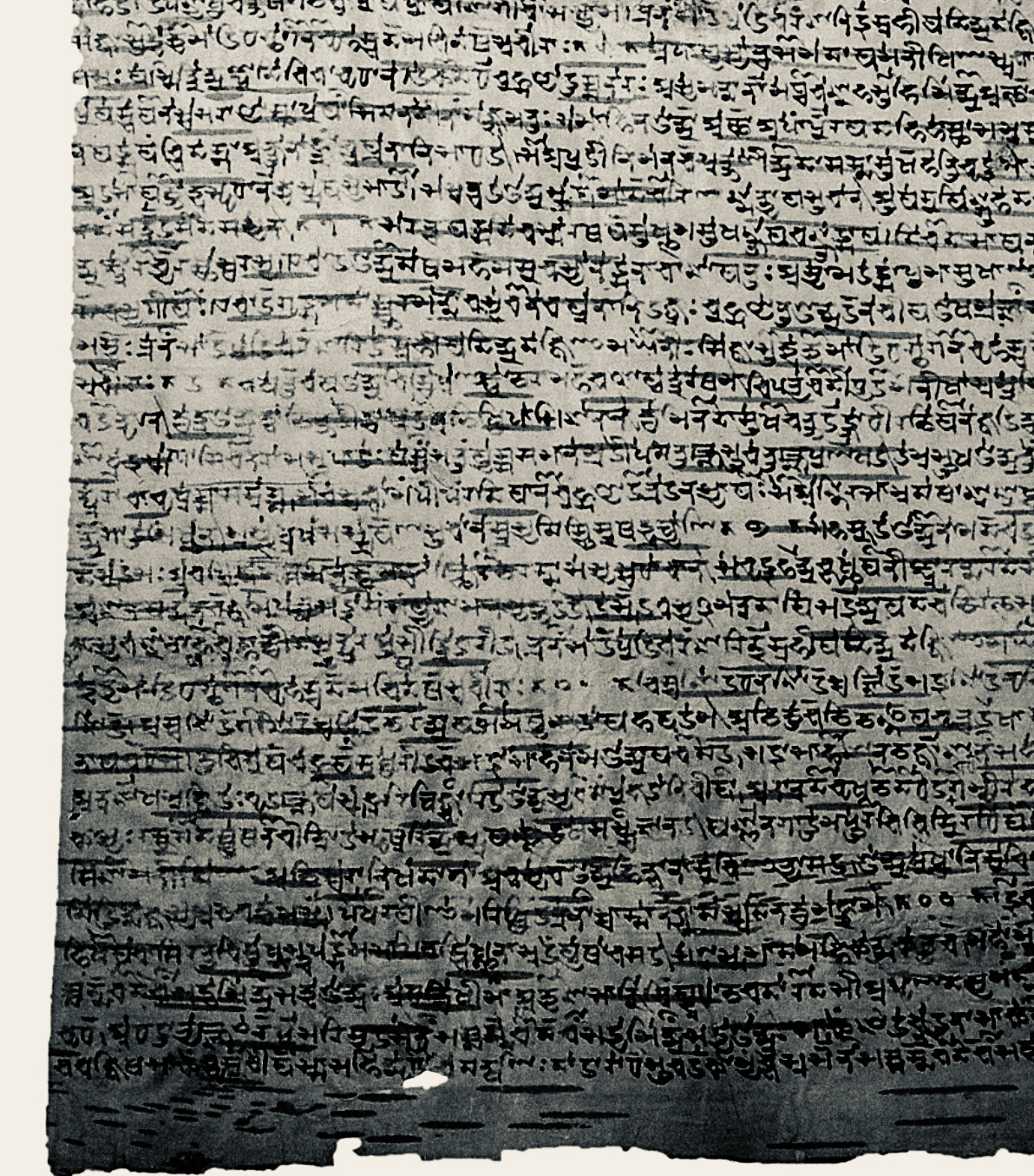
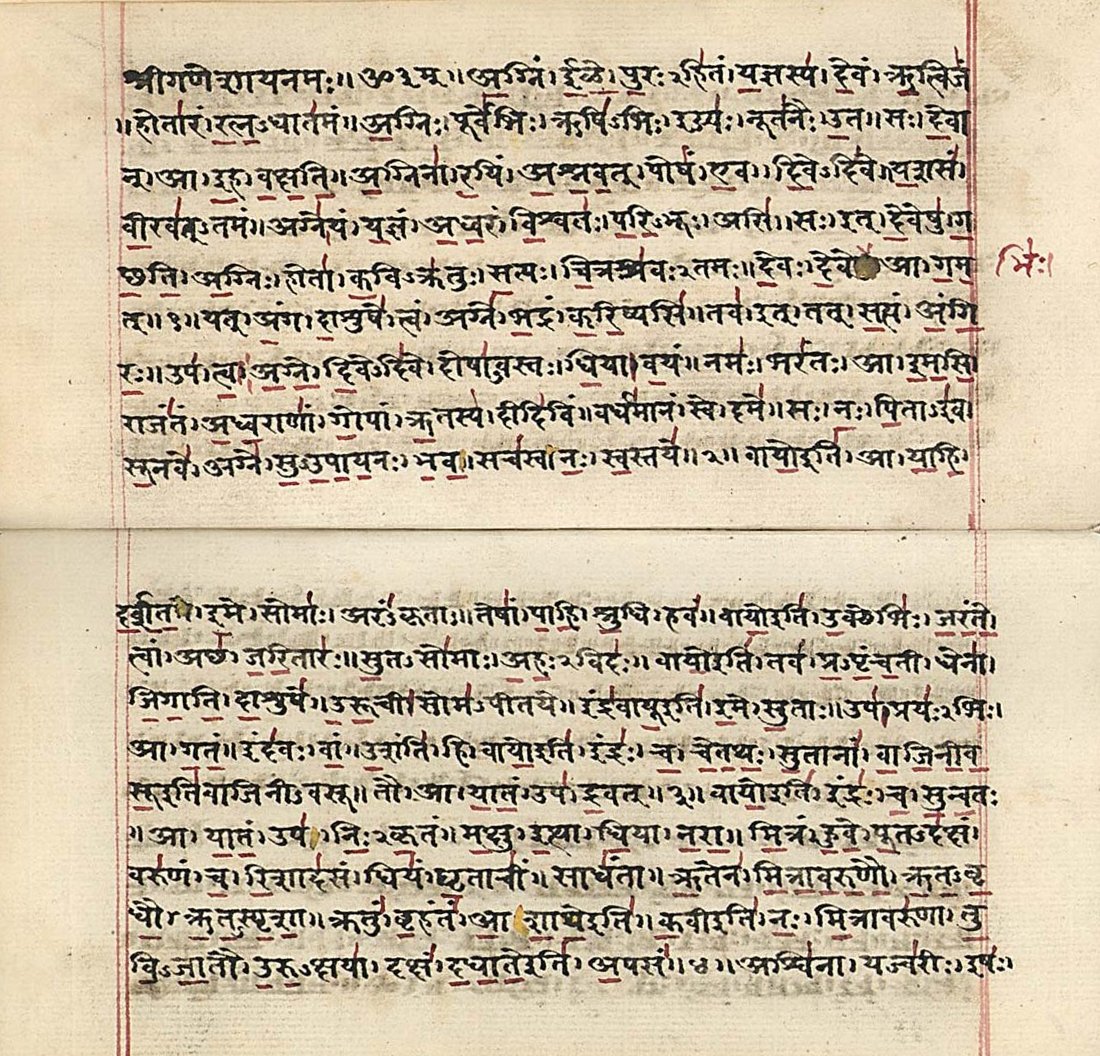
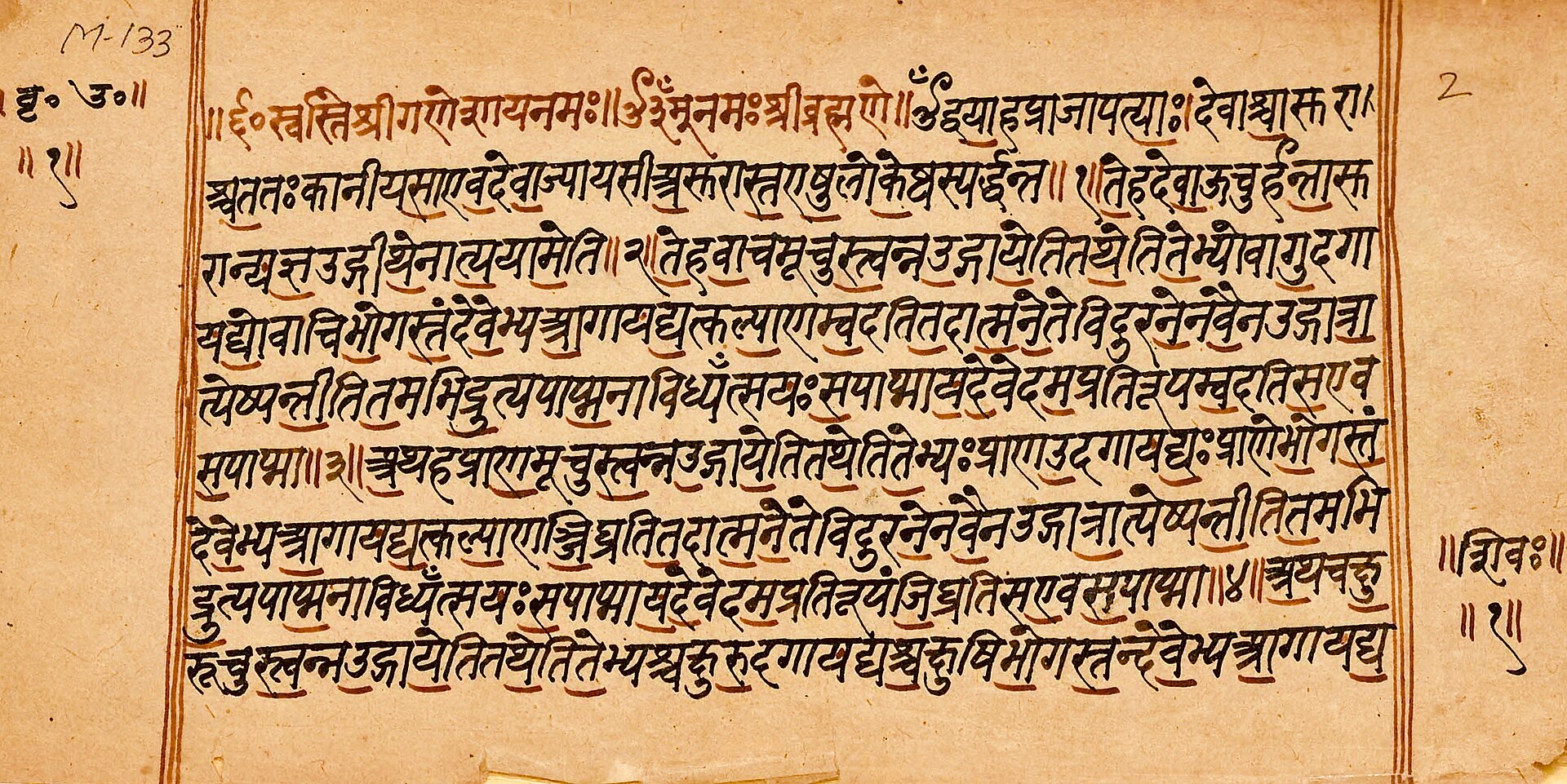
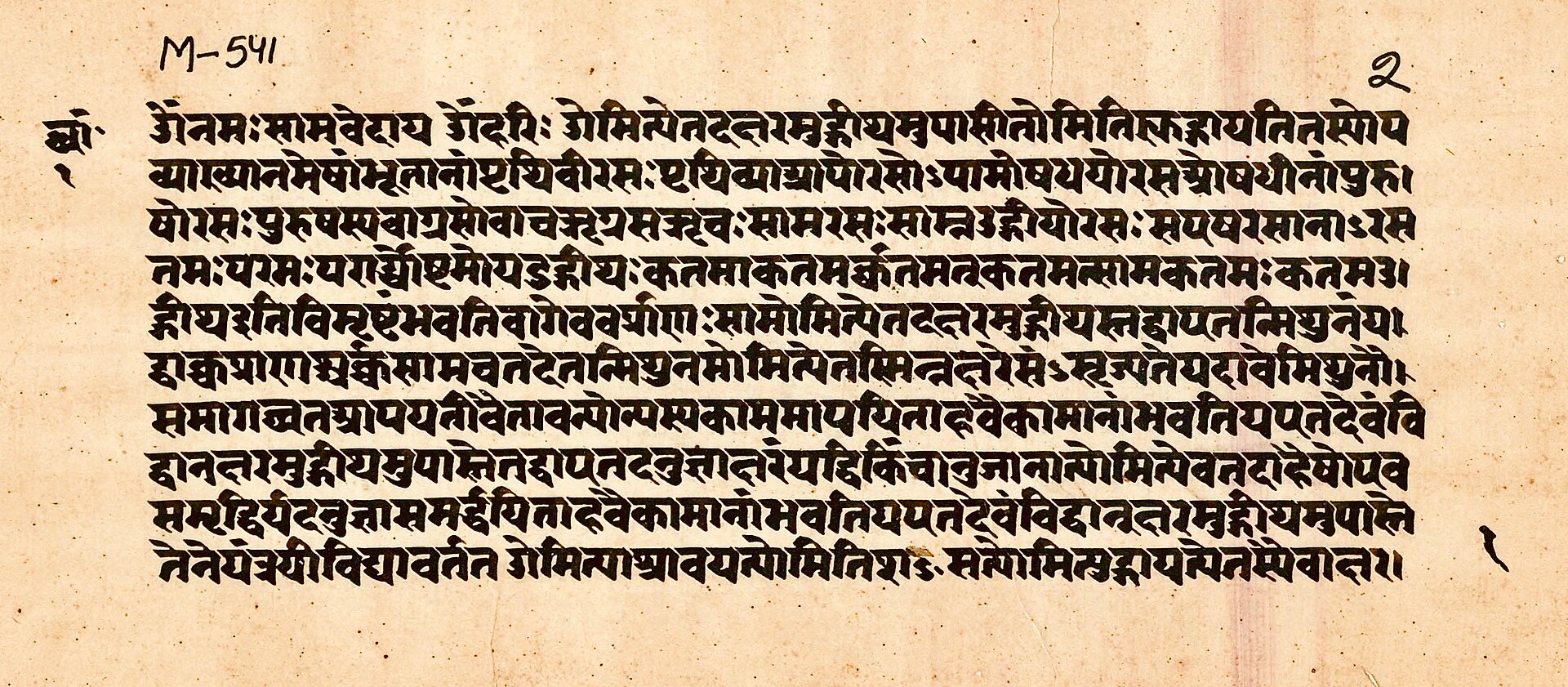
    Image: Brihadaranyaka Upanishad 1.3.1–1.3.4 in a Devanagari manuscript. Ms Sarah Welch, CC BY-SA 4.0, via Wikimedia Commons.

    Partridges gathered what he cast away;
    the Sun gave him learning new.
    Not this, not this, of the Self he spoke,
    and into the forest he went from view.

    The Learning Given Back

    Of a quarrel with a teacher, as later ages told it, and a gift from the Sun.

    In those days the sacrificial fires were being carried east across the rivers into Videha, where the forests still stood thick, and new teachers of the Veda rose there. The greatest of them was Yājñavalkya. He was called Vājasaneya after his family line, and he had learned from Uddālaka Āruṇi, among others, and he would teach a king.

    Long after his time, the tellers of old tales gave him a stormier youth. They said he studied the Yajus formulas under Vaiśampāyana, and that when the master asked his pupils to perform a penance on his behalf, Yājñavalkya refused, calling his fellow students miserable and useless. The angry master told him to give back everything he had learnt. So Yājñavalkya brought up the texts as a man vomits, stained with blood, and walked away. The other pupils turned themselves into partridges, tittiri, and pecked up what he had cast out, and their branch of the Veda was called Taittirīya after them.

    Then Yājñavalkya turned to the Sun and praised it, and the Sun came to him in the form of a horse and gave him formulas that even his old teacher did not know. His own lineage puts it in one line: these white Yajus formulas came from the sun, proclaimed by Vājasaneya Yājñavalkya.


    Gold on the Horns

    Of a king’s sacrifice, a thousand cows, and a pupil told to drive them home.

    Janaka, king of Videha, once set out to perform a sacrifice with lavish gifts for the priests. Brahmins from the Kuru and Pañcāla lands, the old heartland of the Veda, flocked to it. Janaka wanted to know which of them was the most learned. He had a thousand cows penned, and to the horns of each were tied ten pieces of gold.

    “Distinguished Brahmins!” he said. “Let the most learned man among you drive away these cows.”

    No one dared. Then Yājñavalkya called to his own pupil: “Sāmaśravas! Son, drive these cows away.” And the young man drove them off.

    The Brahmins were furious. “How dare he claim to be the most learned?” they muttered. Janaka’s own Hotṛ priest, Aśvala, asked him outright whether he really thought he was the most learned among them.

    “We bow humbly to the most learned man!” said Yājñavalkya. “But we are really after the cows, aren’t we?”

    I am Yājñavalkya, and I will not pretend I came for anything but the cows. A thousand of them, with gold on every horn, and a hall full of men too proud to ask and too timid to take. I sent my pupil to drive them home, and I bowed to whoever was wisest. Let them question me. They did, one by one.


    The Questions in the Hall

    Of challengers rising one by one, and heads that would shatter.

    Aśvala began, with questions about the priests and the sacrifice, and fell silent. Then Ārtabhāga asked what becomes of a man when he dies, when his speech goes into fire, his breath into the wind, his sight into the sun and his body into the earth. “My friend, we cannot talk about this in public,” said Yājñavalkya. “Take my hand, Ārtabhāga.” They went aside together, and they talked about nothing but action: a man becomes good by good action and bad by bad action. Ārtabhāga returned and fell silent.

    Uṣasta asked him to name the self within all, plainly, as one would point to a cow or a horse. “You can’t see the seer who does the seeing,” Yājñavalkya told him, and Uṣasta fell silent too.

    Gārgī Vācaknavī, whose own chapter came earlier, asked what the waters are woven on, back and forth, and then the air, and world beyond world, until he warned her: “Don’t ask too many questions, Gārgī, or your head will shatter apart!” She fell silent, but later she rose again, with two questions held like two deadly arrows in a warrior’s hand. When he had answered both she told the gathering that none of them would ever defeat this man in debate.

    Uddālaka Āruṇi turned the same threat on Yājñavalkya himself: if he drove away the cows without knowing the inner controller, his head would shatter. Yājñavalkya answered him.

    Last came Vidagdha Śākalya. “How many gods are there?” he asked, and Yājñavalkya gave the figure of the ritual invocation, three hundred and three, and three thousand and three. “Yes, of course,” said Śākalya, “but really, Yājñavalkya, how many gods are there?” Thirty-three. Then six, then three, then two, then one and a half, and at last one, which was breath.

    Śākalya would not leave it there, and pressed question after question until Yājñavalkya turned on him and asked about the hidden person, the one of whom one can only say “not this, not this”. If Śākalya could not answer, he warned, his head would shatter apart. Śākalya did not know, and his head did shatter apart. Robbers, it is added, stole his bones, thinking they were something else.

    Then Yājñavalkya offered to question any of them, singly or all together. No one dared.


    Cows or Subtle Disquisitions

    Of a king who had heard many teachers, and a brahman with one leg.

    Another day Janaka was seated in state when Yājñavalkya came up to him. “Why have you come?” the king asked. “Are you after cows or subtle disquisitions?”

    “Both, samrāṭ,” said the sage, giving him the title of sovereign.

    Janaka told him what other teachers had said: that brahman was speech, or breath, or sight, or the mind. Each time Yājñavalkya asked whether the teacher had told him its abode and foundation, and each time the king said no. “Then it’s a one-legged brahman,” said Yājñavalkya, and he supplied the missing legs. Again and again Janaka offered a thousand cows with bulls and elephants. Yājñavalkya refused them, saying his father had taught him never to take a gift before the teaching was complete.

    Once, during a talk about the daily fire offering, Yājñavalkya had granted Janaka a wish. The king chose the right to ask any question he liked, whenever he liked.


    The Light of a Person

    Of a question as simple as a child’s, and a light that remains when the others go out.

    So it was the king who asked first. “Yājñavalkya, what is the source of light for a person here?”

    “The sun, samrāṭ, is his source of light,” he replied. “It is by the light of the sun that a person sits down, goes about, does his work, and returns.”

    The king asked what light a person has when the sun has set. The moon, said the sage. When both have set, a fire. When the fire too has died out, the voice.

    “The voice is then his source of light,” said Yājñavalkya. “When someone cannot make out even his own hand, he goes straightway toward the spot from where he hears a voice.”

    Janaka asked once more, for the time when the voice too is stilled.

    “The self is then his source of light.”

    The teaching ran on through dreaming and deep sleep and death, and at its end Janaka said: “Here, sir, I’ll give you the people of Videha together with myself to be your slaves!”


    Maitreyī

    Of a settlement offered, and a wife who asked for something else.

    Yājñavalkya had two wives. Maitreyī took part in talk about brahman; Kātyāyanī’s understanding, it is told, was limited to womanly matters. When he was preparing to take up a different way of life, he called Maitreyī. “I am about to go away from this place,” he said. “So come, let me make a settlement between you and Kātyāyanī.”

    Maitreyī asked whether, if the whole earth full of wealth were hers, it would make her immortal.

    “No,” said Yājñavalkya. “Through wealth one cannot expect immortality.”

    “What is the point in getting something that will not make me immortal?” she said. “Tell me instead, sir, all that you know.”

    He told her she had always been dear to him and was dearer now, and he taught her. A husband is held dear, and a wife, and children, and wealth, out of love for the self. Where there is a duality, one sees another and hears another. When the whole has become one’s very self, there is no other to see and nothing to see with. About this self one can only say neti neti, “not this, not this”.

    I had divided my cows and my goods a hundred times in my head before I called her. She wanted none of it. She asked what I knew, and I told her all of it, down to the last thing: that the one who perceives cannot be perceived. Then there was nothing left for me to give, and I went.

    When she said he had confused her, he answered that he had said nothing confusing. “That’s all there is to immortality,” he said. After saying this, Yājñavalkya went away.


    The truth behind the tale

    Yājñavalkya is the leading voice of the Bṛhadāraṇyaka Upaniṣad, usually dated to roughly the 7th or 6th century BCE, before the Buddha. The cows with gold on their horns, the debate at Janaka’s sacrifice with Aśvala, Ārtabhāga, Uṣasta, Gārgī, Uddālaka and Śākalya, the talks with Janaka and the parting from Maitreyī all come from it (2.4, 3.1–3.9, 4.1–4.5). Śākalya’s shattered head is in the text, but it reads as a teaching story about pressing a question past its limit, and there is no way to treat it as a report. The partridges, the blood-stained texts and the Sun as a horse come from the Viṣṇu Purāṇa (3.5), many centuries later, which also derives the school’s name from vājin, “horse”. The Upaniṣad’s own lineage already says the white Yajus formulas came from the sun through Vājasaneya Yājñavalkya. Tradition links him to the Śatapatha Brāhmaṇa and the White Yajurveda. Whether he was one man or a famous name to which teachings gathered is debated. He has no archaeological trace.

    On the translations. Quotations in English follow Patrick Olivelle’s translation, where samrāṭ is “Your Majesty”, except the Viṣṇu Purāṇa legend, which follows H. H. Wilson. For neti neti, Olivelle has “not —, not —”; “not this, not this” is the common older rendering. The Sanskrit words follow the text on GRETIL.

    Imagined voice: the italic passages in which Yājñavalkya speaks in the first person are imagined. They are built only from the texts and studies named here, add no events, and are not quotations.

    Sources

    1. Patrick Olivelle (trans.), The Early Upaniṣads: Annotated Text and Translation (Oxford University Press, 1998): Bṛhadāraṇyaka 2.4, 3.1–3.9, 4.1–4.5, 6.3.7 and 6.5.3.
    2. H. H. Wilson (trans.), The Vishnu Purana (1840), Book III, chapter 5.
    3. Bṛhadāraṇyaka Upaniṣad, Sanskrit text with Śaṅkara’s commentary, GRETIL: samrāṭ (4.1–4.3) and neti neti.
    4. Julius Eggeling (trans.), The Satapatha-Brahmana, Sacred Books of the East vols 12, 26, 41, 43 and 44 (1882–1900).
    5. Michael Witzel, “The Development of the Vedic Canon and its Schools: The Social and Political Milieu”, in Inside the Texts, Beyond the Texts (Harvard Oriental Series, 1997).
  • Satyakāma Jābāla

    Satyakāma Jābāla

    Image: Chāndogya Upaniṣad, opening verses, in an 1849 Devanagari manuscript. Ms Sarah Welch, CC BY-SA 4.0, via Wikimedia Commons.

    No father’s name had the boy to give,
    only the truth he was told;
    four hundred lean cows he drove away,
    and a thousand came home to the fold.

    A Question for His Mother

    Of a boy who wished to study, and a mother who would not pretend.

    In those days the teachers of the Veda kept their sacred fires in households at the edge of the clearings, and boys came to live with them as brahmacārins, students bound to a teacher’s house. A boy who wished to be taken in had to give his gotra, the line of his fathers. One boy, Satyakāma, came to his mother with that question. His name means “one who loves the truth”.

    “Mother,” he said, “I want to become a vedic student. So tell me what my lineage is.”

    His mother’s name was Jabālā, and she did not invent a line for him. “Son, I don’t know what your lineage is,” she said. She had been young when she bore him, and in those years she had worked as a maid in other people’s houses and had been with many men. She could not say who his father’s people were. “But my name is Jabālā, and your name is Satyakāma. So you should simply say that you are Satyakāma Jābāla.”

    He took the name she gave him, the son of Jabālā, and went to look for a teacher.


    At Gautama’s Door

    Of a lineage confessed, and firewood fetched for a teacher’s fire.

    The teacher he chose was Hāridrumata Gautama. Satyakāma came to him with the old words of asking. “I want to live under you as a vedic student,” he said. “I come to you, sir, as your student.”

    Gautama put the question every teacher put: kiṃgotro nu somyāsi, “Son, what is your lineage?”

    Satyakāma could have named any house he liked, and no one on that road would have known. He told the teacher, word for word, what his mother had said: that she had been a maid, that she had been with many men in her youth, that she did not know his line. “So I am Satyakāma Jābāla, sir.”

    Gautama heard him out. “Who but a Brahmin could speak like that!” he said. “Fetch some firewood, son. I will perform your initiation. You have not strayed from the truth.”

    So the boy brought samidh, sticks for the teacher’s fire, and Gautama initiated him.

    I am Satyakāma, son of Jabālā. My mother told me plainly what she knew and what she did not, and I carried her words to my teacher’s door as she had given them to me. He asked my line, and I gave him her name and mine. He sent me for firewood. I have never been asked for a father since.


    Four Hundred Lean Cows

    Of a thin herd driven out, and a vow made over it.

    The first lesson came without words. Gautama went among his cattle and picked out four hundred of the thinnest and weakest, and he told the new student to look after them.

    Satyakāma turned the herd out towards the wild country. As he drove them off he called back over his shoulder: “I will not return without a thousand!”

    He lived away for a number of years, through rains and dry seasons and the slow growth of a herd, until the four hundred had become a thousand head.


    The Bull Speaks

    Of a bull that called a herdsman by name.

    Then the bull of the herd called out to him. “Satyakāma!”

    “Bhagavaḥ,” he answered. “Sir?” It was the word a pupil gives his teacher.

    “Son, we have reached a thousand,” said the bull. “Take us back to the teacher’s house, and I will tell you one quarter of brahman.”

    The word for quarter, pāda, also means a foot, as a beast has four feet to stand on. Brahman was the hidden power behind the sacred word and behind all things.

    “Please tell me, sir.”

    The east was one sixteenth of it, said the bull, and the west another, the south another and the north another. Those four sixteenths made one quarter of brahman, and its name was prakāśavān, the Far-flung, the Shining. A man who knew it so and venerated it would spread far in this world, his name carried wide. And the bull said that the fire would tell him the next quarter.


    Fire, Goose and Waterbird

    Of three evenings, three fires, and three teachers who were not men.

    The next morning Satyakāma drove the cows on towards home. Wherever they happened to be at sunset, he built a fire, penned the cattle, fed the fire with wood and sat down behind it, facing the east.

    The fire called out to him. “Satyakāma!”

    “Sir?”

    The earth was one sixteenth, said the fire, the middle air another, the sky another and the ocean another. That quarter was named anantavān, the Limitless, and the man who knew it would find no limits in this world. A wild goose, the fire said, would tell him the next.

    On the next evening, by the next fire, a goose, a haṃsa, flew down and called his name. It told him the third quarter: fire, sun, moon and lightning, and its name was jyotiṣmān, the Radiant. A waterbird would tell him the last.

    On the third evening a waterbird, a madgu, came down beside the flames. Breath, it said, and sight, hearing and mind; this quarter was named āyatanavān, the one that has an abode. The man who knew it would have a resting place in this world.

    Four evenings, four fires, and every one of them began the same way: my name called out of the dark, and my answer. A bull, a fire, a goose and a diving bird taught me what my teacher had not yet spoken. I listened to each as a pupil listens. Then I drove the herd home.


    The Glow on His Face

    Of a teacher who saw a change, and a pupil who asked to be taught regardless.

    At last Satyakāma drove a thousand cattle into his teacher’s yard. Gautama called out to him: “Satyakāma!”

    “Sir?”

    “Son, you have the glow of a man who knows brahman! Tell me, who taught you?”

    “Other than human beings,” Satyakāma said. Yet he asked his teacher to teach him all the same, for he had heard from people of Gautama’s standing that knowledge reaches its goal most surely when it is learnt from a teacher. So Gautama explained it to him, and he did so without leaving anything out.


    The Student Who Stopped Eating

    Of a pupil kept back, and fires that took pity on him.

    The herdsman became a teacher, with fires of his own and students to tend them. One of these was Upakosala Kāmalāyana, who tended Satyakāma’s fires for twelve years. Other students finished their time and were sent home to marry and keep households. Upakosala he kept, and did not dismiss.

    Satyakāma’s wife spoke up for the young man. “The student has performed his austerities and faithfully tended the fires,” she said. “Teach him before the fires beat you to it.” But Satyakāma went off on a journey without teaching him.

    Upakosala fell sick at heart and stopped eating. When the teacher’s wife pressed him to eat, he said that the desires lurking within him were many and that he was overwhelmed.

    Then the fires spoke among themselves. The student had served them faithfully, they said; let them teach him. “Brahman is breath,” they told him. “Brahman is joy. Brahman is space.” He could grasp that brahman was breath, he said, but not joy or space, and the fires told him that joy and space were the same. Then each of the three fires taught him in turn, and at the end they told him that his teacher would show him the goal.


    Water on a Lotus Leaf

    Of a teacher come home, and a pupil who pointed at the fires.

    When Satyakāma came back, he called out, “Upakosala!”

    “Sir?”

    “Son, your face glows like that of a man who knows brahman. Tell me, who taught you?”

    “Who could possibly have taught me, sir?” said Upakosala, half denying it, and he looked towards the fires. They looked one way now, he said, but they had been different.

    Satyakāma asked what the fires had told him, and heard it. The fires had taught him about the worlds, he said, but he would teach him the thing about which it is said that bad actions do not stick to the one who knows it, “just as water does not stick to a lotus leaf”.

    “Sir, please teach me that,” said Upakosala, and his teacher did.


    A Name Passed Down

    Of a saying carried to a king’s court, and a rite handed from pupil to pupil.

    At the court of Janaka of Videha the sage Yājñavalkya asked the king what his other teachers had told him. “Brahman is the mind,” said Janaka. “That’s what Satyakāma Jābāla told me.” Yājñavalkya allowed that it was true as far as it went, and asked whether Satyakāma had said what its abode and foundation were. He had not. Then it was a one-legged brahman, said Yājñavalkya, a thing that stands on a single foot.

    In a list of teachers handing down a rite of mixed herbs and butter, Satyakāma appears as one link in the chain. He received it from his own teacher, Jānaki Āyasthūṇa, and passed it on to his pupils with the same promise: pour this mixture on a withered stump, and it would sprout new branches and grow new leaves.


    The truth behind the tale

    Satyakāma Jābāla appears in the Chāndogya Upaniṣad (4.4–4.15) and in the Bṛhadāraṇyaka Upaniṣad (4.1.6 and the teacher lineage of 6.3). Both texts are usually placed before the Buddha, roughly in the 7th to 6th centuries BCE, though no date is firm. The talks with his mother and with Gautama, the herd, the teachings of the bull, the fire, the goose and the waterbird, the return, and the story of Upakosala all follow the Chāndogya. Nothing is recorded of his years with the herd, and this chapter adds no events to them. The talking bull, fires and birds are the Upaniṣad’s own way of teaching and are not history.

    Jabālā’s words, bahv ahaṃ carantī paricāriṇī yauvane tvām alabhe, are read by most modern translators as saying that she had been a maid with many partners. The medieval commentator Śaṅkara read them more gently: that she was so busy serving guests in her husband’s house that she never thought to ask his lineage, and that his father died about the time of the boy’s birth. The name of the eastern quarter, prakāśavān, can mean “far-flung” or “shining”, and both senses may be intended. Gautama’s judgement that the boy’s honesty showed him a Brahmin is often quoted in later debates about birth and worth; an older verse in the Yajurveda already asks why one should inquire about a Brahmin’s father and mother when learning can be found in him. Whether Satyakāma was one real teacher or a name that gathered stories cannot be known.

    On the translations. Quotations in English follow Patrick Olivelle’s translation. The Sanskrit words, including Gautama’s question kiṃgotro nu somyāsi and the reply bhagavaḥ, follow the GRETIL text.

    Imagined voice: the italic passages in which Satyakāma speaks in the first person are imagined. They are built only from the texts and studies named here, add no events, and are not quotations.

    Sources

    1. Patrick Olivelle (trans.), The Early Upaniṣads: Annotated Text and Translation (Oxford University Press, 1998): Chāndogya 4.4–4.15; Bṛhadāraṇyaka 4.1.6 and 6.3.7–12; notes on 4.4.2, 4.4.5 and 4.5.2.
    2. Chāndogya Upaniṣad with Śaṅkara’s commentary, Sanskrit text, GRETIL: 4.4.1–4.5.1.
    3. Heinrich Lüders, “Zu den Upaniṣads: II. Die Ṣoḍaśakalavidyā”, in Philologica Indica (1940): the episode and the name prakāśavān.
  • Sudās Paijavana

    Sudās Paijavana

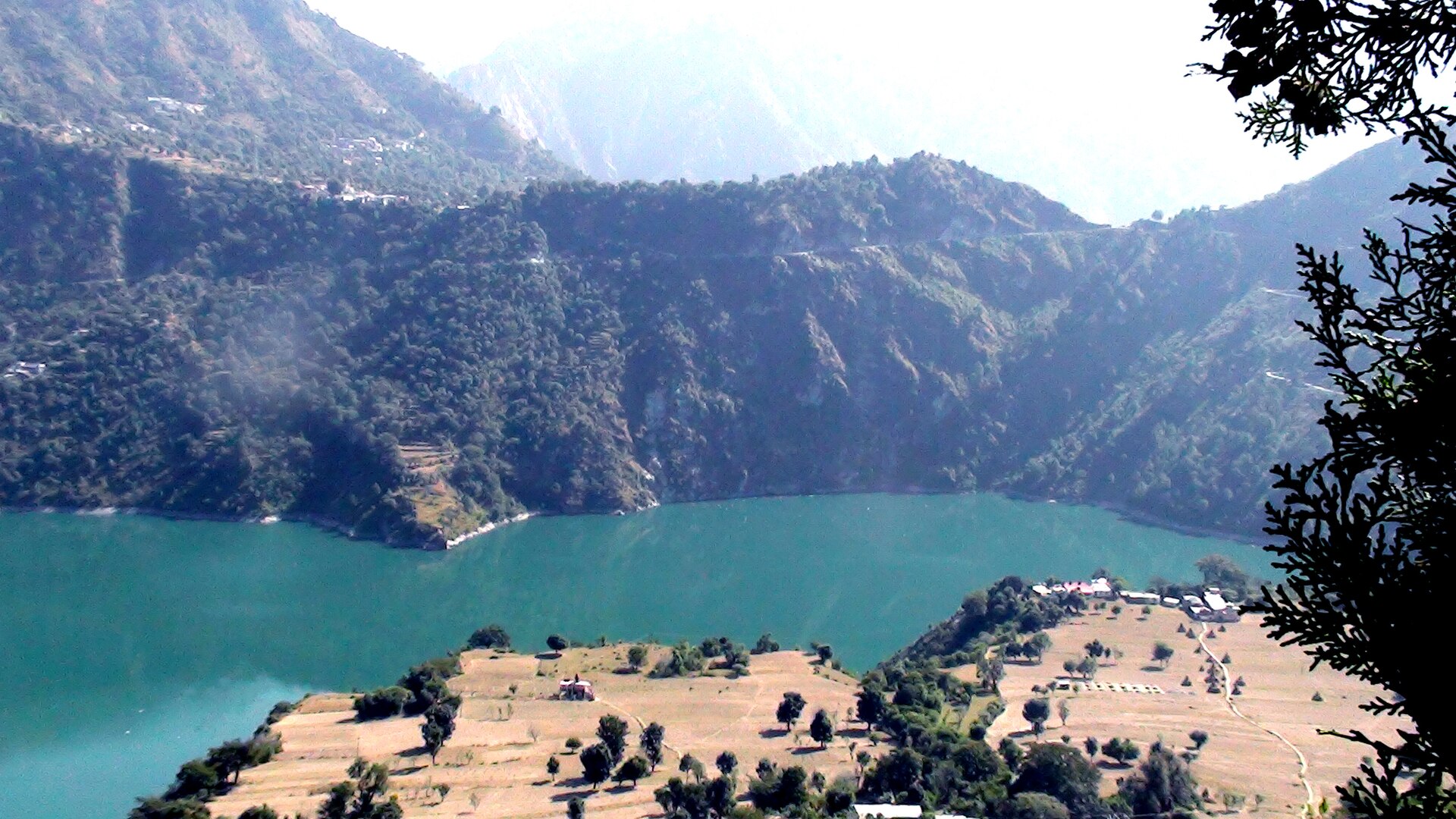
    Image: The Ravi in Chamba district, traditionally identified with the Paruṣṇī. Sridhar Rao, CC BY-SA 4.0, via Wikimedia Commons.

    The dust rose up at the ends of the earth,
    and the few stood ringed by the many;
    the river ran on, the fords lay clear,
    and the good giver gave as any.

    The Good Giver

    Of a king of the five rivers, known only from his poets’ songs.

    In those days the land of the five rivers lay open under a wide sky, and the peoples who sang to Indra moved across it with their herds, seeking grass and water. Among them were the Bharatas, and with them a clan called the Tṛtsus. Their king was Sudās, and his name means “good giver”. The singers called him Paijavana, the son or the descendant of one Pijavana, and they named the great chief Divodāsa as “the father of Sudās”. How these men truly stood to one another the songs leave unclear.

    No chronicle of Sudās was ever made. What remains are hymns sung beside the sacred fire by the poets he rewarded, and they praise the king and their own craft in the same breath.


    Two Singers

    Of two houses of poets, and one who stood beside the king.

    It is told that the Bharatas once had another singer, Viśvāmitra, son of Kuśika, whose tale came earlier in these Chronicles. By the power of his words he begged two swollen rivers to stand still so that the Bharata host might cross, and the songs of his house remember that he brought Sudās over the waters. In the songs of the great battle, though, another poet stands at the king’s side.

    He was Vasiṣṭha, and his house was proud. The Vasiṣṭhas wore their hair braided on the right, and they said their forefather was born of a flash of lightning seen by the gods Mitra and Varuṇa. They held that a well-made hymn, a bráhman, a sacred formulation, could draw a god down from heaven to the place where they sat.


    The Ten Kings Gather

    Of old comrades turned to foes, and dust at the ends of the earth.

    Then ten kings joined against Sudās, though the peoples named are more than ten. There were the Pūrus, once the Bharatas’ kin; the Anus and the Druhyus; Turvaśa and the Matsyas, whose name means “fish”; the Bhṛgus; and the Pakthas, the Bhalānas, the Alinas, the Viṣāṇins and the Śivas, though some read these last as nicknames for raiders. Former comrade, sang the poet, now crossed former comrade.

    The Bharatas were few and their foes were many. A singer cried out in the hour of danger, “The ends of the earth have appeared covered in dust!” The tumult climbed to heaven, and the enmities of the tribes closed in on every side. In that hour, another sang, they were cut short like goads for driving cattle, “the puny Bharatas”.

    I am Sudās, son of Pijavana, king of the Bharatas, and I will tell you of that day. Dust rose at the ends of the earth, and men I had called kin came against me. We were few. My singers say that we looked to Indra as the thirsty look to the sky for rain, and of that hour they told the truth.


    The Prayer at the Fire

    Of a god who left another man’s soma for a better song.

    The Vasiṣṭhas kept faith. It is sung that Indra was far off, drinking the soma pressed for him by one Pāśadyumna, when the Vasiṣṭhas called to him. He rose from that man’s ritual grass and came to them instead, for he preferred them above the other.

    “Like thirsty ones looking toward heaven” for rain, the hemmed-in Bharatas looked to Indra. Indra heard Vasiṣṭha as he praised, and he made broad room for the Tṛtsus. So the Vasiṣṭhas told it, and in their telling it was their sacred formulation that won the day for Sudās.


    The River That Turned

    Of the Paruṣṇī, a broken flood, and a lioness slain by a wether.

    The battle was fought by the Paruṣṇī, the river most often held to be the one now called the Rāvī. Here the hymn grows dark and broken, full of jests and turns of speech whose meaning is half lost.

    The allies, it seems, sought to turn the river from its course. “They parted inexhaustible Paruṣṇī,” sang the poet. The waters would not serve them. Indra had already made the spreading floods into fords easy to cross for Sudās, and the enemy came to the river as to a goal and found their ruin there. “Not even the swift one made it home for supper.” Kavaṣa, old and famous, was wrenched down into the waters, and with him the Anu and the Druhyu.

    Then the singer counted the dead. The Anu and Druhyu people fell down to sleep, “sixty hundred, six thousand” of them. The words that follow are uncertain. Some read sixty-six heroes more among the fallen. Others read the sixty-six as the small band who fought on Sudās’s side. Either way, the few had overthrown the many. With a feeble thing, the poet sang, Indra “smote even the lioness with a wether”, and he broke seven strongholds and gave the wealth of Anu’s line to the Tṛtsus.

    The song moves east, to the Yamunā. There a chief called Bheda was stripped of all he had, for the Yamunā helped Indra, and so did the Tṛtsus, and three peoples, the Ajas, the Śigrus and the Yakṣus, brought horses’ heads as tribute. Whether this was the same war or another, the verses do not say.

    In yet another hymn the victory belongs to Indra and Varuṇa together, the one who smashes obstacles in battle and the one who guards his commands. The ten kings had gathered without zeal for the sacrifice, it says, and they could not stand against Sudās.


    Gifts in the Evening

    Of cows and chariots, and horses hung with pearls.

    When the dust settled, the king gave as his name promised. Vasiṣṭha sang of two hundred cows from the line of Devavant, and two chariots from Sudās, “carrying brides” or “with mares to draw them”, for the old word can be read both ways. There were four horses besides, covered with pearls, to carry the poet and his son. Then the singer asked the storm gods to stand by Sudās as they had stood by Divodāsa before him.

    They call me the good giver. When the river had done its work I gave as a king should give: cows to my singer, chariots, and horses hung with pearls. A king whose name is sung beside the fire must open his hand.


    Echoes in Later Ages

    Of a later king of a like name, and the Bharatas moving east.

    Long afterwards, the great epic told of a king named Kalmāṣapāda, son of Sudāsa of the line of Ikṣvāku, who was cursed by a son of Vasiṣṭha, became an eater of men, and devoured Vasiṣṭha’s sons while Viśvāmitra urged him on. The names and the old rivalry of priests echo there. The king himself belongs to another royal house and a later legend.

    The Bharatas did not fade. In time, it is thought, they moved east and became part of the Kuru realm, and the name of the Bharatas lived on.


    The truth behind the tale

    Sudās is known only from the Ṛgveda, chiefly hymns 7.18, 7.33 and 7.83, with a mention in 3.53. These were composed somewhere around 1400 to 1000 BCE, though no date is fixed, and no archaeological find has identified the battle or anyone in it. The alliance, the fight at the Paruṣṇī, the drowning of Kavaṣa, Bheda’s defeat by the Yamunā and the gifts to Vasiṣṭha are in the text. That the enemies tried to breach or divert the river, and that the Bheda fight was a second campaign, are modern readings. Hymn 7.18 is full of puns and obscure words; translators differ on many verses, including the list of peoples, the sixty-six and the “brides”. The identification of the Paruṣṇī with the Rāvī is traditional but not certain.

    Many scholars think the victory let the Bharatas settle further east, where they later merged into the Kuru realm, and some trace the name “Bhārata” for India to this tribe; later tradition credits it instead to a legendary king Bharata. A feud between Viśvāmitra and Vasiṣṭha belongs to later tradition more than to the hymns. The Mahābhārata‘s Kalmāṣapāda, son of Sudāsa, is a later legend of an Ikṣvāku king.

    On the translations. “They parted inexhaustible Paruṣṇī” (7.18.8) and “with mares to draw them” (7.18.22) follow Ralph Griffith’s translation. Every other quotation follows Jamison and Brereton: “the father of Sudās” (7.18.25), “The ends of the earth have appeared covered in dust!” (7.83.3), “the puny Bharatas” (7.33.6), “Like thirsty ones looking toward heaven” (7.33.5), “Not even the swift one made it home for supper” (7.18.9), “sixty hundred, six thousand” (7.18.14), “smote even the lioness with a wether” (7.18.17) and “carrying brides” (7.18.22). Where Jamison and Brereton have the river “diverted”, Griffith has it “parted”.

    Imagined voice: the italic passages in which Sudās speaks in the first person are imagined. They are built only from the texts and studies named here, add no events, and are not quotations.

    Sources

    1. Stephanie W. Jamison and Joel P. Brereton (trans.), The Rigveda: The Earliest Religious Poetry of India (Oxford University Press, 2014): RV 3.53, 7.18, 7.33 and 7.83 and their introductions; the term bráhman, “sacred formulation”.
    2. Ralph T. H. Griffith (trans.), The Hymns of the Rigveda (1896), Book 7, hymns 18, 33 and 83.
    3. Michael Witzel, “Early Sanskritization: Origins and Development of the Kuru State” (1995/1997): Sudās’s victory and the Bharata settlement in Kurukṣetra.
    4. Kisari Mohan Ganguli (trans.), The Mahabharata, Ādi Parva (Chaitraratha Parva), sections 177 to 179: Kalmāṣapāda, son of Sudāsa.
  • Makkhali Gosāla

    Makkhali Gosāla

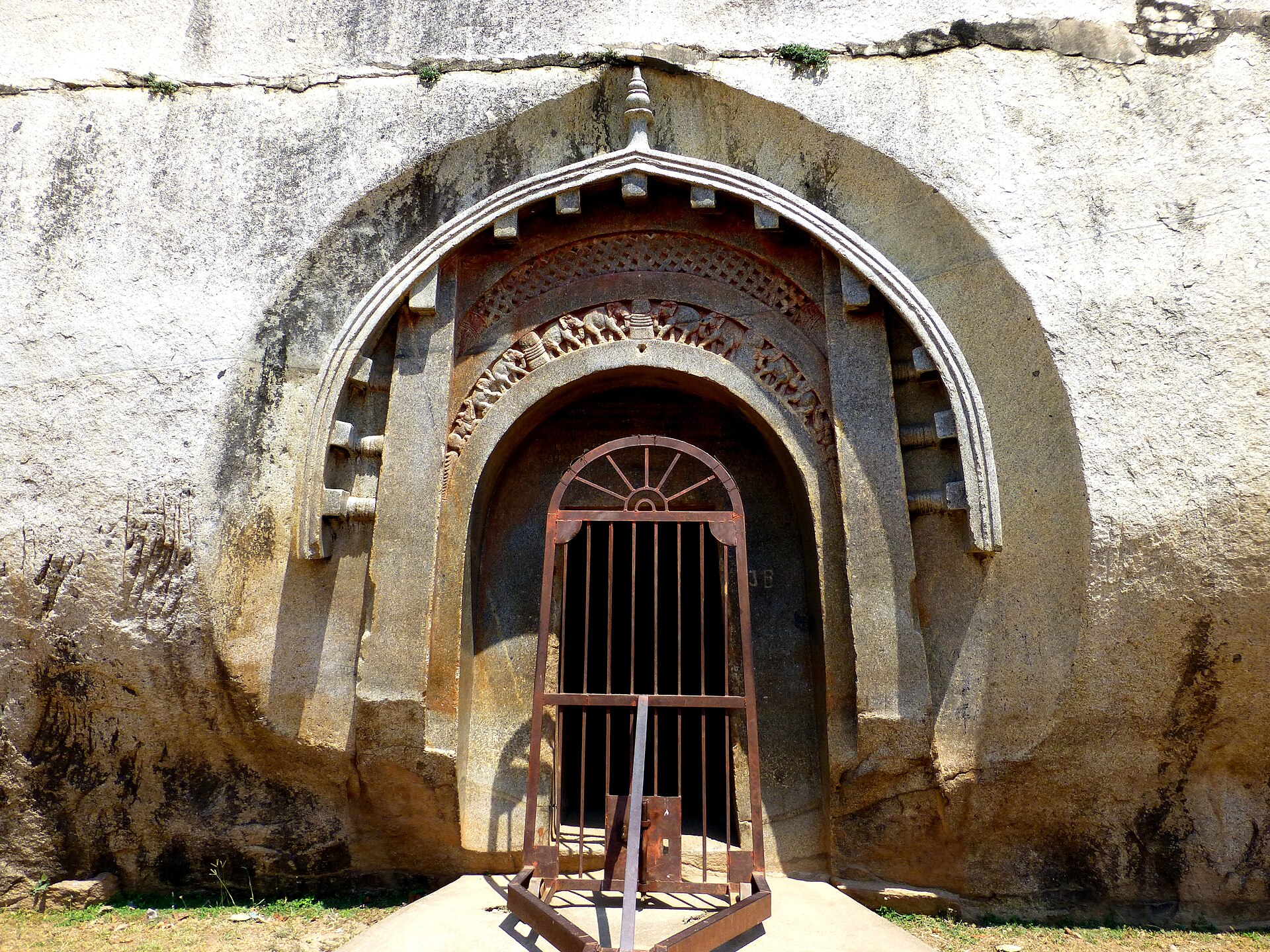
    Image: Lomas Rishi cave in the Barabar Hills, Bihar, where Aśoka dedicated caves to the Ājīvikas. Photo Dharma (Anandajoti Bhikkhu), CC BY 2.0, via Wikimedia Commons.

    Throw down the ball and let it run,
    unwinding down the dusty track;
    the fool, the wise, go on as one,
    and none can wind the thread-ball back.

    A Tale Told by Rivals

    Of a teacher whose own words are lost, and the enemies who kept his name.

    In those days many teachers walked the roads of Magadha and Kosala. One of them taught that there was no road to choose. All beings, he said, run their course as a thread runs off a ball, and when the thread is spent they come to the end of sorrow, the fool and the wise alike. That teacher was Makkhali Gosāla, and the naked ascetics who followed him were called the Ājīvikas.

    Of his own words nothing has come down. All that is told of him was told by two rival houses, the followers of Mahāvīra and the followers of the Buddha, and neither loved him. This is the tale of a man as his enemies remembered him.

    I am Makkhali Gosāla, and nothing I said has reached you in my own voice. Every word you will hear of me was carried by those who stood against me. Listen to them, then, and remember who is speaking.


    The Cowshed at Saravaṇa

    Of a showman’s son, born where the cattle sheltered from the rain.

    The Jains tell it so. Long afterwards, in Sāvatthī, Indabhūti Goyama, the eldest of Mahāvīra’s disciples, asked his master, bhante, “sir”, whence this Gosāla had come. And Mahāvīra told him.

    There was a man named Mankhali, a mankha, a wandering showman who earned his bread by showing a picture he carried in his hand. His wife was Bhaddā. As the rains set in he came to the settlement of Saravaṇa and found no shelter but the cowshed of a wealthy Brahmin. There Bhaddā bore a son, and because he was born in a cowshed, a gosālā, they named him Gosāla.

    Among the Buddhists, long after, another tale was told. Makkhali was a servant carrying a pot of oil across muddy ground, and his master called after him, “My dear man, take care lest you stumble!” He stumbled all the same and fled, and when the master caught the edge of his garment he let the cloth go and ran on naked.

    Both tales make him low-born, and both were told by his rivals.


    The Sesame Plant

    Of a plant torn up by its roots, and seeds that formed regardless.

    Gosāla met Mahāvīra, whose own tale is still to come, in a weaver’s shed at Nālandā outside Rājagaha. Three times Gosāla asked to be his disciple and three times he was refused. At last he gave away his clothes and his pictures, shaved his head, and was accepted, and for six years the two lived together, practising austerities.

    Once, on the road to Kummagāma, they passed a great sesame plant in flower. Gosāla asked whether it would perish. Mahāvīra answered that it would, and that its seeds would form in the pods of that same plant. To prove him false, Gosāla went quietly back and tore the plant up by its roots. Just then a shower of rain fell, and the plant took root again and stood. When they passed that way again, the seeds were in the pods.

    From that day, it is told, he held that all living beings, like the sesame, may die and be quickened again. Soon after, he went his own way. By hard discipline he won a burning power of his own, named himself a Jina, a conqueror, and became head of the Ājīvikas.


    Fire at Sāvatthī

    Of a burning power hurled at a master, and turned back as from a rock.

    His chief seat was Sāvatthī, where a potter woman named Hālāhalā, a lay follower of the Ājīvikas, gave them lodging in her workshop. When Mahāvīra came to that city and said that Gosāla was no Jina, the word ran through the streets, and Gosāla came out in anger with his Ājīvikas to face him.

    “You have called me your pupil; but that pupil of yours, Gosāla Mankhaliputta, is long since dead and reborn in the world of the devas,” he said. Another soul, he claimed, now dwelt in the dead man’s body.

    Mahāvīra answered that he was like a thief who hides under one disguise after another and fancies that no one knows him. Gosāla abused him grossly. Two of Mahāvīra’s disciples rebuked him, and he struck each of them down with his burning power, the tejolesā. Then he drew back a few paces and hurled the fire at his old master. It rebounded as from a rock, and turned back and burned Gosāla himself.

    “You will die of fever within six months,” said Gosāla.

    “I shall live sixteen years yet,” said Mahāvīra. “It is you who will die of fever, within seven days.”


    Seven Days in the Potter’s House

    Of a mango held in a fevered hand, and a burial with two faces.

    Many of the Ājīvikas left him then and went over to Mahāvīra. A few stayed. Gosāla fled back to the potter woman’s house, and there, in the fever, he held a mango in his hand, and drank and sang and danced, and sprinkled himself with the cool, muddy water in the potter’s vessels.

    A lay follower named Ayampula came to ask him what a certain insect was like, and the elders signed to Gosāla to throw the mango away. Gosāla answered, “it is like the root of the bamboo; play the lute, brother, play the lute!”

    Knowing he would die, Gosāla told his elders to bury him with every honour and to proclaim that with him the last Tīrthaṅkara had passed. At the end his certainty gave way. He declared that Mahāvīra alone was the true Jina, that he himself was only Gosāla, the son of Mankhali, a wicked man, and that they should bury him in dishonour. Then he died.

    The elders shut the doors of the workshop and within its walls made a show of the shameful rite. Then they opened the doors and buried him in public with every honour, as he had first commanded.


    The Ball of String

    Of a king’s question, and an answer like a ball of string unwinding.

    The Buddhists remembered his teaching more than his life. On a full-moon night, it is told, King Ajātasattu of Magadha, the son of Bimbisāra, asked his ministers which ascetic he might visit to bring peace to his mind. One of them, addressing him as deva, “Your Majesty”, said, “Your Majesty, this bamboo-staffed ascetic Gosāla leads an order and a community, and tutors a community.”

    The king had gone to him once already. He had greeted him as bho Gosāla, “good sir”, and asked what fruit the ascetic life could show in this very life. Gosāla answered, “Sentient beings are purified without cause or reason,” and, “There is no power, no energy, no human strength or vigor.” All living things are shaped by niyati, destiny, by circumstance and by their own nature, and through eight million four hundred thousand great aeons the fool and the wise wander from birth to birth. No vow or penance can ripen a deed before its time.

    “It’s like how, when you toss a ball of string, it rolls away unraveling. In the same way, after transmigrating the foolish and the astute will make an end of suffering.”

    Fool and wise man, you are a ball of string thrown down upon the road. You will roll until the string runs out, and there you will stop, every one of you, at the end of sorrow. No vow can make the string run faster. My followers went naked and fasted all the same, and why they did so went into the dark with their books.

    Ajātasattu was displeased, but he would not rebuke an ascetic living in his realm. He rose from his seat and left. It was, he later told the Buddha, like someone who, “when asked about a mango, answered with a breadfruit.”

    The Buddha spoke harder words to his mendicants. A hair blanket, he said, is the worst of woven cloths, “cold in the cold, hot in the heat, ugly, smelly, and unpleasant to touch”, and Makkhali’s teaching was the worst of all, for it denied the power of deeds and effort. He called him moghapurisa, a futile man, a trap set at a river’s mouth to the harm of many fish.


    Caves in the Granite Hills

    Of polished caves given to an order that outlived its founder.

    Gosāla died, and the Ājīvikas lived on. Some two hundred years later King Aśoka had caves cut into the granite of the Barabar hills, their walls ground smooth as glass, and gave them to the Ājīvikas. His grandson Daśaratha gave more in the Nāgārjunī hills nearby, to be theirs for as long as sun and moon endure. Later a hand chiselled at the name of the Ājīvikas on those stones, yet it can still be read.

    The caves remain in the hills of Bihar, dark and cool.


    The truth behind the tale

    Makkhali Gosāla was a real teacher of the fifth century BCE, a rival of Mahāvīra and the Buddha. One modern estimate puts his death around 485 BCE, but the dates of this age are uncertain. No Ājīvika writing survives, so all we know comes from Jain and Buddhist sources hostile to him. What he truly taught, and how his followers squared fixed destiny with hard asceticism, we do not know.

    Where the story’s details come from. The cowshed birth, the years with Mahāvīra, the sesame plant, the quarrel at Sāvatthī, the burning power, Ayampula’s visit, the confession and the double burial come from the Jain Bhagavatī Sūtra, book 15, set down in its present form centuries later. They are retold from A. F. R. Hoernle’s summary translation, and most of the dialogue is recast from his indirect speech; only Gosāla’s challenge and his answer to Ayampula are quoted. The magic and the deathbed recantation are best read as sectarian legend: the same chapter claims that Ājīvika doctrines grew out of Gosāla’s delirium. The oil-pot story is from Buddhaghosa’s commentary on the Sāmaññaphala Sutta (5th century CE). The king’s visit and Gosāla’s doctrine are from the Sāmaññaphala Sutta (DN 2), the hair blanket and the trap from AN 3.137,. “Bamboo-staffed ascetic” is Bhikkhu Sujato’s rendering of Makkhali, whose meaning is disputed.

    The caves are firm history. Aśoka’s inscriptions at Barabar and Daśaratha’s at Nāgārjunī (3rd century BCE) name the Ājīvikas, and in several the word was later chiselled away.

    Imagined voice: the italic passages in which Gosāla speaks in the first person are imagined. They are built only from the texts and studies named here, add no events, and are not quotations.

    Sources

    1. Bhikkhu Sujato (trans.), Sāmaññaphala Sutta (DN 2), SuttaCentral: the quotations of the minister, of Gosāla and of the king; Pāli deva, bho.
    2. Bhikkhu Sujato (trans.), Kesakambala Sutta (AN 3.137), SuttaCentral: the hair blanket; Pāli moghapurisa.
    3. A. F. R. Hoernle (trans.), The Uvāsagadasāo, vol. II (1888), Appendices I and II, Internet Archive: summary of Bhagavatī 15 and Buddhaghosa on DN 2, and the quotations “You have called me your pupil…”, “it is like the root of the bamboo…” and “My dear man, take care lest you stumble!”
    4. Bhagavatī Sūtra 15, Ardhamāgadhī text as quoted in studies of the Gosāla chapter (Journal of Indian and Buddhist Studies, J-STAGE): Goyama’s address bhante; the term tejolesā.
    5. A. L. Basham, History and Doctrines of the Ājīvikas (1951).
    6. E. Hultzsch, Inscriptions of Asoka, Corpus Inscriptionum Indicarum I (1925); Harry Falk, “Barabar Reconsidered” (2007): the cave dedications.
  • Ghoṣā

    Ghoṣā

    Image: Ṛgveda on palm leaf in Śāradā script, Kashmir; Bhandarkar Oriental Research Institute, Pune. Ms Sarah Welch, CC0, via Wikimedia Commons.

    Riders of morning, swift as thought,
    you have healed the old and the lame;
    come to the house where a daughter waits,
    and stay when the dawn has come.

    The House of the Singer

    Of a poet’s house, and a daughter who stayed.

    In those days, when the Ṛgveda was still being sung into being, there lived a poet named Kakṣīvant. He came of an old line of singers: he was called the son of Uśij, and the house of the seer Dīrghatamas was counted among his forebears. Of all the gods, he loved best the Aśvins, the twin horsemen of the morning. In one of his songs he praised them for pouring from the hoof of their horse a hundred jars of honey for the people.

    It is told that Kakṣīvant had a daughter, and her name was Ghoṣā. In the old tongue the word means a sound or a cry, a fitting name for one remembered for her voice.

    The seasons went over the house of her father. Rains came and went, the herds were driven out at dawn and home at dusk, and other girls left with husbands. Ghoṣā stayed. One of her father’s own hymns remembers it in a single line: “Even to Ghoṣā, living at home with her father, you gave a husband, though she was growing old.” The rest must be heard in the hymns that bear her name.

    I am Ghoṣā, daughter of Kakṣīvant, and I will tell you how the seasons passed over my father’s house. The rains came and went. Other girls went away with husbands. I stayed, and I grew older, and each morning I heard the singers call upon the riders of the dawn.

    The Riders Before the Sun

    Of the twin horsemen of morning, and the deeds sung of them.

    Each morning, before the sun was up, the singers turned their faces east. That was the hour of the Aśvins. Their chariot was swifter than thought, made for them by craftsmen of the gods, and when it was yoked, so the song says, Dawn, the Daughter of Heaven, was born.

    The first of the hymns given to Ghoṣā calls them by their old fame as healers. They are “good fortune even for the woman growing old at home”, it says, and help for the slow, the hungry, the blind and the broken.

    Then the song tells their great deeds, one after another, like beads on a thread. They “fashioned old Cyavāna, like a chariot, into a youth again”. They made the poet Kali young again. They pulled the son of Tugra out of the waters. They dug Vandana out of a snare and raised up Rebha, hidden and already given up for dead. For Atri they made a pit of heat a place of comfort. In an instant they made Viśpalā go again; Ghoṣā’s father sang that they gave her a leg of metal. They brought a bride to Vimada and freed a quail “even from within the mouth of the wolf”.

    And in the middle of all this praise, a woman’s voice breaks in. She begs the twins to care for her as parents care for a child, for she is “without friends, without kin”, and she asks to be saved from her shame. Many have heard Ghoṣā herself in that cry. Yet the song does not name her, and some who know it well think it is another woman’s voice, set there beside hers.

    Where Do You Rest at Night?

    Of questions light as a child’s, and a name spoken once.

    The second hymn opens with questions, light as a child’s. Where are the Aśvins in the evening, and where at dawn? Where did they sleep? Who draws them home, as a maiden draws a dashing youth to a meeting? They come to the soma rites, the singer says, “like kings’ sons”, as young princes ride to a feast.

    Then a name rings out, the only time it is spoken in her hymns. “Ghoṣā, the daughter of a king”, circling about the twins, speaks to them boldly: “Will you be there for me for the day and be there for the night?” She names the ones they have aided before, Bhujyu among them, and the widow, and she says that she takes delight in their kindness.

    So I spoke to them myself. Where do you rest at night, you two? Will you be there for me by day and by night? You helped Bhujyu and the widow. I take delight in your kindness.

    Here there is a riddle. In her father’s song she is growing old in his house; in her own she is a princess. Perhaps the princess is her proud name and the lonely house her sorrow. Perhaps they are two women. The old songs do not say.

    The Wedding Song

    Of sprouts and rivers, and a marriage at last.

    After her words, the hymn turns to a wedding, and the images come like spring after a long dry season. The maiden is born. The sprouts spring up by the wonder of the Aśvins. The rivers run down as if into a valley. And then, plain and glad: “this is marriage!”

    The kin weep at the rite. The fathers have long planned the match, and it is precious to them that the couple is brought together; to the husbands it is a joy to hold their wives. At the last the singer begs the twins to clear every stump from the path, and asks once more where they have gone.

    What Later Tellers Said

    Of sixty years in a father’s house, and a story grown like ivy.

    Long after the hymns were fixed, other tellers filled the silence with a story. An old book of the gods and their legends says that Ghoṣā was “disfigured by an evil disease”, and that she stayed in her father’s house for sixty years. At last she thought that her father had won youth and health by praising the Aśvins, and that she might win beauty in the same way. Then she “saw” the two hymns, as seers were said to see their songs. The twins were pleased. They made her “ageless, free from disease, and beautiful”, and gave her a husband and a son, the sage Suhastya. A teacher of a much later age named her sickness: it was leprosy, he said, and that was why no man would wed her.

    To Suhastya the tradition gives a short hymn of his own, set just after his mother’s. It too begins with the chariot of the Aśvins at break of dawn.

    So the story grew around the songs, as ivy grows around a doorway. Whether a woman truly made these hymns, or whether her name was later drawn from the woman who speaks in them, no one can now say.


    The truth behind the tale

    The hymns are real: Ṛgveda 10.39 and 10.40, fourteen verses each, from Book 10, a late layer of a collection usually placed around 1500–1000 BCE. Ghoṣā is named in 10.40.5 as a king’s daughter, and her father’s hymn 1.117.7 says the Aśvins gave her a husband when she was growing old in his house; the long list of rescues comes from 10.39, except Viśpalā’s metal leg (1.116.15). Older readings that find her in 1.120.5 and 1.122.5, with a husband named Arjuna, are doubtful, since ghoṣā there may simply mean “cry”. The ancient index (Anukramaṇī) names her as poet, but it often took poets’ names from people in a hymn, and some modern translators see no firm evidence that a woman composed these songs, or that the friendless woman of 10.39.6 is Ghoṣā. The disease, the sixty years and the son Suhastya come from the Bṛhaddevatā (7.42–48), a later work of disputed date, and the passage is missing from some manuscripts; the word “leprosy” comes from the commentator Sāyaṇa (14th century CE). We do not know where or exactly when she lived, or whether she lived at all.

    Imagined voice: the italic passages in which Ghoṣā speaks in the first person are imagined. They are built only from the texts and studies named here, add no events, and are not quotations.

    Sources

    1. S. W. Jamison and J. P. Brereton (trans.), The Rigveda (2014): introduction; RV 1.116–122; 10.39–41.
    2. R. T. H. Griffith (trans.), The Hymns of the Rigveda (1896), sacred-texts.com: RV 1.117, 10.39, 10.40.
    3. A. A. Macdonell (trans.), The Bṛhad-devatā (1904), vol. II, 7.42–48.
    4. H. H. Wilson (trans.), Rig-Veda Sanhitá with Sāyaṇa’s commentary, note on RV 1.117.7 (wisdomlib.org).
  • Pāṇini

    Pāṇini

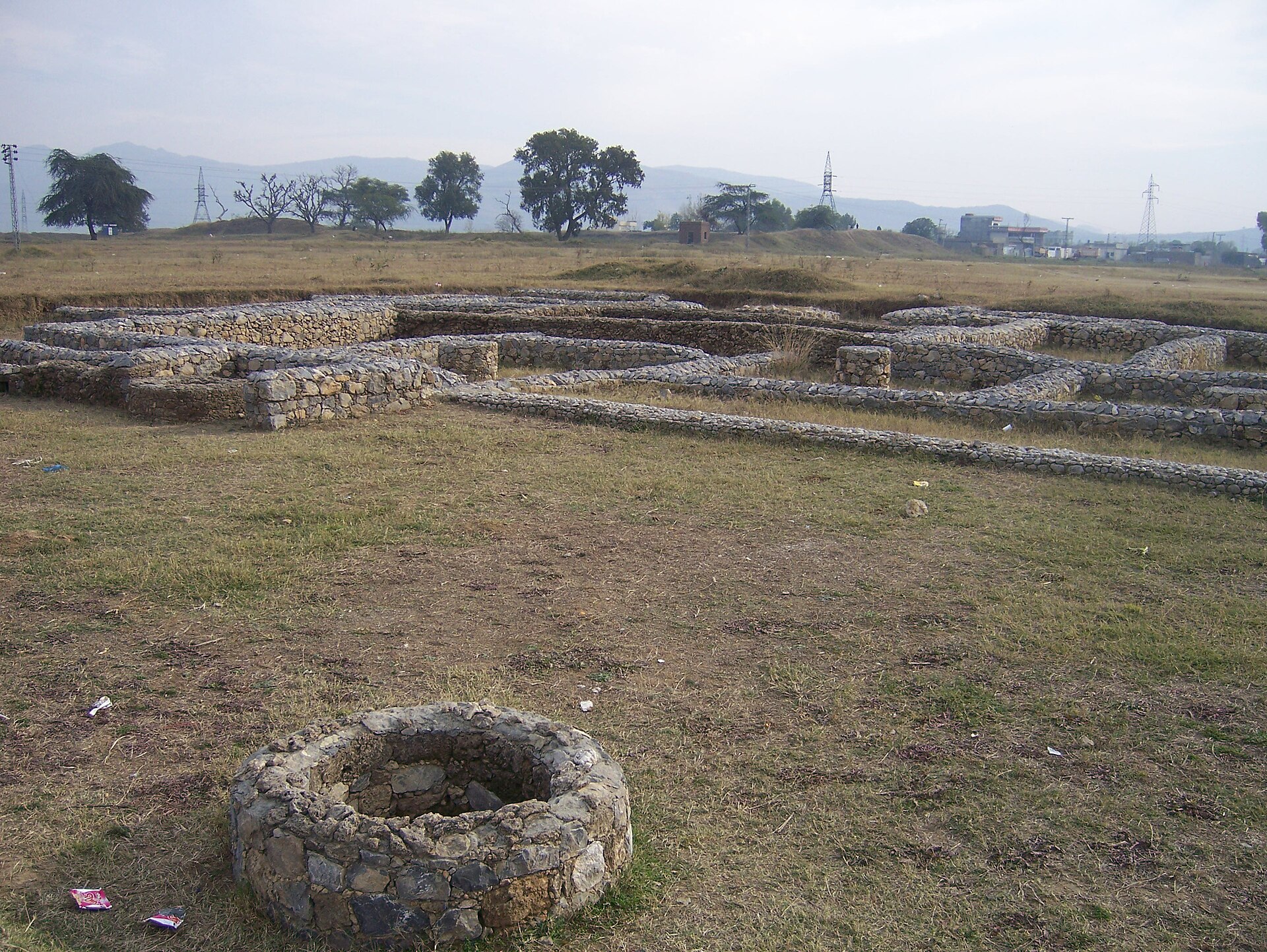
    Image: Ruins at Bhir Mound, ancient Taxila, a city named in Pāṇini's own rules (4.3.93). Dawoodmajoka, Public domain, via Wikimedia Commons.

    Where the cold river meets the broad,
    fourteen lines of sound were set;
    four thousand threads in eight books bound,
    and a name the brown hills keep yet.

    Where the Two Rivers Meet

    Of a town in Gandhāra, and a man whose age is lost.

    Far to the northwest of the kingdoms of the Ganges, the land of Gandhāra climbs toward the mountains. There the Kabul River, cold with the snows of the western heights, comes down to join the broad Indus. Brown hills stand behind the meeting of the waters, and in those days a town called Śalātura stood near that joining. Beyond the Indus to the southeast lay Takṣaśilā, a city of teachers and traders; but our tale begins in the smaller place among the hills.

    There, it is told, was born Pāṇini. His mother is remembered as Dākṣī. Of his life we know almost nothing more. Even his age is lost in mist. Some say he lived about five hundred years before the Common Era; others place him a century earlier, or a century later. Yet he left behind one thing that has outlasted every wall of his town: a grammar, a full account of how the words of a language are made.

    The Sounds Set in Order

    Of fourteen lines, and the markers set at their ends.

    The language was Sanskrit, and Pāṇini wished to show how every word of it is built.

    He began with the sounds themselves. He laid them out in fourteen short lines, and at the end of each line he set a marker: a letter outside the sounds themselves, used only as a signpost. With these markers he could name a whole group of sounds in a single breath. Just as we might say “from A to F” rather than naming six letters one by one, so one short word, made of a first sound and a marker, could stand for all the vowels, or for every consonant. Such a compact name is called a pratyāhāra, a drawing-together. Later ages named these fourteen lines after the god Śiva, as though they had come from him, and they are called the Śiva Sūtras still.

    I am Pāṇini, son of Dākṣī, of Śalātura. Of my days I will tell you nothing, for I left you nothing of them. But hear the sounds: I set them in fourteen rows, and at each end I placed a mark, so that a whole company of sounds could be called by a single name.

    Eight Chapters, Learned by Heart

    Of rules as short as threads, and a cloak returned at the door.

    Then he wove his rules. There are nearly four thousand of them, set in eight chapters, and so the work is called the Aṣṭādhyāyī, “the Eight Chapters”. Each rule is a sūtra, a “thread”, and many are only two or three words long. Some are easy to grasp: when two like vowels meet, they melt into one long vowel. Others work only together, like the wheels of a mill. One rule builds the body of a word, another gives it an ending, and a third smooths the sound where two words touch. A word said once in a rule is carried forward into the rules that follow, so it need not be said again.

    So short were his threads that grammarians of later times had a saying: that saving half a short vowel (ardhamātrā) gave them as much joy as the birth of a son.

    The grammar was learned by heart. Pupils sat before their teacher and repeated each line until it was their own, and so it passed from mouth to ear down the long years. Whether Pāṇini himself ever wrote it down, no one can say.

    At its very end stands one of the shortest rules of all, two sounds only: a a. All through the work the short vowel a has been treated as open and full (vivṛta), for the sake of the rules. This last line quietly gives back its true sound in speech, closed (saṃvṛta), as a guest returns a borrowed cloak at the door.

    Through all my rules I let the short a stand open and full, because the rules needed it so. At the last I gave it back its true sound. A borrowed thing should be returned.

    The Names of the Northwest

    Of wells by the Vipāś, and the man of Śalātura.

    His grammar speaks for the whole Sanskrit world, yet it keeps turning towards home. One rule tells how to name a man whose forebears came from the Sindhu country or from Takṣaśilā. The very next tells how to name a man of Śalātura, and long afterwards that same name, Śālāturīya, “the man of Śalātura”, was given to Pāṇini himself. His rules name the Gāndhāris, the people of that northwest land, and the Yavanas, strangers from the far west. He even noticed that wells on the northern side of the river Vipāś were named in a slightly different way from others, as only a man who knew that country well might do. Later commentators marvelled at the subtle eye of the sūtra-maker who paused for so small a thing.

    What Later Tellers Said

    Of a dull pupil, a god’s thunder, and a lion.

    Where history falls silent, later tellers speak. Some fifteen hundred years afterwards, a tale told in Kashmir made him a “rather stupid pupil” in the house of the teacher Varṣa at Pāṭaliputra, far away in the east. Sent away by his teacher’s wife, he went up into the Himalaya and did hard penance, until Śiva granted him “a new grammar, the source of all learning”. Then he came down and challenged the learned Vararuci, also called Kātyāyana. For seven days they argued. On the eighth Vararuci was winning, when a terrible sound came from Śiva in the sky, and Pāṇini prevailed.

    A book of animal fables remembered a darker end in a single verse: “A lion took the life of Panini, / Grammar’s most famous name”. What lies behind it, no one knows.

    In the seventh century of the Common Era, a Buddhist pilgrim from China came to Śalātura. He wrote that “this is the place where the Rishi Pāṇini” was born. In a tale he heard there, a Brahmin of the town says that its children honour the sage, and that “a statue erected to his memory still exists”.

    The Long Road of the Rules

    Of the teachers after him, and two thousand years of Sanskrit.

    The grammar did not stay in the northwest. Some generations later, a scholar named Kātyāyana wrote short notes on its rules, testing them and adding what the language had gained. After him, perhaps in the second century before the Common Era, Patañjali wrote the Great Commentary, the Mahābhāṣya, and in it Pāṇini is called Dākṣīputra, “son of Dākṣī”.

    Through such teachers his rules became the measure of good Sanskrit. Poets and philosophers, priests and kings wrote by them for more than two thousand years, and the language we call Classical Sanskrit is in great part the language he described. In our own age, those who study how all human languages work still marvel at how much he caught in so few words.

    The houses of Śalātura in his day are long gone.


    The truth behind the tale

    The Aṣṭādhyāyī itself is real and survives: about 3,960–4,000 short rules (the count varies slightly by tradition) in eight chapters, opened by the fourteen sound lists called the Śiva Sūtras. Pāṇini’s own rules name Takṣaśilā (4.3.93), Śalātura (4.3.94), the Gāndhāris (4.1.169) and wells north of the Vipāś (4.2.74), which is why most scholars place him in the far northwest; Śalātura is usually identified with Lahor, Swabi district, Pakistan. The name “son of Dākṣī” comes from Patañjali’s Mahābhāṣya (c. 2nd century BCE), and the name Śālāturīya is found only in much later sources, including an 8th-century CE inscription. His date is uncertain: most put him around the 5th century BCE, but estimates run from the 6th to the 4th. The story of the dull pupil and Śiva’s gift is from Somadeva’s Kathāsaritsāgara (11th century CE), the lion verse from a medieval Pañcatantra, and the statue from a legend recorded by Xuanzang (7th century CE); none is historical evidence. We do not know how he lived, whom he taught, whether he used writing, or how he died.

    Imagined voice: the italic passages in which Pāṇini speaks in the first person are imagined. They are built only from the texts and studies named here, add no events, and are not quotations.

    Sources

    1. Aṣṭādhyāyī sūtrapāṭha (sanskritdocuments.org), esp. 4.1.49, 4.1.169, 4.2.74, 4.3.93–94, 6.1.101, 8.4.68.
    2. C. H. Tawney (trans.), The Kathá Sarit Ságara, vol. I (1880), ch. 4.
    3. A. W. Ryder (trans.), The Panchatantra (1925), Book II.
    4. S. Beal (trans.), Si-yu-ki: Buddhist Records of the Western World, vol. I (1884), Book II, Gandhāra.
    5. H. Scharfe, Grammatical Literature (1977), p. 88; G. Cardona, Pāṇini: A Survey of Research (1976/1997).
    6. Aṣṭādhyāyī: the Śiva Sūtras (akṣarasamāmnāya) and pratyāhāra designations; 8.4.68 a a, restoring short a from open (vivṛta) to closed (saṃvṛta) (Mahābhāṣya on 8.4.68).
    7. Kāśikāvṛtti on 4.2.74 (udak ca vipāśaḥ): wells north of the Vipāś; mahatī sūkṣmekṣikā vartate sūtrakārasya.
    8. Nāgeśa Bhaṭṭa, Paribhāṣenduśekhara: ardhamātrā-lāghavena putrotsavaṃ manyante vaiyākaraṇāḥ (saving half a short vowel equals joy at a son’s birth).
    9. G. Cardona, Pāṇini: A Survey of Research (1976/1997); H. Scharfe, Grammatical Literature (1977): northwest placement, oral transmission, dating.
  • Janaka

    Janaka

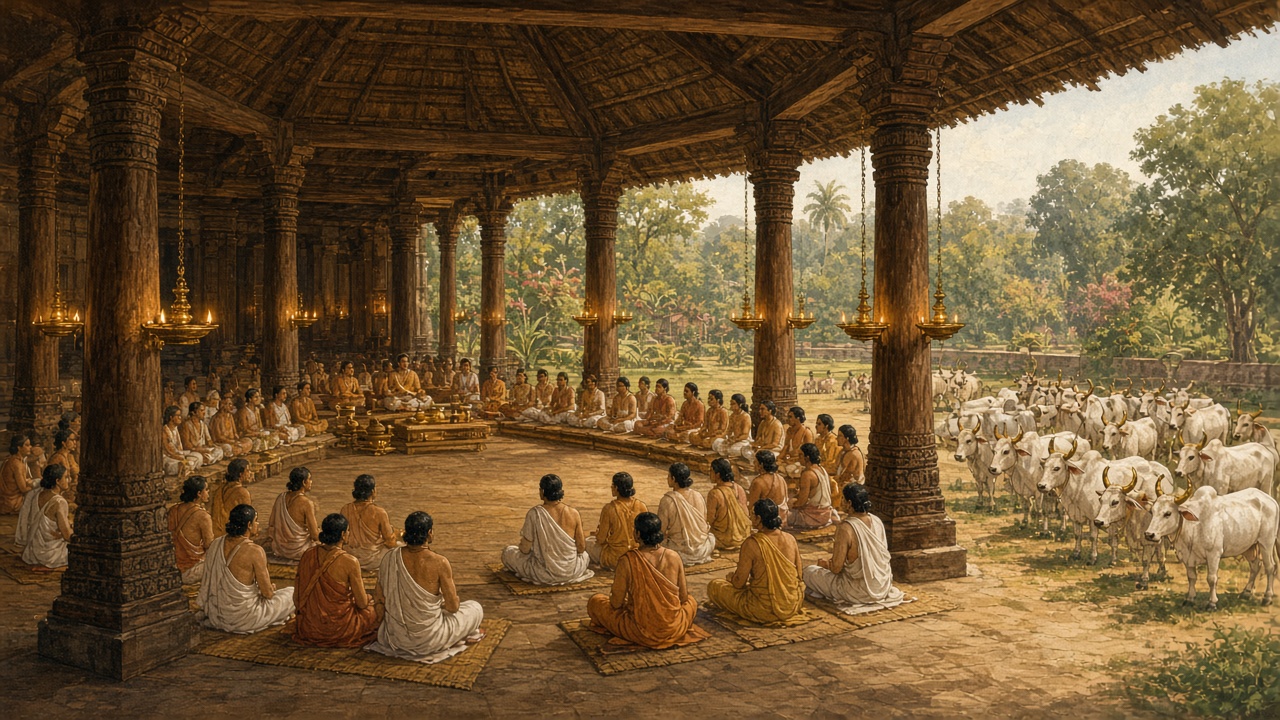
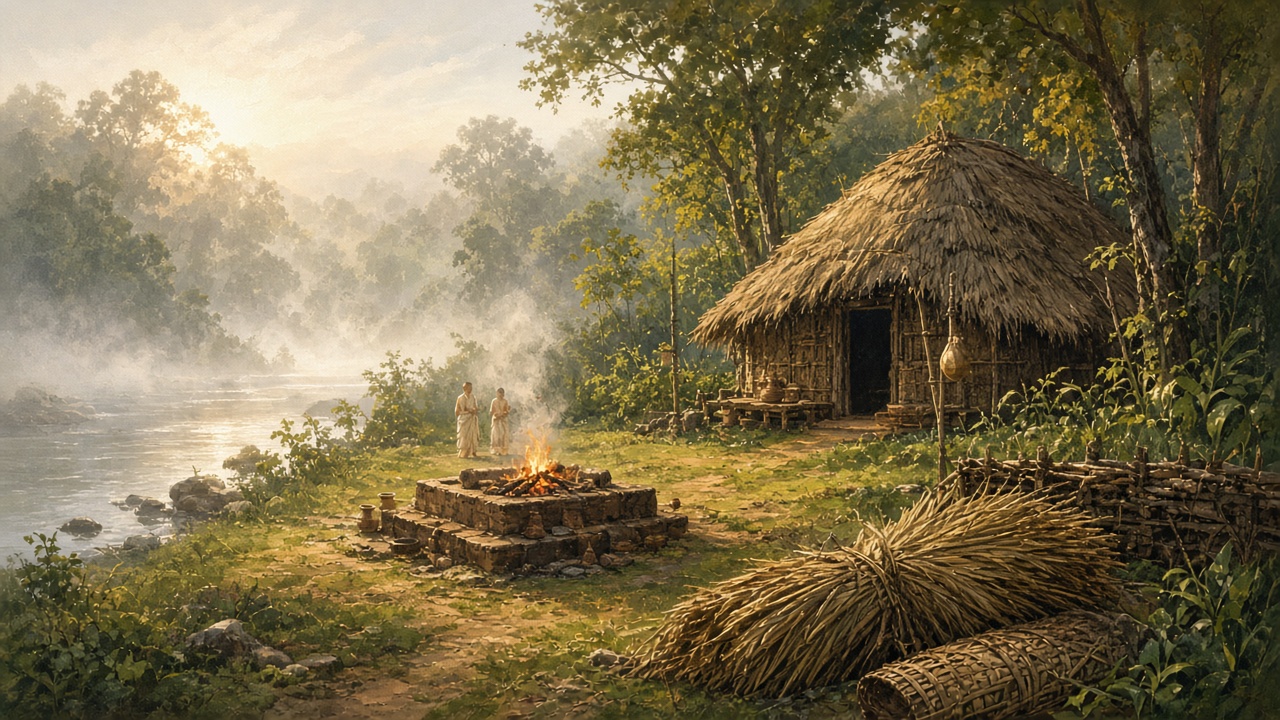
    AI illustration: a scholars' assembly in Janaka's hall at Mithilā, with the prize cows (an imaginative reconstruction).

    Gold on the horns in the eastern court,
    a thousand cows, a challenge laid;
    sun and moon and fire gone out,
    and still the king asked for light.

    Gold upon the Horns

    Of a thousand cows and a challenge laid before the wise.

    In those days, when the smoke of a great sacrifice hung over the eastern kingdom of Videha, a thousand cows stood penned in the king’s courtyard. On every pair of horns, the old book says, gold was fastened: ten pādas of it, five upon each horn, and it glinted as the beasts tossed their heads. The rite was a bahudakṣiṇa sacrifice, one of abundant gifts, and Brahmins had come to it from the Kuru and Pañcāla lands far to the west.

    The king was Janaka, called samrāṭ, sovereign. He spoke to the assembly as brāhmaṇā bhagavantaḥ, “honoured Brahmins”: let the wisest among you drive these cows away.

    No one dared. Then the sage Yājñavalkya, whose own tale is still to come in these Chronicles, turned to his pupil Sāmaśravas, a brahmacārin, and said, “Drive them away, my dear.” The word is somya, as a teacher speaks to a pupil. And the young man drove them off.

    I am Janaka, king of Videha, and I will tell you why I set gold upon the horns of my cows. I wished to know who among the learned was wisest. Not one of them would claim it. Then one man did, and his pupil drove the herd away before my eyes.

    The Brahmins were angry. Janaka’s own priest, Aśvala the hotṛ, asked Yājñavalkya whether he truly thought himself the wisest of them all. “I bow before the wisest,” the sage replied, “but I wish indeed to have these cows.”

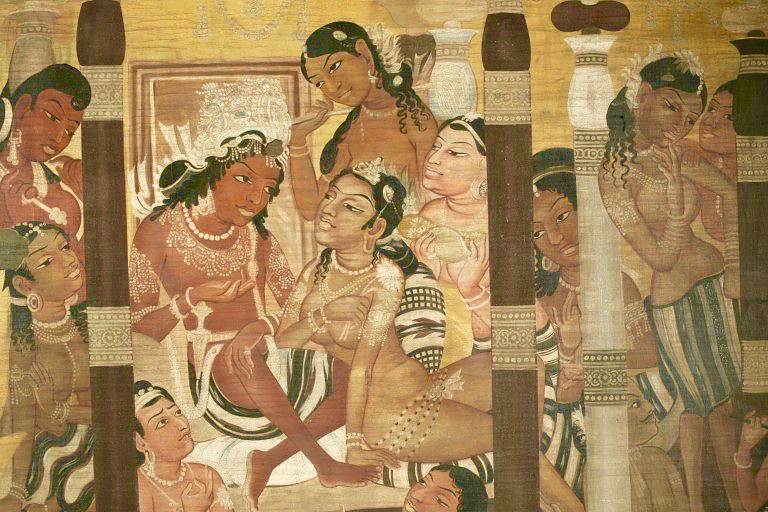
    Painted copy of an Ajanta mural showing a king seated in a palace with his queen and attendants
    Image: King Janaka in his palace, Robert Gill's 1854 copy of a wall painting in Ajanta Cave 1 (Mahājanaka Jātaka). Robert Gill (V&A), Public domain, via Wikimedia Commons. A later legend, painted centuries after the Upaniṣads.

    So began a long brahmodya, a contest of questions. One by one the learned rose against him, and one by one they fell silent. Among them was Gārgī, who alone stood twice, and whom these Chronicles have met already. Tonight our tale is of the king who set the gold upon the horns, and watched.


    The Fire That Walked East

    Of a fire carried east, and the one river it spared.

    It is told in an older book how Videha was first settled. Long ago, a chief named Videgha Māthava carried the sacred fire, Agni Vaiśvānara, in his mouth, and when it burst forth, it went burning eastward from the river Sarasvatī, drying up the rivers. The chief and his priest Gotama Rāhūgaṇa followed behind it.

    But one river it did not burn: the Sadānīrā, whose name means always full of water, flowing cold from the northern mountains. For a long time Brahmins would not cross it, for the land beyond lay “very marshy”, untouched by the fire. Then the fire told the chief to make his home east of that river. So Videha began, a land of wide rivers and wet fields beneath the Himalaya; and even now, the tellers say, that river marks the boundary of the Kosalas and the Videhas.

    Janaka ruled that frontier country, yet his court drew the wise from the old heartlands. Even in the old dialogues his name is a byword: a king of Kāśī complains that everyone runs off to Janaka, calling him their patron.


    The King Who Drove Away

    Of a king who outtalked the Brahmins, and drove off in his chariot.

    Once, it is said, Janaka met three travelling Brahmins, Yājñavalkya among them, and asked how each performed the daily offering to the fire, the agnihotra. To Yājñavalkya, whose answer was best, the king gave a hundred cows. Then he told them that not even he truly understood the offering, mounted his chariot, and drove away.

    The Brahmins muttered that this warrior “has outtalked us”, and wished to challenge him. But Yājñavalkya warned them: if they won, they had only beaten a warrior; if they lost, men would laugh that a warrior had beaten Brahmins. Then he climbed into his own chariot and went after the king, who taught him the hidden meaning of the offering. In return Yājñavalkya granted him a boon, and Janaka chose the right to ask him any question he liked. From that day, the book says, Janaka was counted a Brahman.


    What Is the Light of Man?

    Of a question asked in a hall, and the light that remains.

    Yājñavalkya came to the king’s hall more than once. One day Janaka offered him, again and again, “a thousand cows with a bull as big as an elephant”, but the sage would not take them. His father, he said, had taught him never to accept a reward before the pupil was fully taught. At last the king came down from his throne, bowed, and asked to be taught. When the lesson ended, “You have indeed reached fearlessness,” Yājñavalkya told him, and Janaka answered with his whole realm: “Here are the Videhas, and here am I.”

    Another day the sage came meaning to say nothing at all. But the king used his boon, and spoke first.

    “Yājñavalkya,” he said, “what is the light of man?”

    “The sun, O King,” the sage answered, calling him samrāṭ, sovereign. By the sun a man sits, moves about, does his work, and returns.

    And when the sun has set? The moon. And when the moon has set as well? Fire. And when the fire has gone out? Sound, said Yājñavalkya: for when one cannot see even one’s own hand, still one walks towards a voice.

    “When the sun has set, O Yājñavalkya, and the moon has set, and the fire is gone out, and the sound hushed, what is then the light of man?”

    “The Self indeed is his light.”

    I asked of the sun, and of the moon, and of fire, and of the voice in the dark. Each answer was true, and each was not enough. Then he spoke of the Self, and I offered him the Videhas and myself with them.

    Then the sage spoke long of dream and deep sleep, and of a falcon that folds its wings and goes home to its nest. Again and again the king offered a thousand cows and begged him to speak on, until, the text admits, Yājñavalkya grew afraid that this clever king would drive him from every position he held. When the teaching was done, Janaka gave everything once more: “I give you the Videhas, and also myself, to be together your slaves.”


    Smoke over Mithilā

    Of a name that outgrew a man, and a city that might burn.

    The name of Janaka outgrew any one man. Later tellers made it the name of a whole line of kings in Mithilā. In the later epic tale, a Janaka ploughing a field for a sacrifice finds a baby girl in the furrow and names her Sītā, “furrow”; later tellings call him Sīradhvaja, “plough-bannered”. Whether that Janaka and the questioner of Yājñavalkya were ever one man, no one can say.

    An epic verse is sung by a Janaka who wanted nothing: if all Mithilā were burnt to ashes, “nothing of mine will be burnt”. Buddhist tellers gave a like saying to their own King Mahājanaka as he left his palace for the homeless life.


    The truth behind the tale

    The cows with gold on their horns and the “light of man” dialogue come from the Bṛhadāraṇyaka Upaniṣad (3.1 and 4.1–4.4). The chariot story comes from the Śatapatha Brāhmaṇa (11.6.2); its tale of the fire’s march east (1.4.1) is legend, though it may remember the eastward spread of Vedic ways. Both texts took shape roughly in the 8th to 6th centuries BCE and were edited over a long time. Janaka is a figure of literature: no inscription, coin or ruin names him, though Videha lay in what is now north Bihar and the Nepal Terai. Even these early texts treat him as a model king, so they may already be idealising a real ruler. The Rāmāyaṇa’s Sītā tale, the Mahābhārata verse and the Mahājanaka Jātaka are later legend, written down centuries afterwards. Whether “Janaka” was a personal name or a family title, and how many Janakas there were, we do not know.

    Where the story’s details come from. The golden-horned cows, the brahmodya, Aśvala the hotṛ, and the light-of-man dialogue follow the Bṛhadāraṇyaka Upaniṣad 3.1 and 4.1–4.4, in Patrick Olivelle’s translation and the GRETIL Sanskrit; the ten pādas of gold and the addresses somya, samrāṭ and brāhmaṇā bhagavantaḥ are from that text. The fire’s march east (Agni Vaiśvānara, Gotama Rāhūgaṇa, the Sadānīrā as Kosala–Videha boundary) and the chariot agnihotra story follow the Śatapatha Brāhmaṇa 1.4.1 and 11.6.2, in Julius Eggeling’s translation. The king of Kāśī’s complaint is in the Bṛhadāraṇyaka Upaniṣad; Sītā found in the furrow and the name Sīradhvaja are from the Rāmāyaṇa; the verse “nothing of mine will be burnt” is from the Mahābhārata.

    Imagined voice: the italic passages in which Janaka speaks in the first person are imagined. They are built only from the texts and studies named here, add no events, and are not quotations.

    Sources

    1. F. Max Müller, The Upanishads II (SBE 15, 1884), Bṛhadāraṇyaka Upaniṣad 2.1, 3.1, 4.1–4.4; cf. P. Olivelle, The Early Upaniṣads (1998).
    2. J. Eggeling, The Śatapatha Brāhmaṇa I and V (SBE 12, 1882; SBE 44, 1900), 1.4.1 and 11.6.2.
    3. K. M. Ganguli, The Mahabharata, Śānti Parva, sections XVII and CCXVIII–CCXIX.
    4. R. T. H. Griffith, The Rámáyan of Válmíki, Book I, cantos LXVI and LXXI; H. H. Wilson, Vishnu Purana IV.5.
    5. E. B. Cowell (ed.), The Jātaka VI (1907), No. 539, Mahājanaka-Jātaka.
    6. M. Witzel, “Moving Targets? Texts, Language, Archaeology and History in the Late Vedic and Early Buddhist Periods” (2009).
    7. Bṛhadāraṇyaka Upaniṣad, Sanskrit text with Śaṅkara’s commentary, GRETIL, and P. Olivelle, The Early Upaniṣads (1998), 3.1 and 4.1–4.4: somya, samrāṭ, brāhmaṇā bhagavantaḥ, the ten pādas of gold, the bahudakṣiṇa sacrifice, Aśvala the hotṛ, and the brahmodya.
    8. J. Eggeling, The Śatapatha Brāhmaṇa I and V (SBE 12, 1882; SBE 44, 1900), 1.4.1 and 11.6.2: Agni Vaiśvānara, Gotama Rāhūgaṇa, the Sadānīrā as Kosala–Videha boundary, and the agnihotra chariot dialogue.
  • Caṇḍa Pradyota

    Caṇḍa Pradyota

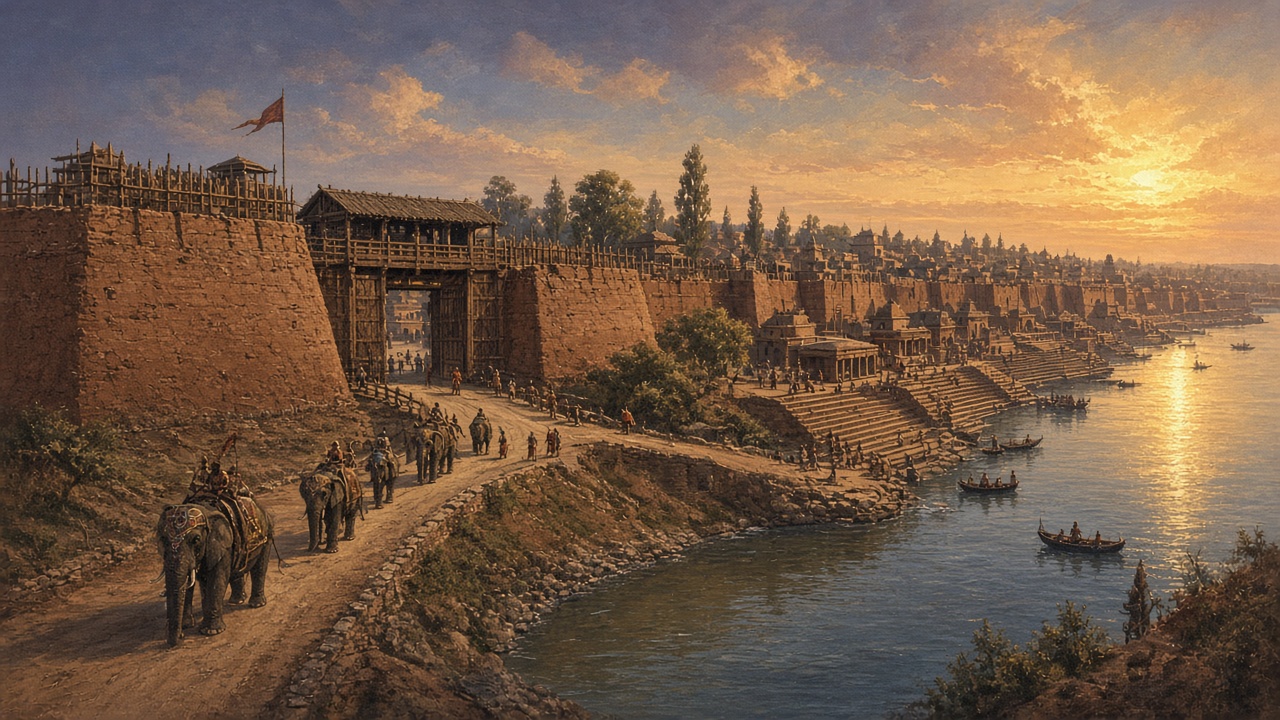
    AI illustration: the ramparts of Ujjayinī on the Śiprā at sunset (an imaginative reconstruction).

    West of the forests a fierce king reigned,
    and a cup of ghee was his shame;
    a she-elephant fled through the night,
    and a cloth bore the Buddha’s name.

    The City Beyond the Forests

    Of Avanti on the Śiprā, and a king called the Fierce.

    Four and twenty centuries ago, when the Buddha still walked the roads of the Ganges country, there was a kingdom far to the south and west, beyond the long forests. It was called Avanti, and its chief city was Ujjayinī (Ujjenī in the eastern tongue), on a wide plain beside the river Śiprā. Caravans passed through its gates, and it owed nothing to the kings of the east.

    There ruled Pradyota, whose name means “radiance”; the monks of the east called him Pajjota. Yet men seldom spoke that name alone. They called him Caṇḍa, the Fierce, for his temper was swift and his anger feared. Tibetan tellers later said the world was lit as by a lamp at his birth, on the day the Buddha was born. But that is a later song.


    The Yellow Sickness

    Of a proud king yellow with jaundice, and a doctor sent from the east.

    It is told in the old book of monastic rules that Pradyota fell sick with jaundice (paṇḍuroga). Famous physicians came, took their gold, and went away; none could heal him. So the proud king sent east to Bimbisāra of Magadha, whom these Chronicles have met already, asking for Jīvaka, the vejja, the doctor of that age, whose own tale is still to come in these Chronicles.

    Bimbisāra spoke as kings spoke to those beneath them, saying bhaṇe, “I say”: go to Ujjenī and treat King Pajjota. Jīvaka answered Evaṃ, deva, “As you say, Your Majesty,” and went west.

    He looked upon the king and saw what was needed: medicine boiled in ghee. He addressed him as deva, as attendants addressed a sovereign. But the king would have none of it. “I have an aversion and a distaste for ghee,” he said. Heal me some other way.

    I am Pradyota of Ujjayinī, and men call me the Fierce. I will tell you of my sickness. The great physicians came, took their gold and failed me. Then the young doctor from the east spoke of ghee, and I would not drink what I loathe.


    The Cup and the She-Elephant

    Of an astringent decoction, leave to pass any gate, and flight upon Bhaddavatikā.

    Jīvaka knew there was no other way. So he boiled the ghee with many drugs until it had the colour, smell and taste of “an astringent decoction” (kasāva: an astringent draught). When the king digested it, he would vomit and know he had been tricked. And this king was cruel, and might have him killed.

    So Jīvaka asked a favour. We vejjā, he said, must dig roots and gather herbs at odd hours: let him take any beast, pass any gate, and come and go at any hour. The king granted it.

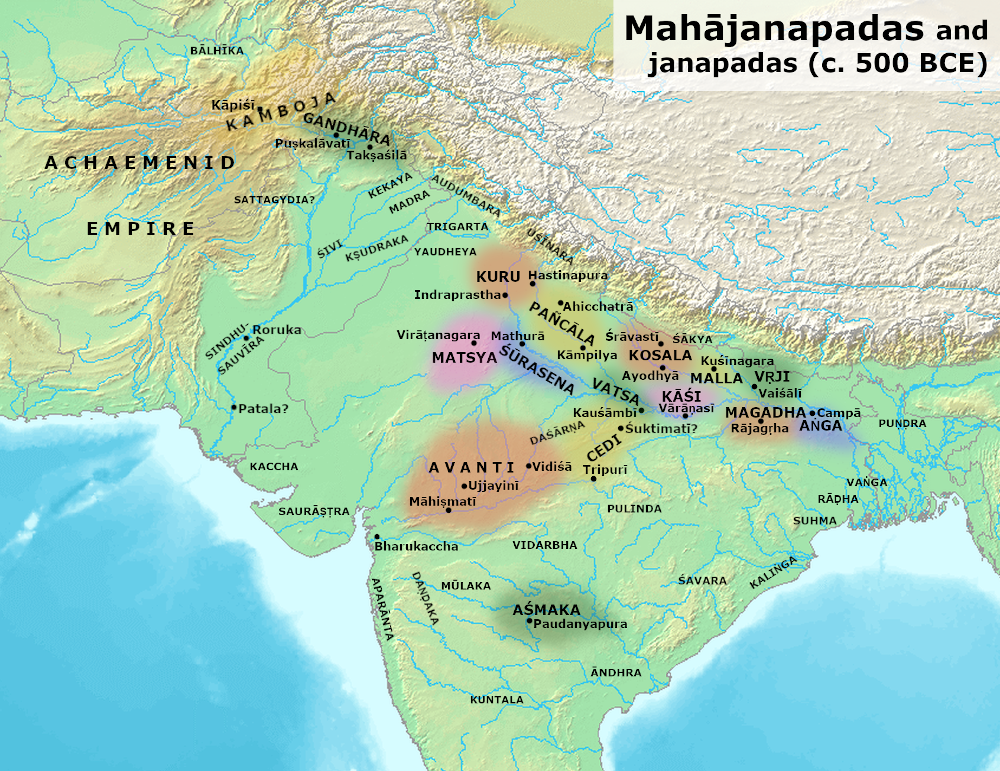
    Map of northern India around 500 BCE showing the kingdoms of Avanti, Magadha, Kosala and others
    Image: Map of the great realms (mahājanapadas) around 500 BCE, Avanti among them. Avantiputra7, CC BY-SA 3.0, via Wikimedia Commons. Boundaries are approximate.

    Then Jīvaka gave him the cup, saying Kasāvaṃ devo pivatū, “May Your Majesty drink the astringent.” While the king drank, the doctor went to the stalls. There stood Bhaddavatikā, the king’s she-elephant, who could travel fifty leagues in a day. Upon her back Jīvaka passed out of the city and was gone.

    Soon the ghee did its work, and the king rose in fury. He sent after the doctor a slave named Kāka, said to be born of a spirit, who could travel sixty leagues in a day. He spoke to him as to a servant, saying bhaṇe: “Those physicians,” the king warned him, “are cunning people.” Take nothing from his hand.


    The Myrobalan on the Road

    Of Kāka overtaken at breakfast, half a fruit, and a cloth finer than thousands.

    Kāka overtook the doctor at breakfast in Kosambī, and called him ācariya, teacher: the king orders you turned back. Jīvaka would share his meal; Kāka refused. But Jīvaka had secretly worked a drug into a myrobalan fruit with his fingernail. He ate of it himself and offered the rest, and Kāka, thinking no harm could lie in the doctor’s own food, ate half a fruit and fell sick on the spot. Be not afraid, said Jīvaka; you will be well, and so will your king. But I will not return to a king who might kill me. He gave the she-elephant back into Kāka’s keeping and went on to Rājagaha, and Bimbisāra said he had done rightly.

    When Pradyota was healed, his wrath cooled into gratitude. He offered a boon; Jīvaka asked only to have his service remembered. So the king sent him a suit of Siveyyaka cloth, the finest among many thousands. Jīvaka judged that none but the Buddha or Bimbisāra was worthy of it, and gave it to the Buddha. Soon after, the Buddha first allowed his monks to accept robes from householders.

    Yes, he tricked me, and I raged. But I was well again. So I sent him the finest cloth of all my thousands. What he did with it I learned afterwards.


    The Elephant That Was Not an Elephant

    Of a wooden beast, a captive king, and a lesson behind a curtain.

    Tellers of a later age remembered Pradyota in a wilder tale. Looking once upon his own splendour, he asked whether any king could match it. His courtiers named Udayana of Kosambī, who could charm wild elephants with a spell and a lute. So Pradyota had an elephant made of wood, wrapped in cloth and painted, with sixty men hidden in its belly, and set it loose near his rival’s land. Udayana rode after it, playing his lute, but the wooden beast only ran faster. He left his army far behind, and Pradyota’s men seized him.

    When the king demanded the elephant charm, Udayana would teach it only if the king paid him homage. The king threatened death. “Do so,” Udayana answered; “you are lord of my body, not of my mind.”

    So Pradyota plotted. His daughter would learn the charm, and he would learn it from her. But fearing they might fall in love, he told Udayana that his pupil was a hunchback, and told the princess that her teacher was a leper. She sat behind a curtain while he taught from outside. One day, when she stumbled over the words, Udayana cried, “Dunce of a hunchback!” She answered in anger, and he lifted the curtain. There sat Vāsuladattā, the king’s daughter, whom later poets call Vāsavadattā. From that day there were no more lessons.

    When the king went out to his garden, Udayana loaded sacks of gold and silver onto the she-elephant Bhaddavatī, lifted the princess up, and fled. When soldiers pursued, he scattered the coins, and while they stooped to gather them, he escaped home to Kosambī and made her his chief queen. Later poets told the tale again in plays and in the great Ocean of Story, where the fierce king is often called Mahāsena, “he of the great army”.


    Walls in the East

    Of a chaplain who became a monk, and walls raised against the west.

    The commentators also tell that Pradyota’s chaplain, Kaccāna, went east at his bidding to invite the Buddha, and there became a monk. The Buddha sent him home in his stead; and it is said the king, frightened by a dream, learned gentler ways from him. Among the verses kept under that monk’s name is a line a fierce king might heed: “mortals have deeds as their kin.”

    Yet the oldest discourses keep a harder memory. Not long after the Buddha passed away, Bimbisāra’s son Ajātasattu was strengthening the walls of Rājagaha, suspicious of King Pajjota. So the Fierce outlived the Master.


    The truth behind the tale

    The ghee story comes from the Pali Vinaya (Mahāvagga VIII), though the fifty-league elephant and spirit-born slave are storytelling. The plainest early evidence for Pradyota as a real, feared power is one line in the Majjhima Nikāya (MN 108). The wooden elephant and the flight with the princess come from the Dhammapada commentary, written down in Sri Lanka around the 5th century CE; Bhāsa’s plays and the 11th-century Kathāsaritsāgara tell later versions. Kaccāna’s mission and the dream are commentarial; the Tibetan birth story is later still. The Purāṇas list five “Pradyota” kings ruling 138 years, founded when a minister killed his master and crowned his son; they place them in Magadha, but many historians think this remembers Avanti. Excavations at old Ujjain found a great clay rampart and moat, though its date is debated. Pradyota lived in the Buddha’s time, usually placed in the 5th century BCE (some say the 6th), so all dates are approximate.

    Imagined voice: the italic passages in which Pradyota speaks in the first person are imagined. They are built only from the texts and studies named here, add no events, and are not quotations.

    Sources

    1. T. W. Rhys Davids and H. Oldenberg, Vinaya Texts II (SBE 17, 1882), Mahāvagga VIII.1.23–29; also Bhikkhu Brahmali, Vinaya Khandhaka 8 (SuttaCentral).
    2. E. W. Burlingame, Buddhist Legends I (Harvard Oriental Series 28, 1921), Book 2, Story 1, Part 4.
    3. Bhikkhu Sujato, Majjhima Nikāya 108 and Theragāthā 8.1 (SuttaCentral).
    4. G. P. Malalasekera, Dictionary of Pali Proper Names, “Caṇḍappajjota”.
    5. H. H. Wilson, Vishnu Purana IV.24; C. H. Tawney, Kathāsaritsāgara, chapters XI–XIV.
    6. “The Ganga-Yamuna Basin”, Expedition (Penn Museum).
    7. Vinaya, Mahāvagga VIII.1 (Khandhaka 8), Pāli text and trans. Bhikkhu Brahmali, SuttaCentral: vejja (doctor); Jīvaka’s address deva to King Pajjota; the king’s bhaṇe to Kāka; the astringent (kasāva); Kāka’s address ācariya; Bhaddavatikā and the Siveyyaka cloth.
  • Lopāmudrā

    Lopāmudrā

    AI illustration: a Vedic forest hermitage by a river at dawn (an imaginative reconstruction).

    Evening and morning the fire was fed,
    through autumns many and long;
    the sage spoke of labour, the wife of love,
    and the student kept the song.

    The Fire at Evening

    Of a wife who had waited many autumns, and a sage who gave way.

    The fire was lit again, as it was every evening and every morning, in the days when the hymns were young. A woman watched her husband bending over the rite, and she had had enough. “For many autumns have I been laboring,” she says, “evening and morning, through the aging dawns. / Old age diminishes the beauty of bodies.” Then, with no softening at all: “Bullish (men) should now come to their wives.”

    Like one pleading at law, she cites precedent: even the ancients “who served truth and at one with the gods spoke truths” still “got out of harness, for they did not reach the end.” No one ever reached the end of the work, she says; and so they may rest awhile.

    Page of a Ṛgveda manuscript in Devanagari script with red accent marks
    Image: Ṛgveda manuscript in Devanagari, early 19th century (Schøyen Collection MS 2097). Unknown scribe, Public domain, via Wikimedia Commons.

    I am Lopāmudrā, and I will tell you of the many autumns. Evening and morning I tended that fire beside him, while the dawns grew old and we grew old with them. The ancients themselves laid down the work unfinished. So I said to him: lay it down awhile, and come to me.

    Her husband, the sage Agastya, answered like a man long wedded to the altar. “Not in vain is the labor that the gods help,” he insists, and he turns their marriage into a campaign of war: “let us two win here the contest of a hundred stratagems, when as a united couple we will drive on.” It is a noble speech. It lasts one verse. In the next, desire “has come to me … from here, from there, from everywhere,” and the steadfast man yields to the woman he calls flighty. Then a third voice, by tradition a student, sighs over his soma: “for of many desires is mortal man.”


    The Closing Cycle of Book One

    Of Agastya the punning poet, and a hymn tucked somewhat oddly away.

    The Ṛgveda’s thousand-odd hymns were made and handed down by mouth long before anyone wrote them down. Every date is an estimate: they are commonly set around 1500–1000 BCE, and this chapter takes no side in debates about origins.

    Readers of the Viśvāmitra chapter met the “family books”, 2 to 7. Agastya’s hymns stand elsewhere, as the closing cycle of Book 1 (1.165–191). He was one of the great masters of the hymn-makers’ craft, a poet of puns and riddles. He names himself Mānya, son of Māna. His best-known hymns (1.165, 170 and 171) tell how Indra and the Maruts, the storm gods, quarrelled over a sacrifice he offered, until they were reconciled. Nearly all his hymns end with the same signature line: “May we know refreshment and a community having lively waters.”

    Tucked away between his hymns to Indra and his hymns to the Aśvins lies 1.179. It belongs to a small and vivid group of dialogue hymns, beside Yama and his twin Yamī, and the nymph Urvaśī and her mortal husband Purūravas. Tradition names the hymn’s deity as Rati, “Delight”. In one Indra hymn (1.170.4) Agastya says “we two shall extend” the sacrifice, and the second of the two may well be Lopāmudrā.


    Ascetic and Householder

    Of two goals that cannot both be served, and a wife beside the sacrificer.

    In a few lines the hymn holds, in embryo, a theme that runs through all Indian religious literature: the pull between two goals of holy men, ascetic practice and the getting of sons. It brings in also the figure who reconciles them: the eager wife who seduces the ascetic, so that he gains sons without wholly forsaking his austerities.

    Agastya’s call to fight “as a united couple” may also touch a question of the late hymns: whether the sacrificer’s wife (patnī) should stand beside him as a partner in the rite.

    The women in the dialogue hymns speak out boldly, often about sex, and the men beside them tend to look weak and helpless. Tradition went further, and named other women as Ṛgvedic poets: Ghoṣā (whose own chapter follows soon), Apālā and Viśvavārā. Centuries later, Gārgī would rise at a king’s court to cross-examine Yājñavalkya.

    He spoke of a hundred stratagems, and of labour the gods would bless. It was a fine speech. But one verse later he was mine, and a student by the fire was sighing over his soma. Of many desires is mortal man, he said. He was not wrong.


    A Proverb in a Common Accent

    Of a shrug in verse five, and a sage digging with spades.

    The most human line is the smallest. Verse 5 ends with a shrug: “for of many desires is mortal man.” It has the ring of a popular saying. The word for “many” is spoken with an l (pulu-) in place of the standard r (puru-). That homely form comes again only once in all the hymns, in the racy Vṛṣākapi hymn. It is as if a proverb, in an everyday accent, had slipped into sacred verse.

    The last verse sets all in order. Agastya, “digging with spades, seeking offspring, descendants, power”, throve in both “colours”, sons and ascetic power, and “arrived at his hopes.” A fourteenth-century commentator, more decorously, took the digging to mean “obtaining the desired result by means of lauds and sacrifices.”


    What we actually know, and what we don’t

    Text. For the hymn’s six verses, the Anukramaṇī gives verses 1–2 to Lopāmudrā, 3–4 to Agastya and 5–6 to a student. Verse 4 is disputed. Many modern translators, among them Geldner, Renou and Wendy Doniger, give it to Lopāmudrā, making her the one seized by desire. Jamison sides with the Anukramaṇī and Sāyaṇa and gives it to Agastya, which she says “makes for a more psychologically complex portrait.” Verse 5 is often read as the expiation of someone, perhaps a Vedic student, who has broken a vow, quite possibly of chastity. Thieme saw the dialogue as a mythical precedent recited to make the penance work. Griffith (1896) printed verses 3–4 only in Latin, and recorded Abel Bergaigne’s mystical reading, in which Agastya is the heavenly Soma, drawn down by Lopāmudrā as “fervent Prayer.”

    Later tradition, clearly labelled. The Mahābhārata (Vana Parva, Tīrthayātrā section; Ganguli’s sections 96–99) is many centuries later, and very different. Agastya sees his ancestors hanging head-down in a pit, needing a descendant. So he shapes a woman from the most beautiful parts of different creatures and gives her to the childless king of Vidarbha, who raises her as a princess called Lopāmudrā. When she marries the sage, she swaps her silks for bark and deerskin. But when he summons her, she asks for a bed “like to that which I had in the palace of my father”, and for ornaments. Agastya must find wealth without spending ascetic merit. Three kings, Śrutarvan, Bradhnāśva and Trasadasyu, show him that their income exactly matches their expenditure, so he takes nothing from them: a sage who respects a balanced budget. The demon Ilvala is another matter. He kills brahmins by serving them his brother Vātāpi as mutton and then calling him back out. Agastya eats the lot; when Ilvala calls, the sage laughs: “How can he come out? I have already digested that great Asura.” Offered a thousand sons or one, Lopāmudrā answers: “One good and learned son is preferable to many evil ones.” Their son Dṛḍhasyu is born after seven years and nicknamed Idhmavāha, “carrier of sacrificial wood”. Later still, Britannica notes that Agastya is revered as the brahmin who brought Sanskrit-speaking civilisation to the south, and Tamil tradition honours him as Akattiyar. Śrīvidyā tantric lineages attribute one form of their fifteen-syllable Pañcadaśī mantra (the hādi form) to Lopāmudrā. In Kodagu legend, the river Kāverī is Lopāmudrā herself.

    What’s missing. We have no date, place or biography. In the Ṛgveda her name appears only in this hymn. Jamison and Brereton warn that the index’s attributions to women (Ghoṣā, Apālā and Viśvavārā among them) are often drawn from names in the hymns themselves. They conclude that “there is no real evidence for female poets.” So we cannot know whether a woman composed verses 1–2. What survives, beyond doubt, is a woman’s voice.

    Where the story’s details come from. Hymn 1.179 is quoted in Stephanie Jamison and Joel Brereton’s translation (2014). They call Agastya “one of the great masters of the Rgvedic tradition”, find the hymn placed “somewhat oddly”, suggest that the second of “we two” in 1.170.4 is Lopāmudrā, and say it “contains in embryo” the “competing and incompatible goals” of ascetic practice and sons. Building on her Sacrificed Wife/Sacrificer’s Wife (1996), Jamison and Brereton read the late Ṛgveda as debating the wife’s place in the rite, and conclude that the hymn “cannot be seen as a ringing endorsement” of it. They note that women in the dialogue hymns “are quite outspoken, usually about sex, and their male conversation partners tend to look weak and helpless in comparison.” Following Paul Thieme, Jamison says verse 5’s last line “bears the mark of a popular saying.” The deity Rati is named in the Anukramaṇī, and the decorous reading of the digging is Sāyaṇa’s, as reported by Griffith.

    Imagined voice: the italic passages in which Lopāmudrā speaks in the first person are imagined. They are built only from the texts and studies named here, add no events, and are not quotations.


    Sources (lightly noted)

    1. Stephanie W. Jamison and Joel P. Brereton, The Rigveda: The Earliest Religious Poetry of India (Oxford University Press, 2014): introduction, Agastya cycle (I.165–191) and I.179.
    2. Stephanie W. Jamison, Rigveda Translation: Commentary, I.100–191 (UCLA, online, 2026 revision); Sacrificed Wife/Sacrificer’s Wife (Oxford University Press, 1996).
    3. Ralph T. H. Griffith, The Hymns of the Rigveda (1896), I.179 with notes, Internet Sacred Text Archive.
    4. Mahābhārata, Vana Parva, sections 96–99, trans. K. M. Ganguli, Internet Sacred Text Archive.
    5. Encyclopaedia Britannica, “Hinduism: narratives of culture heroes” (Agastya); Douglas R. Brooks, Auspicious Wisdom (SUNY Press, 1992), on Śrīvidyā.

    Myth and text flagged throughout: the cold open follows RV 1.179 in Jamison and Brereton’s translation; verse assignments follow the Anukramaṇī, with the dispute over verse 4 noted; the Vidarbha princess, Vātāpi and the seven-year pregnancy are Mahābhārata legend; Śrīvidyā, Tamil and Kāverī traditions are later still; all dates are approximate.

  • Anāthapiṇḍika

    Anāthapiṇḍika

    Image: The Jetavana medallion from the Bharhut stupa, 2nd–1st century BCE, Indian Museum, Kolkata. Photo Dharma (Anandajoti Bhikkhu), CC BY 2.0, via Wikimedia Commons.

    Gold on the grass of the prince’s park,
    cart after cart in the sun;
    a gate left bare for a giver’s name,
    and a banker’s long road run.

    The Field of Gold

    Of a prince’s park, covered coin by coin.

    Outside Sāvatthī, in the old days, the carts kept coming. Load upon load of gold coins was brought out and spread across Prince Jeta’s park, until the ground lay hidden beneath a skin of metal. And the man who paid for it all was a banker named Sudatta, better known as Anāthapiṇḍika. He was spending a fortune on a garden for a teacher he had first met on a journey of trade.

    It began, it seems, as a bluff. When Anāthapiṇḍika asked to buy the park, the prince answered: “I wouldn’t give it away even if you covered the park with ten million gold coins.” “It’s a deal!” said the banker. “No it isn’t!” said the prince. So they took the matter to judges, who ruled: “Sir, since you gave a price, the park is sold.”

    Now only a small patch near the entrance lay bare, and Anāthapiṇḍika sent his men back for more. Jeta watched, and thought, “This must be really worthwhile, as he’s giving up so much money.” So he stayed them: “That’s enough, householder, don’t cover that area. Let me keep it. It will be my gift.” Anāthapiṇḍika reflected that it is “very beneficial” when well-known people gain confidence in the path; and he agreed. And on that spot Prince Jeta built a gatehouse.

    I am Sudatta of Sāvatthī, and men call me Anāthapiṇḍika. Do not think the gold was a burden to me. I counted it out gladly, and when the prince asked for the last patch by the gate, I let him have it. A gift from a prince brings others to the path.


    The Road to Rājagaha

    Of a city of three roads, a busy brother-in-law, and a night of three wakings.

    Sāvatthī (Sanskrit Śrāvastī) lay near the Rapti river, in what is now Uttar Pradesh. It was the capital of Kosala, a prosperous trading town where three great roads met. He was a gahapati, a householder, and so monks and princes address him; a seṭṭhi was a leading banker-merchant, and Anāthapiṇḍika’s byname means “feeder of the destitute”.

    Yet his tale truly begins in another city. Readers of the Bimbisāra chapter will know Rājagaha, capital of Magadha. Anāthapiṇḍika had a brother-in-law there, a wealthy merchant. Coming there on business, he found this man, who would ever drop all else to greet him, hurrying about and giving orders to his household. Anāthapiṇḍika asked whether there was a wedding, or whether he had invited “King Seniya Bimbisāra of Magadha and the army”. No, said the merchant: he had invited the Buddha and his monks to tomorrow’s meal.

    “Did you say, ‘Buddha’?” Anāthapiṇḍika asked, three times over. That night he rose three times, “thinking it was light”. At last he set out. The Sivaka gate was opened for him by spirits; but beyond it the light went out, and fear took hold of him. Then an unseen spirit, Sivaka, called out that a hundred thousand jewelled maidens “are not worth a sixteenth part / of a single forward stride!”. His road led to the Cool Grove, Sītavana. Later tellers said it held a cemetery that was “filling with fear”. And at first light he found the Buddha walking there. The Buddha greeted him: “Come, Sudatta.”

    Three times I woke in that house, thinking it was dawn. When I went out, the dark came down on me beyond the gate and I was afraid. A voice told me to go forward, and I went. And at the end of the road the teacher called me by my own name.

    By the end of the teaching he had become a lay follower. Then he would pay for a meal himself, and turned away offers of help from his brother-in-law, from the householders of the city, and even from Bimbisāra: “There’s no need, sir. I have the means.”

    The date hangs upon the Buddha’s. Scholars have been divided between setting his death around 480 BCE and setting it as much as a century later.


    The Receipt

    Of two names kept together, and teaching for those who handle money.

    Many of the old discourses open with the same words: the Buddha was “staying near Sāvatthī in Jeta’s Grove, Anāthapiṇḍika’s monastery.” The name of the prince who sold the land and the name of the banker who paid for it are kept together, as in a receipt. Then the banker built dwellings, halls, wells, saunas, ponds and walking paths. And when he asked the Buddha what to do with the grove, the answer was to give it “to the Sangha as a whole, both present and future.” The Buddha named him foremost among his lay disciples “as a donor”.

    He drew forth also a particular kind of teaching: counsel for those who work and handle money. In AN 4.62 the Buddha speaks to him of four kinds of happiness a householder may earn: ownership, the use of wealth, freedom from debt, and blamelessness. The wealth in question is to be “gathered by the sweat of the brow”. AN 5.41 gives him five good reasons to grow rich, among them the support of family, servants and friends, and ends by saying that if such riches run out, the giver “has no regrets”.

    Earlier we met Āmrapālī, who gave her mango grove at Vesālī. Anāthapiṇḍika bought his grove at enormous cost.


    The Last Teaching

    Of a great giver on his sickbed, and a god in the grove.

    MN 143 tells of his death. He lies gravely ill, and sends for Sāriputta, who comes with Ānanda. Calling him bhante, “Honourable Sāriputta”, Anāthapiṇḍika speaks of his pain with startling honesty: it is like “a strong man drilling into my head with a sharp point.” Sāriputta teaches him to let go of all things: eye, ear, this world, the next. And the great benefactor bursts into tears. Ānanda asks whether he is sinking. No, he says. In all his years of serving the monks he has “never before heard such a Dhamma talk.” Then comes a banker’s plea for a wider audience: “let such Dhamma talk strike when teaching white-clothed laypeople as well!”

    Soon afterwards he died. Late that night, it is told, he returned as a shining god, “lighting up the entire Jeta’s Grove”. And his verse is a strange one for a banker: people are purified “not by clan or wealth.”


    What we actually know, and what we don’t

    Text. The Rājagaha meeting and the purchase come from the Vinaya (Cullavagga VI.4, Senāsanakkhandhaka), and the night walk is also told in SN 10.8. His deathbed is MN 143, and he is named in many Aṅguttara suttas. These texts were passed down orally for centuries, so their details (ten million coins, helpful spirits) are the tradition’s telling, not an audited account.

    Commentarial and later tradition, clearly labelled. Everything in this paragraph comes from commentaries and Jātaka stories written centuries later, as gathered by Malalasekera and retold in Hellmuth Hecker’s Wheel booklet. In these stories the sums grow to eighteen crores each for the land, the buildings and the festival. His generosity reduces him to poverty. A spirit living over his gate objects to the monks’ visits, is expelled, and wins her way back by recovering his lost fortune. His daughters are models of devotion. His worldly son Kāla is bribed with a thousand coins to keep a fast-day and then to listen to the Buddha, and in the end he refuses the money. A daughter-in-law, Sujātā, is described as the sister of Visākhā, the great woman patron of Sāvatthī. The commentaries also claim that he never asked the Buddha a question, so as not to tire him. The detail that the grove held a cemetery is commentarial too.

    Archaeology. None of this dates from his own lifetime. The earliest evidence is a medallion on the railing of the Bharhut stupa, which the Indian Museum, Kolkata, dates to about the 2nd–1st century BCE. It shows an unyoked bullock cart and men laying square coins. Its inscription reads jetavana anadhapediko deti kotisamthatena keta, which Pia Brancaccio translates as “Anadhapedika gives the Jetavana after buying (it) with a layer of crores”. That is centuries after him, but it shows the story was already famous. At Saheth-Maheth, Alexander Cunningham identified Jetavana and Śrāvastī in 1862–63. Later ASI excavations followed, including nine seasons in 1986–95 with Kansai University, Japan. They exposed stupas, monasteries and the city’s rampart, but nothing found so far names the banker or can be tied to him.

    Where the story’s details come from. The purchase of Jeta’s Grove and the buildings follow the Vinaya, Cullavagga VI.4, in Bhikkhu Brahmali’s translation; the night walk past the Sivaka gate follows SN 10.8 in Bhikkhu Sujato’s translation, and the cemetery in the Cool Grove comes from the commentaries. The Buddha names him foremost donor at AN 1.248–257. “Feeder of the destitute” is Malalasekera’s gloss (Dictionary of Pāli Proper Names); Sāvatthī as Kosala’s capital and the divided dating of the Buddha are as given by Encyclopaedia Britannica.

    Imagined voice: the italic passages in which Anāthapiṇḍika speaks in the first person are imagined. They are built only from the texts and studies named here, add no events, and are not quotations.


    Sources (lightly noted)

    1. Vinaya, Cullavagga VI.4 and VI.9 (pli-tv-kd16), trans. Bhikkhu Brahmali, SuttaCentral.
    2. SN 10.8, MN 143, AN 1.248–257, AN 4.62 and AN 5.41, trans. Bhikkhu Sujato, SuttaCentral.
    3. G. P. Malalasekera, Dictionary of Pāli Proper Names: “Anāthapiṇḍika”, “Sītavana”, “Kāḷa”; Hellmuth Hecker, Anathapindika: The Great Benefactor (Wheel 334), Access to Insight.
    4. Pia Brancaccio, “Art and Performance in the Buddhist Visual Narratives at Bhārhut” (Journal of Indian Philosophy, 2022); Indian Museum, Kolkata, Bharhut Gallery.
    5. Encyclopaedia Britannica, “Shravasti” and “Buddha”; ASI Excavation Branch, Patna, and Rees & Yoneda (World Archaeology, 2013) on Saheth-Maheth.
    6. Vinaya, Cullavagga VI.4 (Khandhaka 16) and MN 143, Pāli texts, SuttaCentral: the address gahapati, bhante Sāriputta, the Sivaka gate and the Sītavana.

    Myth and text flagged throughout: the cold open and night walk follow the Vinaya and SN 10.8; the lost fortune, the gate spirit, Kāla’s bribe and the family stories are marked as commentarial; Bharhut and Saheth-Maheth are later evidence; all dates are approximate.